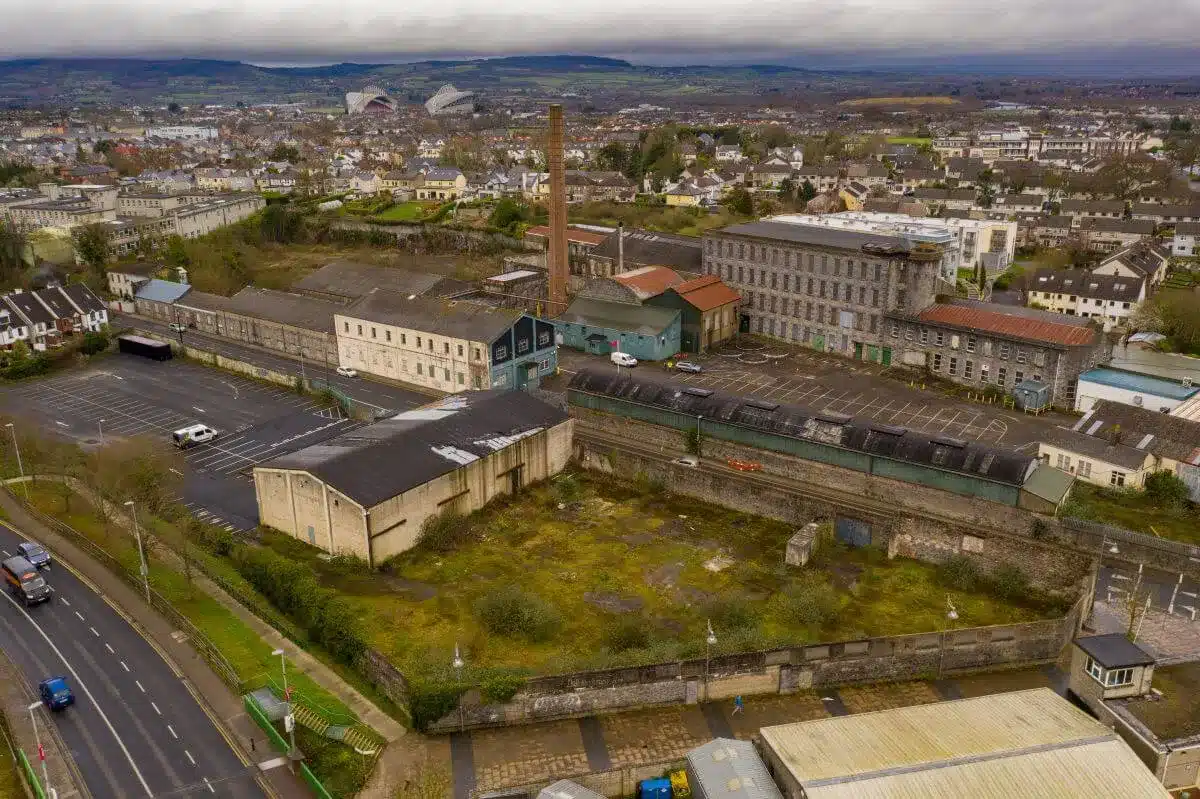
Aerial drone surveys have fundamentally changed how construction firms, engineers, surveyors, and infrastructure operators collect site data across Ireland. What once required weeks of fieldwork, scaffolding, road closures, and large survey teams can now be completed in hours using a single drone platform with centimetre-level accuracy.
At Drone Services Ireland, we have been delivering commercial drone surveys since 2016. Over nearly a decade of operations, we have seen firsthand how this technology transforms project timelines, reduces costs, and eliminates the safety risks associated with traditional survey methods. This article breaks down the key benefits based on our experience across thousands of Irish projects.
Table of Contents
Drone Surveys vs Traditional Survey Methods
The most effective way to understand the benefits of drone surveys is to compare them directly against the alternatives. Each method has its place, but for the majority of commercial projects in Ireland, drone surveys deliver the strongest combination of speed, accuracy, coverage, and value.
Ground-Based Surveying
Traditional ground surveys using total stations and GNSS rovers remain the industry standard for boundary surveys and precise point measurements. However, they have significant limitations for large sites, vegetated terrain, or projects requiring full-area coverage. A ground survey team typically captures individual spot measurements, which are then interpolated to create a terrain model. The more complex the site, the longer this takes and the more expensive it becomes.
For a recent 300-acre solar farm project in County Meath, traditional ground surveying was estimated to take 8 to 12 weeks of fieldwork. Our drone survey, combining photogrammetry and LiDAR, was completed in 10 days, achieving comparable accuracy while providing significantly more detailed data coverage, capturing millions of survey points rather than thousands.
Manned Aircraft Surveys
Helicopter and fixed-wing aerial surveys were once the only option for large-area mapping. They remain useful for very large regional surveys (hundreds of square kilometres), but for typical Irish project sites ranging from a few acres to a few hundred acres, manned aircraft surveys are disproportionately expensive. The mobilisation costs alone – pilot, fuel, flight permissions – can exceed the entire cost of a drone survey. Manned aircraft also operate at higher altitudes, which limits the ground resolution achievable in the data.
Satellite Imagery
Satellite imagery is useful for broad overview mapping, environmental monitoring, and change detection over very large areas. However, it lacks the resolution, accuracy, and on-demand availability required for construction, engineering, and infrastructure projects. Satellite data is also affected by cloud cover, a frequent challenge in Ireland, and cannot be scheduled to match project milestones.
Where Drone Surveys Excel
Drone surveys occupy the sweet spot: they deliver survey-grade accuracy across areas ranging from a single building to several hundred acres, with rapid turnaround, minimal site disruption, and a fraction of the cost of manned aircraft. For the vast majority of Irish commercial projects – construction sites, infrastructure inspections, topographical surveys, roof inspections, and environmental assessments – drones are the most efficient data-collection method available.
Speed and Efficiency
Speed is often the first benefit clients notice. A drone survey that captures an entire construction site in a single morning would take a ground survey team several days or longer to achieve with equivalent coverage.
There are two components to this efficiency. The first is data capture. A drone flying at 80 to 120 metres above ground level, following an automated flight path, can cover 20 to 50 acres per hour, depending on the required resolution and the sensor type. The second is processing. Modern photogrammetry and LiDAR processing workflows produce deliverables – orthomosaics, point clouds, digital terrain models, and volumetric calculations – within 24 to 48 hours of the flight.
For our emergency stockpile survey, data capture and processing were completed within a single working day, providing the client with accurate volume calculations when time was critical.
This speed advantage compounds on projects that require repeat surveys, such as monthly construction progress monitoring. Each site visit takes hours rather than days, and because the flight path is automated, every survey captures exactly the same coverage, making progress comparisons reliable and consistent.
Accuracy and Data Quality
A common misconception is that drone surveys sacrifice accuracy for speed. In practice, the opposite is often true. A drone survey captures millions of individual data points across an entire site, compared to the thousands of spot measurements a ground survey team can reasonably collect in the same timeframe.
Our drone survey equipment includes RTK (Real-Time Kinematic) and PPK (Post-Processed Kinematic) positioning systems that deliver horizontal and vertical accuracies of ±2 to ±5 centimetres. For LiDAR surveys using our DJI Zenmuse L2, we achieve 5cm horizontal and 4cm vertical accuracy at 150 metres above ground, with point densities exceeding 240,000 points per second in single-return mode.
All data is processed in-house through established quality assurance workflows and delivered in IRENET95 (Irish Transverse Mercator) coordinate systems with the Malin Head vertical datum, ensuring compatibility with Irish Ordnance Survey mapping and industry-standard CAD and GIS platforms.
This level of data density means that contours, slope analysis, feature extraction, and volumetric calculations are based on detailed evidence rather than interpolation between sparse measurements.
Cost Savings
Drone surveys typically deliver 60 to 70 per cent cost savings compared to equivalent traditional survey methods. The savings come from several sources: reduced fieldwork time, smaller crew requirements (a single pilot rather than a survey team of three or four), no scaffolding or access equipment, and no road closures or traffic management.
For building and roof inspections, the cost advantage is particularly pronounced. A traditional roof inspection on a commercial building might require a mobile elevated work platform (MEWP), a scaffolding company, and associated safety setup. A drone inspection of the same roof takes 20 to 40 minutes of flight time and requires no access equipment.
On larger sites, the savings scale further. Corridor and linear surveys – such as our power line survey case study covering 15 kilometres of high-voltage lines – would have been prohibitively expensive and logistically complex using ground methods, requiring access agreements with dozens of individual landowners.
Safety
Safety is not just a benefit of drone surveys; it is one of the primary reasons the technology exists in a commercial context. Every drone survey replaces a task that would otherwise require people to work at height, near live infrastructure, in confined spaces, on unstable terrain, or adjacent to active construction operations.
At Drone Services Ireland, all pilots hold current SafePass certification for construction site access, as well as manual handling and working at heights certificates. We carry €13 million in public liability insurance for drone operations and €13 million in employers’ liability insurance. But the fundamental safety advantage is that the drone goes where people should not have to.
Wind turbine inspections are a clear example. A blade inspection using rope access methods takes significantly longer and exposes technicians to working at heights exceeding 100 metres. A drone can complete the same inspection in a fraction of the time while exposing the operator to zero height-related risk.
Storm damage assessments present a similar case. After severe weather events, structures may be unstable and the surrounding areas hazardous. A drone provides a rapid, safe overview of damage before any personnel need to approach the site.
Comprehensive Coverage and Repeatability
One of the less-obvious yet highly valuable benefits of drone surveys is the completeness and repeatability of the captured data.
A ground surveyor selects individual points to measure based on their professional judgement of what is important. This is effective but inherently selective. A drone survey, by contrast, captures everything within the survey boundary – every surface, every feature, every elevation change. This means that questions arising weeks or months after the survey can often be answered from the existing dataset without returning to the site.
Repeatability is equally important. Because drone flight paths are pre-programmed using mission planning software, each repeat survey follows exactly the same trajectory, altitude, and overlap parameters. This makes time-series comparisons – such as monthly construction progress, seasonal environmental change, or stockpile volume tracking – reliable and consistent.
Benefits by Industry
The specific advantages of aerial drone surveys vary by sector and the type of data required. Here is how different industries benefit from the technology, based on our experience operating across Ireland.
Construction and Engineering
Construction monitoring is one of the most established use cases for drone surveys in Ireland. Regular aerial surveys provide project managers, developers, and financial stakeholders with verified progress documentation, volumetric analysis for earthworks, and safety audit records. 3D models and digital twins can be generated from drone data for integration with BIM workflows.
Architecture and Planning
Architects use drone survey data to understand existing site context, verify boundary conditions, and produce accurate base plans for design development. Drone photography provides perspectives that support planning applications and public consultations.
Insurance
Insurance assessors use drone inspections to document property conditions, assess storm and fire damage, and verify claims without requiring access to dangerous or structurally compromised buildings.
Energy and Utilities
Telecoms tower inspections, wind turbine assessments, power line corridor mapping, and solar farm surveys all benefit from the access and efficiency advantages of drone technology. Thermal imaging adds a diagnostic layer for identifying hotspots in electrical infrastructure and panel defects in solar arrays.
Quarrying and Extractive Industries
Quarry operators use drone surveys for regular stockpile volumetric measurements, compliance monitoring, and site planning. The ability to measure volumes accurately from the air, without halting production, is a significant operational advantage.
Agriculture and Forestry
Multispectral mapping provides crop health data, drainage analysis, and yield estimation. For forestry, LiDAR surveys penetrate the canopy to map the terrain beneath, which is essential for harvesting planning, environmental assessments, and forestry management.
Environmental Monitoring
Aerial environmental monitoring provides baseline data for Environmental Impact Assessments (EIAs), coastal erosion tracking, flood risk modelling, and habitat mapping. Drone surveys can cover sensitive ecological areas with minimal physical disturbance.
Sensor Versatility
Modern drone platforms carry a range of interchangeable sensor payloads, allowing a single aerial survey to capture multiple data types. The key sensor options we deploy include:
RGB Camera (Photogrammetry) – High-resolution optical imagery used to produce orthomosaics, 3D models, and visual documentation. Suitable for construction monitoring, roof inspections, and drone photography.
LiDAR (Light Detection and Ranging) – Active laser scanning that penetrates vegetation to map ground terrain. Essential for topographical surveys on vegetated sites, forestry, and power line corridor mapping. Our Zenmuse L2 captures up to 1.2 million points per second on multi-return with 5 returns.
Thermal – Radiometric thermal imaging for building energy assessments, flat roof moisture detection, electrical infrastructure hotspot identification, and solar panel diagnostics.
Multispectral – Captures data across multiple light wavelengths beyond what the human eye can see, used for vegetation health analysis and crop management.
This sensor versatility means that drone surveys are not a single service – they are a platform for delivering dozens of different data products depending on what the project requires.
Deliverables You Can Expect
Every drone survey produces tangible, measurable outputs. Typical deliverables from our aerial mapping workflows include:
Orthomosaic Maps – Geo-referenced aerial imagery stitched together into a single high-resolution map. Used as a base layer for design, planning, and measurement.
Point Clouds – Dense three-dimensional datasets containing millions of georeferenced data points. Available as colourised RGB or LiDAR-classified clouds.
Digital Terrain Models (DTM) and Digital Surface Models (DSM) – Elevation models showing bare-earth terrain and surface features, respectively.
Contour Maps and CAD Drawings – Extracted from point cloud data, delivered in formats compatible with AutoCAD, Civil 3D, Revit, and GIS platforms.
Volumetric Calculations – Cut, fill, and stockpile volume measurements accurate to within +/- 2 per cent.
3D Models and Digital Twins – Photorealistic three-dimensional representations for BIM integration, client presentations, and public consultations.
Inspection Reports – Annotated high-resolution imagery with defect identification, thermal analysis, and recommendations.
All geospatial data is delivered in IRENET95 (ITM) with the Malin Head vertical datum as standard.
Frequently Asked Questions
Are drone surveys accurate enough for engineering and construction projects?
Yes. Using RTK/PPK positioning, our drone surveys achieve plus or minus 2 to 5 centimetres of accuracy, which meets or exceeds the requirements for topographical surveys, construction monitoring, and volumetric analysis. Our LiDAR surveys deliver 5cm horizontal and 4cm vertical accuracy at 150m above ground level. All data is processed in-house to survey-grade standards and delivered in IRENET95 (ITM) coordinates.
How much does a drone survey cost in Ireland?
Drone survey pricing depends on site size, location, airspace complexity, required accuracy, and the deliverables needed. There is no fixed price – every project is quoted individually. However, drone surveys typically deliver 60 to 70 per cent cost savings compared to equivalent traditional survey methods. Contact us for a tailored quote.
How long does a drone survey take?
Data capture for a typical construction site takes between one and four hours depending on site size. Processing and delivery of final outputs, including orthomosaics, point clouds, and CAD drawings, is typically completed within two working days. For urgent projects, we offer rapid turnaround services.
Are drone surveys better than traditional land surveys?
Drone surveys and traditional ground surveys serve different purposes and are often complementary. Drone surveys excel at capturing detailed area-wide data quickly and cost-effectively, while traditional surveys are better suited to precise boundary pegging and individual point measurements. For most commercial projects in Ireland – including topographical mapping, construction monitoring, and inspections – drone surveys provide a faster, safer, and more cost-effective solution with equal or better accuracy.
Is Drone Services Ireland licensed and insured for commercial surveys?
Yes. We hold a current IAA Specific Operations Permit and full EASA Specific Category operational authorisation. We carry €13 million public liability insurance for drone operations and €13 million employers’ liability. All pilots are SafePass certified for construction sites. Full documentation is available for tender submissions and pre-qualification questionnaires. Learn more on our About Us page.
Get Started
If you are considering a drone survey for your project, we are happy to discuss your requirements and recommend the most appropriate approach. Whether you need a one-off topographical survey, ongoing construction progress monitoring, or a specialist service like LiDAR mapping or thermal inspection, we provide nationwide coverage from our base in Navan, County Meath.
Call 087 205 2331 or contact us online for a tailored quote. Most quotes are returned within 24 hours.
Written by Fergal McCarthy, Founder and Chief Pilot, Drone Services Ireland. Fergal has been operating commercial drones in Ireland since 2016 and works as Secretary of Drone Professionals Ireland.