Drone Stockpile Volumetrics in Ireland
Drone Services Ireland provides volumetric surveys of drone stockpiles for quarry operators, construction contractors, waste management companies, and materials suppliers across Ireland. We deliver accurate volume measurements from aerial data captured in a fraction of the time traditional methods require, with no disruption to site operations and no personnel walking on or around stockpiles.
On one recent project, we delivered accurate volumetric data within five hours of initial contact, from the initial call to the processed results. That kind of turnaround is possible because we maintain flight-ready platforms, proven processing workflows, and the operational experience to mobilise at short notice. Whether you need a one-off inventory check or a recurring monthly survey programme, we have the capability and availability to deliver.
How Stockpile Volumetrics Work
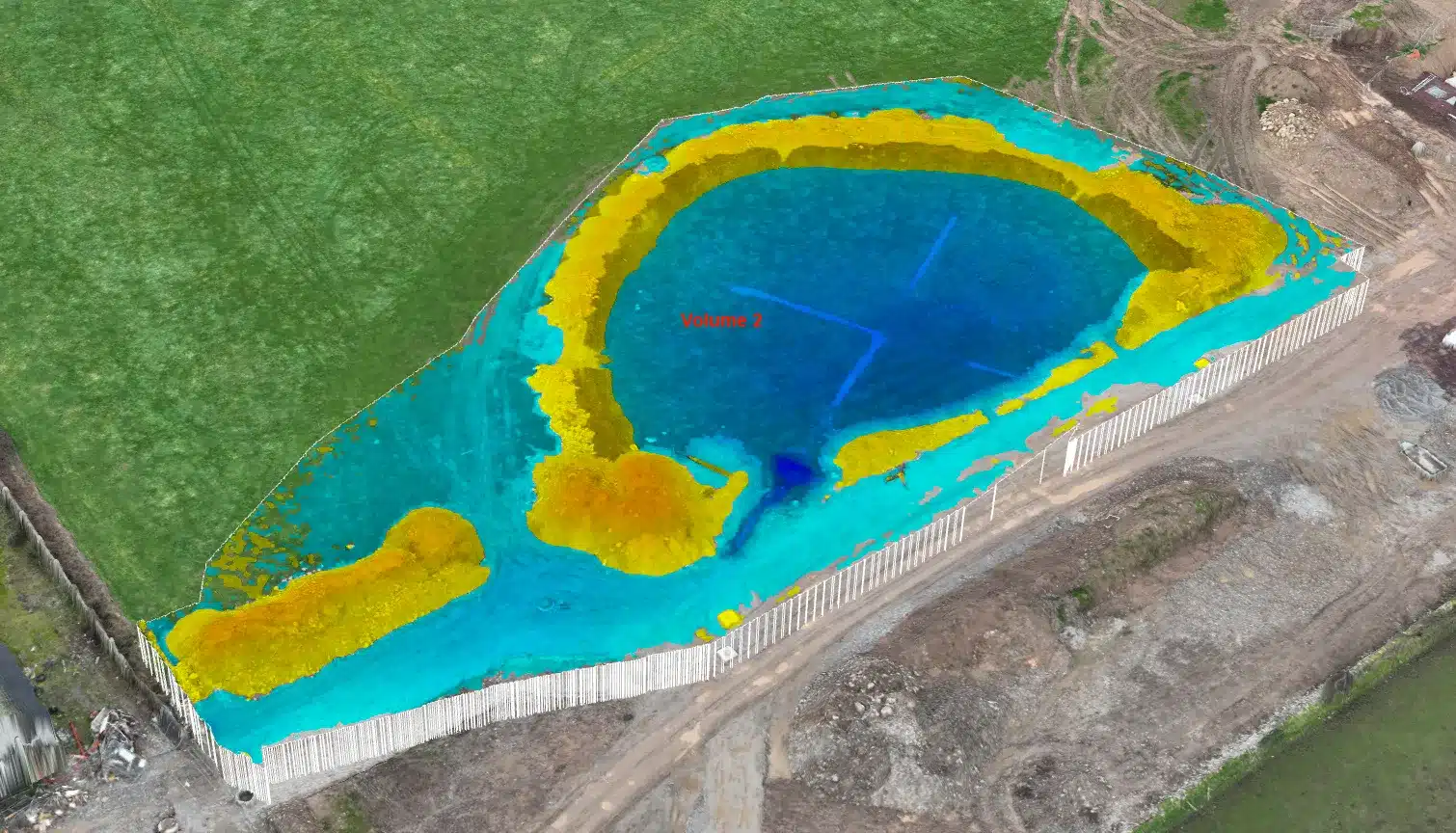
A drone stockpile survey captures hundreds of overlapping aerial photographs of the site from multiple angles. These images are processed with photogrammetric software to generate a dense 3D point cloud and a digital surface model (DSM) of the stockpiles and surrounding terrain.
Volume is calculated by defining a base plane beneath each stockpile and computing the volume of material above that surface. The base plane can be set to match the existing ground level, a flat reference plane, or a design surface, depending on the client’s requirements. Both cut and fill volumes can be calculated from the same dataset.
The accuracy of the volume measurement depends on the quality of the aerial data and the ground control. Using RTK/PPK-positioned flight data verified against surveyed ground control points, we routinely achieve volumetric accuracy of ±2% relative to the true value. This meets or exceeds the accuracy of traditional GPS rover or total station methods, which rely on far fewer measurement points and significant interpolation between them.
What We Deliver
Every stockpile volumetric survey produces a clear, usable set of outputs. Deliverables are tailored to the client’s requirements but typically include the following.
Volume report with individual stockpile volumes in cubic metres, base plane definition, and calculation method (triangulated surface or grid-based). Each stockpile is labelled and referenced to the site plan.
Orthomosaic map providing a georeferenced, high-resolution aerial image of the entire site. This serves as a visual record of stockpile locations, site layout, and ground conditions at the time of survey.
Digital surface model (DSM) showing the elevation of every point across the site, used to derive contours, cross-sections, and volumetric calculations.
3D point cloud for clients who process their own data or require integration with existing CAD or GIS workflows.
Comparison reports for recurring surveys, showing volume change between survey dates, net material movement, and tonnage estimates based on client-supplied material densities.
All data are delivered in the IRENET95 (ITM) coordinate system, using the Malin Head vertical datum (EPSG: 2157) as the standard; other projections are available on request.
Applications
Quarries and aggregate yards are the most common applications for drone stockpile volumetrics. Quarry operators use our surveys for monthly or quarterly inventory reconciliation, production tracking, end-of-year stock counts, and planning submissions. The ability to measure every stockpile on site in a single flight, without halting production or sending staff onto unstable material, makes drone surveys the safest and most efficient method available.
Construction sites use volumetric surveys to track earthworks progress, verify cut-and-fill quantities against design levels, support interim payment applications, and document material storage areas. For large earthworks projects, regular drone surveys provide an auditable record of material movement that supports both project management and contractual verification.
Waste management and landfill operations require accurate volume measurements for regulatory compliance, remaining capacity calculations, and waste acceptance reporting. Drone surveys capture the full surface of a landfill cell without exposing personnel to hazardous conditions.
Ports, rail yards, and bulk storage facilities use our surveys to verify inventory volumes of coal, biomass, grain, and other bulk commodities stored in open yards.


Our Method
We follow a consistent, repeatable process on every stockpile survey to ensure accuracy and comparability between survey dates.
Ground control points (GCPs) are placed and surveyed across the site before the flight. For sites with recurring surveys, we establish permanent GCP positions to ensure consistency between visits. When permanent markers are not practical, we use at least five GCPs distributed across the survey area, plus independent checkpoints, to verify accuracy.
Flight planning is configured using UGCS or DJI Pilot 2 with parameters set for the site size, stockpile height, and required ground sampling distance. We typically fly at 50 to 80 metres AGL with 75% frontal and 65% side overlap to ensure dense image coverage on all stockpile faces, including steep slopes that single-pass nadir flights would miss. For tall or steep stockpiles, we add oblique flight passes to capture the sides of the piles where nadir-only coverage would create data gaps.
Data capture uses our DJI Matrice 300 RTK or DJI Matrice 4 Enterprise with the Zenmuse P1 (45 MP full-frame camera) for maximum resolution, or the Mavic 3 Enterprise for smaller sites. RTK positioning provides centimetre-level accuracy in real time, with PPK available as a backup.
Processing is completed using industry-standard photogrammetry software. The point cloud is verified against ground control and checkpoints before any volume calculations are performed.
Accuracy and Repeatability
Volumetric accuracy depends on three factors: the quality of the ground control network, the density and completeness of the aerial data, and the processing methodology.
With properly surveyed GCPs and RTK/PPK drone positioning, we achieve ±5 cm (XYZ) positional accuracy on the surface model. For a typical quarry stockpile of 5,000 cubic metres, this corresponds to a volumetric accuracy of ±2% or better. This compares favourably with traditional GPS rover surveys, which typically capture 50 to 100 spot measurements per stockpile and rely on interpolation to estimate the volume between points. A drone survey captures thousands of surface measurements of the same stockpile, yielding a far more complete and accurate representation of the pile geometry.
For recurring surveys, consistency is critical. We use the same ground control network, flight parameters, and processing methodology for each visit. This ensures that volume changes between dates reflect real material movement rather than measurement variability.

LiDAR for Complex Sites
When stockpiles are surrounded by vegetation, or when the survey extends beyond the stockyard to include surrounding terrain, we use drone LiDAR instead of, or in addition to, photogrammetry. Our DJI Zenmuse L2 LiDAR sensor captures up to 1,200,000 points per second and penetrates through vegetation to generate bare-earth terrain models beneath the canopy. This is particularly useful for quarry sites where overburden areas, access roads, and site boundaries are overgrown.
LiDAR also performs well on dark or uniform-coloured stockpiles (such as coal, peat, or tarmac) where photogrammetry can struggle to generate accurate surface models due to a lack of visual texture.
Coverage and Scheduling
We operate across the Republic of Ireland and Northern Ireland, with regular stockpile survey work in the Midlands, South-East, and Greater Dublin area, where quarry and construction activity is concentrated. We also service sites in Cork, Galway, Limerick, and Mayo.
For recurring programmes, we schedule surveys on a monthly, quarterly, or annual cycle to suit your reporting requirements. Emergency or short-notice surveys are available, and we have demonstrated the ability to mobilise, capture, process, and deliver results within a single working day.
Why Choose Drone Services Ireland
We have been providing commercial drone services across Ireland since 2016, and volumetric surveying has been a core part of our work from the beginning. Our experience spans single-stockpile checks through to full quarry inventory programmes covering dozens of stockpiles across multiple material types.
Our industry leadership positions (Secretary, Drone Professionals Ireland; former Chair, IPDPA; former Co-Chair, UAAI) and our track record across surveying, LiDAR, construction monitoring, and infrastructure inspection mean we understand the broader context in which volumetric data is used. We do not just deliver numbers. We deliver data that integrates with your existing workflows, CAD systems, and reporting requirements.
We carry €6.5 million public liability insurance and operate under full EASA and IAA authorisation for Specific Category operations.
Frequently Asked Questions

How accurate are drone stockpile volume measurements?
With RTK/PPK positioning and properly surveyed ground control points, we achieve volumetric accuracy of ±2% relative to the true value. This is comparable to, or better than, traditional GPS rover methods, which rely on far fewer measurement points and greater interpolation.
How long does a stockpile survey take on site?
Flight time depends on the site size and the number of stockpiles. A typical quarry with 10 to 20 stockpiles can be flown in 30 to 60 minutes. With GCP setup and equipment preparation included, most sites are completed within half a day. Processing and delivery of the volume report typically follow within 24 to 48 hours, though same-day delivery is available for urgent requirements.
Do site operations need to stop during the survey?
No. The drone operates from a safe distance above the site. There is no need to halt production, move machinery, or restrict access. This is one of the key advantages over traditional methods, which require personnel to physically walk on or around stockpiles.
Can you convert volumes to tonnage?
Yes. If you provide the material density (loose or compacted) for each stockpile type, we include tonnage estimates in the volume report. We can also use standard density values for common materials, such as crushed stone, sand, gravel, topsoil, and clay, when specific densities are unavailable.
How often should stockpile surveys be carried out?
This depends on your operational and reporting requirements. Quarries typically survey monthly or quarterly for inventory management. Construction sites may require surveys at key milestones or on a fortnightly cycle during active earthworks. Landfill operators often conduct quarterly or annual surveys for regulatory reporting.
Can you survey stockpiles in bad weather?
We require dry conditions, moderate wind (below 10 m/s), and reasonable visibility for photogrammetry surveys. Light overcast conditions are actually ideal as they reduce shadows on stockpile surfaces and improve data quality. We monitor forecasts closely and will reschedule if conditions are not suitable for accurate data capture.