Case Study: How a Drone Survey Delivered a 300-Acre Solar Farm Topographical Survey in Just 10 Days
When a renewable energy developer approached us to survey a 300-acre site for a proposed solar farm development in Ireland, they faced a familiar challenge: tight deadlines for the pre-planning phase and concerns that survey costs would spiral with traditional methods. The site’s complexity, featuring multiple field boundaries, drainage ditches, overhead power lines, and existing access roads, would typically require extensive ground-based surveying over several weeks.
We delivered the complete topographical survey, including CAD extraction of all critical features, in just 10 days from project commencement to final deliverable. Here’s how drone technology transformed this solar farm survey project.
The Challenge: Complex Terrain and Tight Pre-Planning Deadlines
Solar farm developments require exceptionally detailed topographical data during the pre-planning phase. Developers need accurate information about:
- Existing field boundaries and property lines
- Drainage patterns and watercourses
- Access roads and potential haul routes
- Overhead cables and existing utilities
- Ground levels for panel array design
- Vegetation and environmental features
Across 300 acres of active farmland, obtaining this data through traditional surveying methods proved challenging. A ground-based survey team would need approximately two weeks on-site, working in all weather conditions and navigating potential hazards, including uneven terrain, waterlogged ditches, and working near overhead power lines.
The pre-planning timeline didn’t allow for a four-week traditional survey process, and the developer needed CAD-ready data that their engineering team could immediately integrate into design software.

Day 1-2: On-Site Data Capture
Our survey team completed the entire 300-acre site capture in just two days. Using RTK-enabled drone technology, we flew systematic grid patterns across the entire property, capturing thousands of high-resolution images with centimetre-level accuracy. We captured ground control points and check points from the pre-planned locations where access was easiest and safest.
The drone-based approach meant our team could:
- Survey difficult-to-access areas without physical entry to all areas
- Maintain safe distances from overhead power lines
- Work efficiently regardless of ground conditions
- Capture uniform data across the entire site
- Avoid disturbing ongoing farming operations and livestock
Where a traditional survey crew would spend days manually measuring ditches and field boundaries on foot, often in challenging conditions, our drone covered the equivalent ground in hours whilst the team maintained safe positions for observation and flight management.
Day 3-8: Data Processing and CAD Extraction
Back in our offices, our experienced team processed the captured imagery into a detailed 3D point cloud model of the entire site. This digital twin provided the foundation for extracting every feature the client required:
Extracted and Delivered Features:
- All drainage ditches with invert levels
- Field boundaries and hedgerows
- Existing road networks and farm tracks
- Overhead cable positions and heights
- Watercourses and culverts
- Spot heights across the site
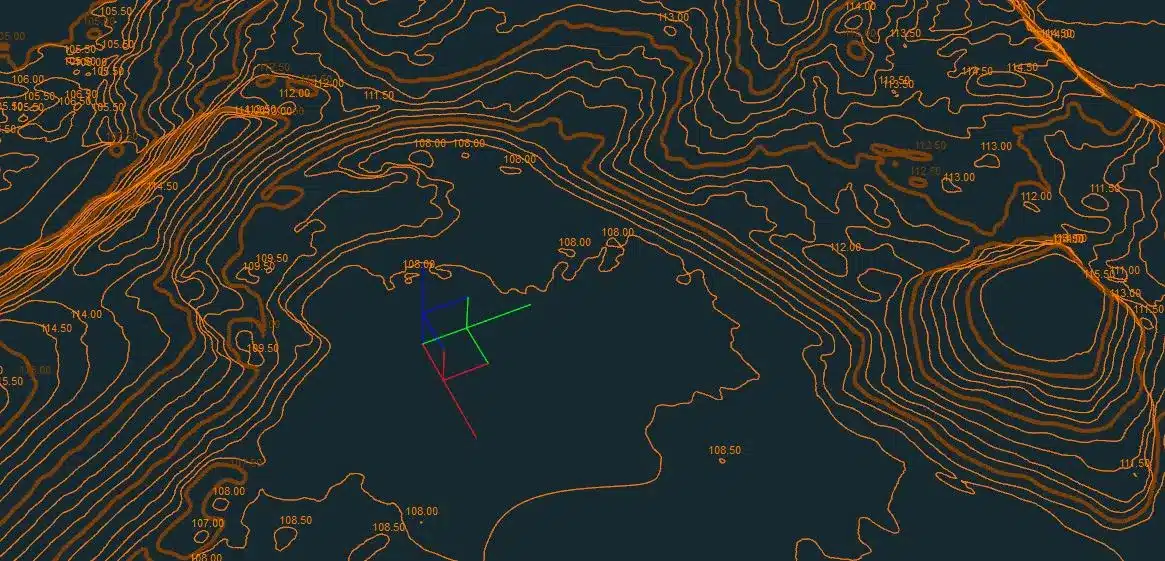
- Contour lines at 0.5m intervals
- Existing structures and buildings
Each feature was meticulously extracted into AutoCAD format, properly layered and attributed for immediate use by the client’s engineering team. The 3D point cloud also remained available for any additional queries or measurements throughout the design process.
Day 9-10: Quality Assurance and Delivery
Before delivery, our team conducted rigorous quality assurance checks, verifying measurements against ground control points and ensuring all CAD layers were properly structured. The final deliverables package included:
- AutoCAD DWG files with all extracted features
- Full-resolution orthophoto mapping
- Digital Terrain Model (DTM)
- 3D point cloud in LAS format
- Comprehensive survey report
The client received everything needed to commence detailed design work just 10 days after we started the project.
80% Reduction in On-Site Time
Two days on-site versus an estimated two weeks represented an 86% reduction in field time. This dramatic decrease meant:
- Minimal disruption to farming operations
- Reduced weather-related delays
- Lower mobilisation and accommodation costs
- Faster project progression
60% Faster Overall Delivery
The 10-day total delivery time, compared to the 4-week minimum for traditional methods, allowed the developer to maintain their pre-planning timeline without compromise. The engineering team received data whilst the project was still fresh, enabling immediate design work to commence.
Eliminated Ground-Based Hazards
Traditional surveying of this site would have exposed survey teams to multiple risks:
- Working in and around drainage ditches
- Surveying near overhead power lines
- Traversing uneven and potentially waterlogged terrain
- Extended exposure to weather conditions
- Vehicle movements on active farmland
Our drone-based approach eliminated these ground hazards entirely. The survey team maintained safe positions throughout the capture phase, with the drone handling all close-proximity work to potential hazards.
CAD-Ready Data for Immediate Use
The engineering team received data in industry-standard formats, eliminating the typical lag time for data conversion or formatting. They could import our CAD files directly into their design software and begin panel layout optimisation immediately.
Why Drone Surveying Suits Solar Farm Developments
Solar farm projects present ideal conditions for drone surveying technology:
Large, Open Sites: The expansive nature of solar farm sites means traditional surveying can become time-consuming and costly. Drones cover large areas efficiently whilst maintaining accuracy.
Pre-Planning Speed Requirements: Planning applications require detailed topographical data quickly. Drone surveys deliver this data in timeframes that keep projects on schedule.
Design Integration Needs: Solar developers need CAD-compatible data for panel layout design, cable routing, and access road planning. Our extraction process delivers data ready for immediate design work.
Ongoing Monitoring Requirements: The same drone survey data can later support construction monitoring, progress tracking, and as-built verification throughout the project lifecycle.
Complex Feature Capture: Drainage patterns, existing utilities, and boundary features all affect solar panel placement. Drone surveys capture these features comprehensively in a single mobilisation.
Technical Capabilities Behind the Results
This project’s success relied on proven drone surveying capabilities developed over nearly a decade of commercial operations:
- RTK GNSS Integration: Real-time kinematic positioning ensures centimetre-level accuracy without extensive ground control networks
- High-Resolution Sensors: Professional survey-grade cameras capture the detail needed for reliable feature extraction
- Photogrammetry Processing: Advanced software converts thousands of images into accurate 3D models
- Expert CAD Extraction: Experienced surveyors interpret and extract features to professional surveying standards
- Quality Assurance Protocols: Rigorous checking ensures deliverables meet accuracy specifications
As Ireland’s number 1 drone operator with over 10 years of commercial experience, we’ve refined these processes across hundreds of surveying projects.
Cost Considerations: Investment Versus Traditional Methods
Whilst drone surveying represents advanced technology, the cost comparison for this project favoured the drone approach significantly:
Traditional Survey Costs:
- 10+ days of field crew time (2-3 person team)
- Travel and accommodation for extended site presence
- Equipment mobilisation
- Weather contingency days
- Processing and CAD work
- Estimated timeline: 4+ weeks
Drone Survey Investment:
- 2 days on-site (2-person team)
- Minimal accommodation requirements
- Single mobilisation
- Weather-flexible timeline
- Integrated processing and CAD extraction
- Delivered timeline: 10 days
The combination of reduced on-site time, faster delivery, and eliminated safety risks created clear value for the developer’s pre-planning budget.
Applications Beyond Solar Farms
The same drone surveying capabilities that delivered this solar farm project apply to numerous renewable energy and infrastructure developments across Ireland:
- Wind Farm Site Surveys: Topographical surveys for turbine placement and access road design
- Grid Connection Routes: Route surveying for cable and transmission line planning
- Substation Developments: Accurate site surveys for electrical infrastructure projects
- Battery Storage Facilities: Site assessment and planning for energy storage developments
- Hydroelectric Schemes: Surveying for small-scale hydro developments
Planning Your Solar Farm Survey
If you’re developing a solar farm project in Ireland and need topographical survey data for planning submissions, consider these key questions:
When in your project timeline do you need survey data? Pre-planning surveys inform feasibility studies and initial designs. We can typically mobilise within days of instruction.
What accuracy specifications do planners require? Most solar farm planning applications specify accuracy requirements. Our drone surveys routinely achieve +/- 50mm accuracy, exceeding typical specifications.
Do you need ongoing survey support? The same survey data supports planning, construction monitoring, and as-built verification. We can structure survey programmes to support your project throughout its lifecycle.
What CAD formats does your engineering team use? We deliver in AutoCAD DWG format as standard, with flexibility to provide data in alternative formats if your team requires.
Get Your Solar Farm Project Moving
This 300-acre solar farm survey demonstrated how drone technology has fundamentally changed what’s possible in renewable energy site assessment. What once required weeks of ground-based surveying with multiple associated risks now happens in days, with better data quality and enhanced safety.
Whether you’re planning a 50-acre installation or a 500-acre solar farm, accurate topographical data forms the foundation of successful project delivery. Our team has surveyed renewable energy sites across Ireland, delivering the CAD-ready data engineering teams need to maintain project timelines and budgets.
Ready to discuss your solar farm survey requirements? Contact Drone Services Ireland to learn how we can support your renewable energy project with accurate, timely topographical data that keeps your development moving forward.