Drone Corridor and Linear Infrastructure Survey

Linear infrastructure projects present a specific survey challenge. Roads, power lines, pipelines, rail corridors, and bus routes extend over long distances, often through built-up areas, across multiple land boundaries, and along routes where ground-based survey teams face access constraints, traffic management costs, and extended project timelines. Drone survey solves these problems by capturing high-resolution aerial data along the full length of a corridor in a fraction of the time.

Drone Services Ireland has direct project experience in corridor and linear survey work across Ireland. We completed a 32 km aerial video survey documenting power connection routes for wind farm and renewable energy projects. We also carried out linear aerial mapping of BusConnects Core Bus Corridor routes in Dublin as a subcontractor, producing 3D models of the routes using nadir and oblique imagery captured along extended corridors throughout the city. These projects required flight planning through complex urban airspace, coordination with multiple stakeholders, and processing of large-scale linear datasets into usable engineering outputs.

What We Deliver

Corridor survey outputs are tailored to the project requirements and can include any combination of the following.

Georeferenced video provides a continuous visual record along the full corridor length. Our 32 km power connection video survey delivered a complete corridor record used for route assessment, environmental review, and stakeholder communication. Video is geotagged with positional metadata, allowing any frame to be located precisely along the route.

3D corridor models combine nadir (directly downward) and oblique (angled) imagery to produce full three-dimensional models of the route and its surroundings. On the BusConnects project, this approach captured building facades, street furniture, footpath geometry, and road surfaces along extended routes through Dublin, providing planners and engineers with a complete spatial dataset of existing conditions. These models are delivered as georeferenced point clouds, textured meshes, or digital surface models, depending on the end use.

Orthomosaic strip maps provide a geometrically corrected aerial image of the corridor at centimetre-level resolution. These are used for route planning, vegetation clearance assessment, encroachment identification, asset condition review, and as base layers for design overlays in CAD and GIS.

Topographical corridor data includes contour maps, digital terrain models (DTMs), cross-sections at specified chainages, and longitudinal profiles. All data are delivered in the IRENET95 (ITM) coordinate system, using the Malin Head vertical datum.

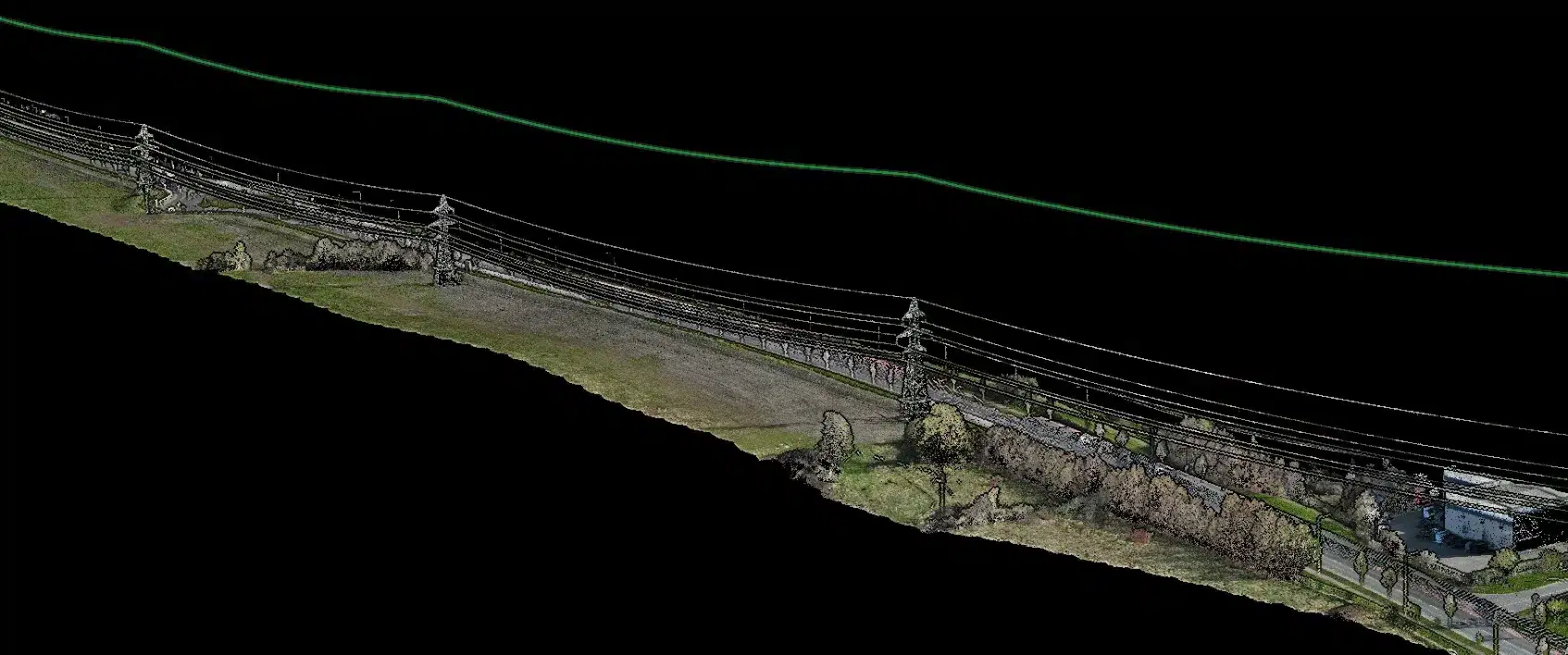
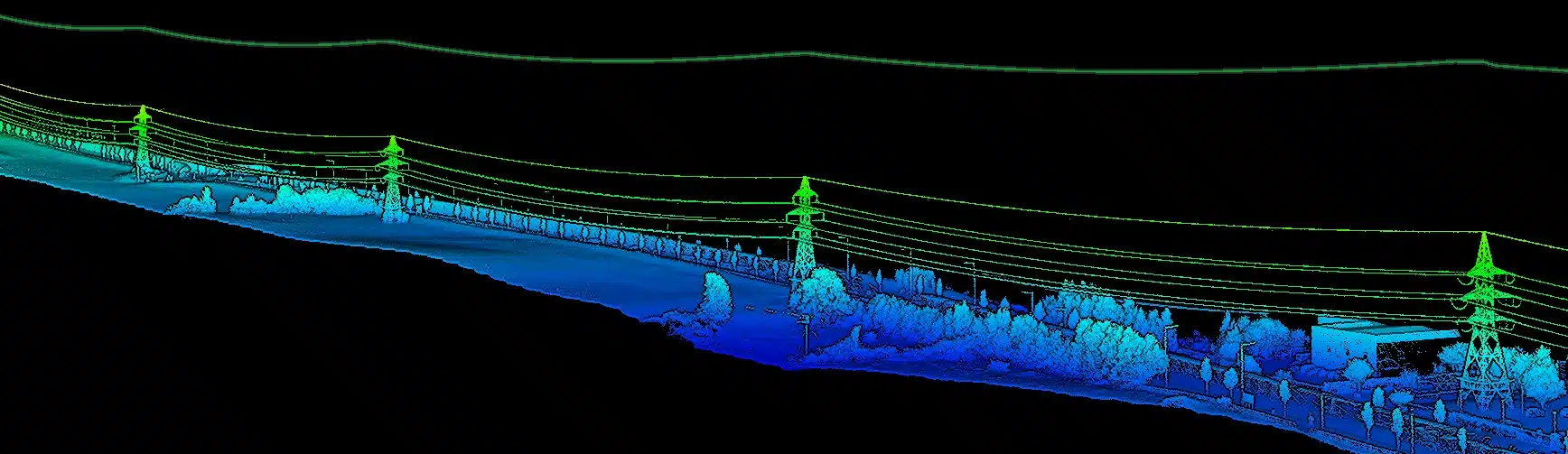
LiDAR corridor mapping uses our DJI Zenmuse L2 sensor to capture dense point cloud data along the corridor. The L2 fires up to 240,000 laser pulses per second in single-return mode (1.2 million points per second with five returns), penetrating vegetation to map the ground surface beneath tree canopies, hedgerows, and overgrown areas that photogrammetry cannot resolve. LiDAR is the preferred method for power line corridor surveys where accurate clearance measurements between conductors, vegetation, and ground are required.

Applications

Power line and grid connection corridors require accurate route mapping, identification of potential obstructions, vegetation encroachment assessment, and documentation for planning submissions. Our 32 km video survey for wind farm power connections is a direct example of this application. For overhead line routes, our Zenmuse L2 LiDAR captures conductor sag profiles, pole positions, and vegetation proximity data that support clearance analysis and route optimisation.

Road and transport corridors benefit from aerial survey at every stage, from initial route selection through detailed design to construction monitoring. Our BusConnects project demonstrated the value of 3D corridor modelling in a dense urban environment, where capturing the full built context of a route (buildings, kerbs, street furniture, junctions, pedestrian crossings) is essential for design development and public consultation.

Pipeline and utility corridors are often located in areas with restricted ground access. Drone survey captures the corridor extent without requiring wayleave access to private land, and LiDAR penetrates vegetation to reveal ground conditions along buried pipeline routes where surface indicators may be obscured.

Rail corridors present particular access and safety challenges for ground survey teams. Drone survey eliminates the need for track possessions, capturing topographical data, asset condition imagery, and vegetation encroachment information without disrupting rail operations.

Greenway and cycleway planning requires topographical data along proposed routes that often follow disused rail lines, canal towpaths, or river corridors. These routes are typically narrow, vegetated, and difficult to survey by conventional means.

32km Linear Video Survey
Classified LiDAR point cloud of a vegetated corridor showing bare-earth terrain beneath tree canopy from Zenmuse L1 survey
3D point cloud of an urban corridor generated from nadir and oblique drone imagery for BusConnects planning

Equipment and Methodology

Linear corridor surveys require specific flight planning and data capture techniques that differ from those used in standard area surveys. We plan corridor missions using DJI Pilot 2’s Linear Route mode, which is purpose-built for long, narrow flight paths and ensures consistent overlap, altitude, and camera triggering along the route centreline.

Photogrammetry corridors are flown using our DJI Matrice 300 RTK with the Zenmuse P1 (45 MP full-frame camera). For projects requiring 3D models (as on the BusConnects corridors), we capture both nadir and oblique imagery in multiple passes to ensure full coverage of vertical surfaces alongside the route, including building facades, retaining walls, and embankments.

LiDAR corridors are flown using our DJI Matrice 300 RTK with the Zenmuse L2. The L2 represents a significant upgrade from the previous generation, offering a smaller spot size for finer detail, five returns for deeper vegetation penetration, and a 450 m detection range. For power line surveys, the L2’s accuracy of 5 cm horizontal and 4 cm vertical at 150 m flight height meets the requirements for conductor clearance analysis and vegetation management planning.

Video corridors use our DJI Matrice 4 Enterprise or Mavic 3 Enterprise to capture continuous, geotagged 4K video along the route. Video corridors are the most efficient method for initial route documentation, condition assessment, and stakeholder presentations.

All corridor surveys use RTK/PPK positioning for centimetre-level accuracy, verified against ground control points placed at intervals along the route. For long corridors, we establish GCP networks at regular spacing to maintain positional accuracy throughout the dataset.

DJI Matrice 300 RTK with Zenmuse L1 LiDAR conducting a power line corridor survey in Ireland

Urban Corridor Operations

Our experience with the BusConnects project demonstrates our ability to operate in complex urban environments. Flying corridor survey missions through Dublin city requires EASA Specific Category authorisation, detailed operational risk assessments for built-up areas, coordination with the Irish Aviation Authority, and liaison with local authorities and project stakeholders.

We hold the regulatory authorisations required for urban corridor operations and have the operational experience to manage the additional complexity of flying in populated areas with high building density, road traffic, pedestrian activity, and restricted airspace near Dublin Airport and other controlled zones.

Coverage

We operate corridor surveys across the Republic of Ireland and Northern Ireland. Corridor projects, by their nature, can extend across multiple counties and local authority areas. We manage logistics for multi-day corridor campaigns, including battery staging, GCP placement, flight permissions, and data continuity across survey segments.

Why Choose Drone Services Ireland

We have delivered corridor surveys at scales ranging from short urban road sections to 32 km cross-country routes. Our BusConnects project work, completed as a subcontractor on one of Ireland’s most significant urban infrastructure programmes, demonstrates both technical capability and regulatory and operational readiness for complex, high-profile corridor projects.

Our surveying and mapping expertise, combined with our LiDAR and thermal imaging capabilities, enables us to integrate multiple data capture methods into a single corridor campaign. We have been providing commercial drone services across Ireland since 2016, and our industry leadership positions (Secretary, Drone Professionals Ireland; former Chair, IPDPA; former Co-Chair, UAAI) reflect the depth of our regulatory and operational experience.

Frequently Asked Questions

This depends on the corridor width, data capture method, and access requirements. For video surveys, we can cover 10-15 km per day. For photogrammetric corridor mapping with nadir and oblique passes, 3-5 km per day is typical in urban environments, with longer distances achievable in open rural corridors. LiDAR corridors cover 5 to 10 km per day, depending on the required point density and flight parameters.

Yes. Our BusConnects project involved extended corridor flights through Dublin city centre. We hold EASA Specific Category authorisation for operations in populated areas and prepare detailed risk assessments for every urban corridor mission. We coordinate with the IAA and local authorities as required.

With RTK/PPK positioning and ground control points, we achieve positional accuracy of ±2-5 cm in photogrammetric outputs. Our Zenmuse L2 LiDAR delivers 5 cm horizontal and 4 cm vertical accuracy at 150 m flight height, meeting the requirements for engineering-grade corridor mapping.

Yes. We routinely capture video alongside photogrammetric or LiDAR data on corridor projects. The video provides an immediate visual record for stakeholders, while the mapping data feeds into engineering design workflows.

Standard deliverables include georeferenced orthomosaic (GeoTIFF), digital terrain model (GeoTIFF/ASCII grid), point cloud (LAS/LAZ), 3D textured mesh (OBJ/FBX), contour drawings (DWG/DXF), cross-sections (DWG/DXF), and georeferenced video (MP4 with KML/GPX track). All data is delivered in the IRENET95 (ITM) coordinate system as standard.

No. Drone corridor surveys are conducted from the air and do not require road closures, traffic management, or lane restrictions. This is one of the primary advantages over traditional ground-based survey methods for road and transport corridors.