Drone Wind Turbine Inspection in Ireland
Drone Services Ireland provides drone wind turbine inspection for wind farm operators, asset managers, and O&M teams across Ireland. We were among the first operators in the country to complete automated drone inspection of wind turbines as part of a project with ESB, and our inspection imagery was used in ESB publications and project materials. That early experience with automated flight paths and structured data capture continues to inform how we inspect turbines today.
Ireland now has over 5,000 MW of installed onshore wind capacity across more than 300 wind farms, with a government target of 9 GW onshore and 5 GW offshore by 2030. Each turbine requires regular external inspections to detect blade damage, surface degradation, and structural defects before they escalate into costly failures or unplanned downtime. Our drone inspections deliver the high-resolution imagery that maintenance teams need to make informed repair decisions, without putting technicians at height and with significantly less turbine downtime than traditional rope access or platform methods.

What We Inspect
A full drone wind turbine inspection covers the three main external components of the turbine structure.
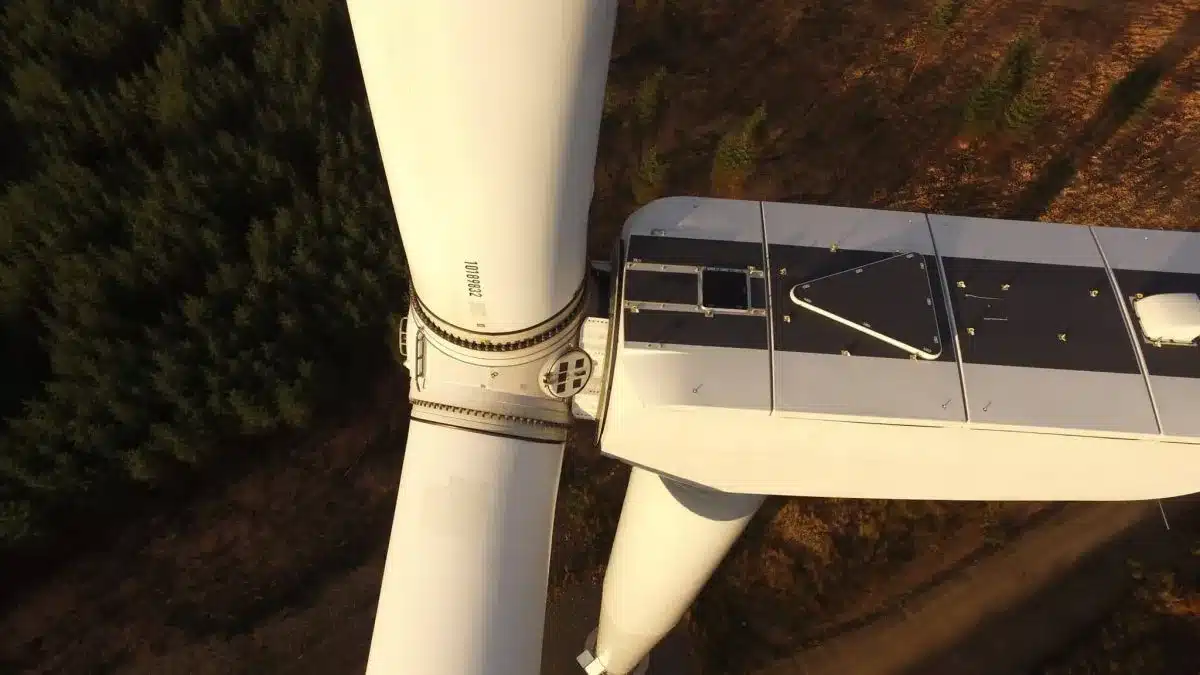
Blades are the primary focus of most inspections. We capture high-resolution imagery of all three blades across their full span, from root to tip, on both the leading and trailing edges, as well as the pressure and suction sides. The imagery is captured at a resolution that enables identification of surface cracks, leading-edge erosion, lightning-strike damage, delamination, debonding, gelcoat damage, and foreign-object impact. Each blade is photographed in a structured sequence, enabling precise location of defects by blade number, radial position, and surface.
Tower sections are inspected for paint degradation, corrosion, weld cracking, sealant failure around access doors and cable entry points, and structural anomalies. Tower inspections are particularly important for ageing turbines approaching or exceeding their original 20 to 25-year design life.
Nacelle and hub exterior surfaces are checked for damage, sealant integrity, and any visible signs of oil leakage, overheating, or component displacement.
How We Inspect
Our inspection methodology uses automated and semi-automated flight paths to ensure consistent, repeatable data capture across every turbine in a campaign. This approach was developed through our early work on the ESB automated inspection project, where we refined flight patterns and camera settings to ensure consistent image quality across pilots and site conditions.
Pre-inspection planning includes reviewing the turbine model, hub height, rotor diameter, and blade length to configure the optimal flight path, standoff distance, and camera settings. We coordinate with the site operations team to schedule turbine lockout and blade positioning (typically at the Y or inverted Y position for three-pass coverage).
Data capture is performed using our DJI Matrice 300 RTK with either the H20T hybrid sensor (combining a 20 MP zoom camera with a wide-angle and thermal camera) or the Zenmuse P1 (45 MP full-frame camera), depending on the required maximum resolution. For larger campaigns, we also deploy the DJI Matrice 4 Enterprise, which features AI-powered data capture that automates waypoint generation and image triggering, reducing per-turbine inspection time and improving consistency across multi-day campaigns.
The drone follows a pre-programmed flight path around each blade, maintaining a consistent standoff distance (typically 5 to 15 metres depending on blade length and camera selection) while capturing overlapping imagery at defined intervals. Each blade face is captured in a single pass, with the blade parked and locked in position. The full three-blade inspection, including tower and nacelle, typically takes 30 to 45 minutes per turbine.
Image review and delivery follow a structured process. All images are geotagged, labelled by turbine ID, blade number, radial position, and surface, then reviewed for quality before delivery. We deliver the full image set in organised folders, along with a summary inspection report highlighting any visible defects or areas of concern. Where clients require defect classification and severity grading, we can provide this as an additional service.


Our Equipment
We maintain a fleet of enterprise-grade platforms configured for turbine inspection work.
DJI Matrice 300 RTK with Zenmuse H20T is our standard turbine inspection platform. The H20T provides a 20 MP zoom camera with 23x hybrid zoom, a 12 MP wide-angle camera, and an integrated radiometric thermal camera. The zoom capability allows detailed close-up capture of blade surfaces from a safe standoff distance, while the thermal channel can identify hotspots associated with delamination, moisture ingress, or electrical faults.
DJI Matrice 300 RTK with Zenmuse P1 is used when clients require the highest possible image resolution. The 45 MP full-frame sensor captures extremely fine detail on blade surfaces, making it the preferred option for detailed condition assessments and warranty inspections where image quality is critical.
DJI Matrice 4 Enterprise brings AI-assisted data capture to turbine inspections. Its intelligent flight features automate waypoint generation and image capture, reducing pilot workload and ensuring consistent coverage. This platform is particularly effective on large inspection campaigns where speed and consistency across dozens or hundreds of turbines are essential.
All platforms are operated by EASA-certified pilots with specific experience in wind turbine inspection. We carry โฌ6.5 million public liability insurance for our operations.
Why Drone Inspection
Traditional wind turbine blade inspection methods include rope access, crane-mounted platforms, and ground-based telescopic cameras. Each has significant limitations that drone inspection overcomes.
Safety is the most compelling advantage. Rope access and platform methods require technicians to work at heights of 80 to 150 metres in exposed, windy conditions. Drone inspection keeps everyone on the ground.
Speed is critical for minimising turbine downtime. A drone inspection of a single turbine takes 30 to 45 minutes compared to a full day or more for rope access. On a multi-turbine campaign, this difference translates directly into reduced production losses. We typically inspect five to seven turbines per day, depending on site layout and weather conditions.
Consistency is a challenge with manual methods, where image quality and defect identification depend heavily on the individual technician. Our automated flight paths and standardised camera settings produce uniform imagery across every turbine, every time.
Cost savings flow from reduced turbine downtime, elimination of rope access or platform hire, and faster campaign completion. Drone inspection typically costs a fraction of an equivalent rope access inspection.
Coverage and Scheduling
We operate across Ireland with regular turbine inspection work in Kerry, Cork, Galway, Mayo, Donegal, and the midlands counties, where wind farm concentration is highest. We also work in Northern Ireland.
Wind turbine inspections are weather-dependent and require specific wind speed and visibility conditions. We monitor forecasts closely and schedule inspection windows to maximise productivity. For multi-site campaigns, we plan efficient routing between wind farms to minimise mobilisation costs and travel days.
We are experienced in securing the airspace authorisations required for wind farm operations, including flights in restricted airspace near airports and military zones.
Why Choose Drone Services Ireland
We bring a combination of proven experience, the right equipment, and an operational track record that wind farm clients require.
Our involvement in the ESB automated turbine inspection project established our credentials in this sector early. That project demonstrated the viability of automated drone flight paths for structured turbine data capture in Irish conditions, and our imagery was used in ESB’s own publications and material about the programme. We have continued to develop our turbine inspection capability since, investing in the latest platforms and refining our methodology with each campaign.
As one of Ireland’s longest-established drone operators (since 2016), we bring deep regulatory and operational experience that is critical in complex wind farm environments. Our industry leadership positions (Secretary, Drone Professionals Ireland; former Chair, IPDPA; former Co-Chair, UAAI) and our track record across surveying, LiDAR, thermal imaging, and infrastructure inspection mean we can also support wind farm clients with topographical surveys, power line corridor mapping, and thermal assessments of balance-of-plant equipment alongside blade inspections.
Frequently Asked Questions
How long does a wind turbine drone inspection take?
A single turbine inspection typically takes 30 to 45 minutes of flight time and covers all three blades, the tower, and the nacelle exterior. Including setup, battery changes, and repositioning, we typically complete five to seven full turbine inspections per day.
What defects can a drone inspection detect on turbine blades?
Our high-resolution imagery identifies surface cracks, leading-edge erosion, lightning-strike damage, delamination indicators, gelcoat cracking, debonding, tip damage, drainage-hole blockages, and foreign-object impact damage. Thermal imaging can also reveal subsurface moisture ingress and delamination that is not visible to the naked eye.
Do turbines need to be shut down for inspection?
Yes. The turbine must be locked out with blades parked in a fixed position (typically Y or inverted Y) for safe, structured inspection. We coordinate shutdown scheduling with your site operations team to minimise downtime.
What image resolution do you achieve?
At typical standoff distances, the Zenmuse P1 captures imagery at sub-millimetre per-pixel resolution on blade surfaces. The H20T zoom camera achieves excellent detail at greater standoff distances. Both are sufficient for identifying the full range of common blade defects.
Can you combine blade inspection with other wind farm surveys?
Yes. We regularly combine turbine inspection campaigns with topographical surveys for access road planning, LiDAR surveys of power line corridors, and thermal imaging of substation and balance-of-plant equipment. Combining services in a single mobilisation reduces overall project costs.