Aerial Environmental Monitoring in Ireland
Drones capture environmental data faster, safer, and in greater detail than traditional ground-based methods. For environmental consultants, state agencies, local authorities, and project developers, drone technology provides a cost-effective way to gather the baseline surveys, repeat monitoring data, and visual evidence needed for regulatory compliance, impact assessment, and conservation management.
We provide aerial environmental monitoring services across Ireland, combining high-resolution photography, multispectral imaging, LiDAR scanning, and specialist sensor payloads to deliver actionable environmental data. Whether you need habitat mapping for an Appropriate Assessment, coastal erosion baselines for a local authority, or emissions monitoring at a licensed facility, we tailor the sensor package and flight plan to your specific requirements.

Habitat Mapping and Invasive Species Monitoring
Habitat assessment under the EU Habitats Directive is a growing area of demand for drone services in Ireland. The National Parks and Wildlife Service (NPWS) is required under Article 17 to assess Annexe I habitats every six years, and environmental consultants preparing Appropriate Assessments or Natura Impact Statements increasingly rely on drone-captured data to map habitat extent, condition, and change over time.
Our multispectral drone surveys produce vegetation indices and classified habitat maps that ecologists use to distinguish between habitat types, identify areas of degradation, and track the spread of invasive species. Rhododendron ponticum, Japanese knotweed, giant hogweed, and Spartina anglica are all targets for drone-based detection in Ireland. Repeat surveys using identical flight paths allow accurate change detection between monitoring periods.

Coastal Erosion and Shoreline Monitoring
Ireland has over 7,500 kilometres of coastline, much of it subject to erosion from winter storms, rising sea levels, and changing sediment dynamics. Drone photogrammetry and LiDAR surveys produce high-resolution digital terrain models (DTMs) of coastal features, including dunes, cliffs, beaches, and salt marshes. By repeating the same survey at intervals, we generate volumetric change analysis that quantifies sediment loss, cliff retreat, and dune migration.
This data supports coastal protection planning for the OPW and local authorities, informs coastal zone management strategies, and provides baseline evidence for climate adaptation projects. Our survey-grade accuracy (plus or minus 5cm with ground control) is sufficient for engineering-level coastal monitoring.
Waste Monitoring and Illegal Dumping
Illegal dumping remains a persistent problem across Ireland. Drones cover large areas of difficult or hazardous terrain, including bogland, forestry, and disused quarries, and record high-resolution evidence of waste deposits. Our optical zoom cameras can identify dumping activity from over 4 kilometres away, providing evidence without alerting those responsible.
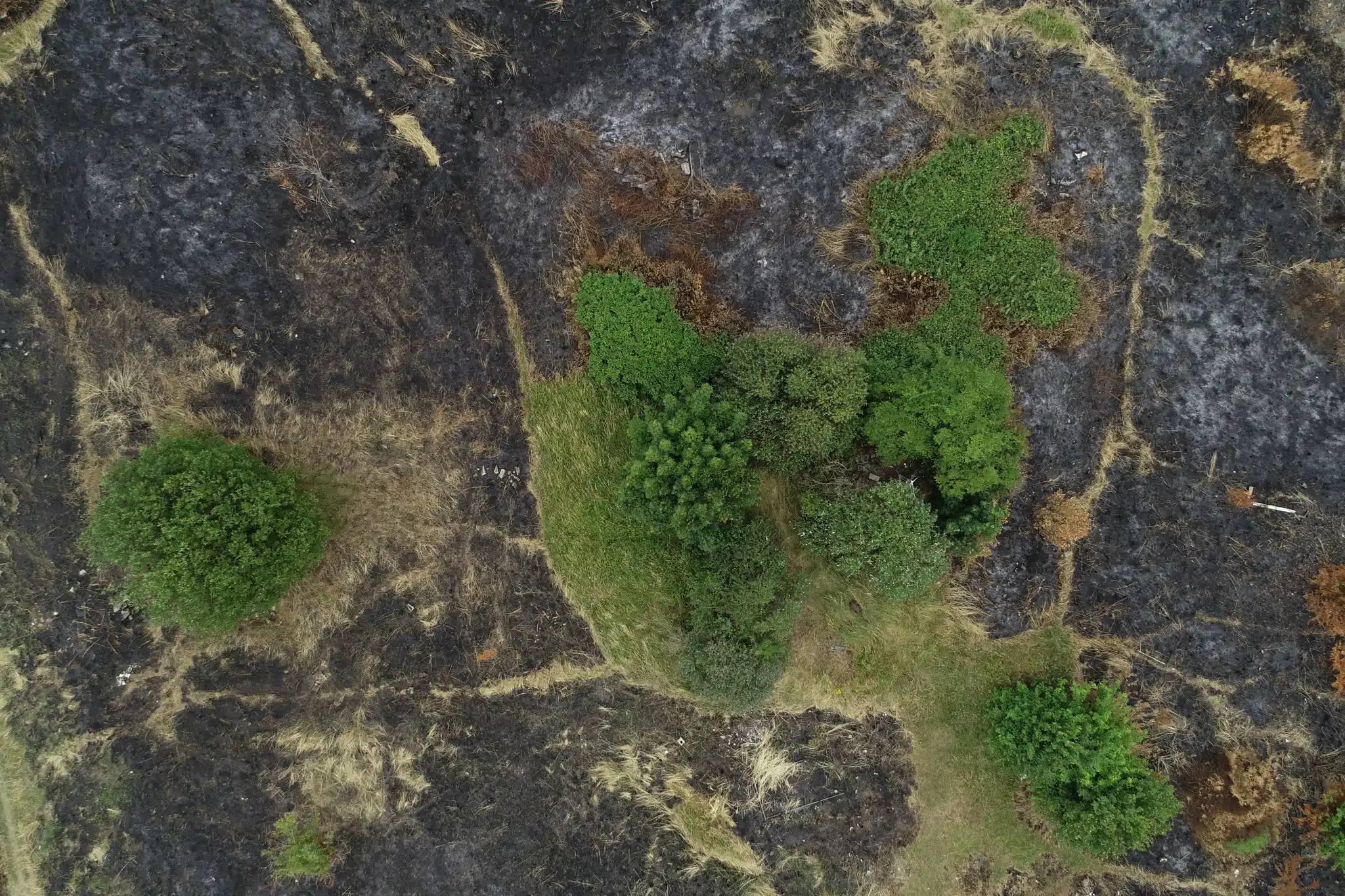
We have worked with city and county councils to document illegal dumping sites and verify cleanup operations. On one project in County Meath, we mapped a site after a cleanup and demonstrated that waste as small as crisp packets remained buried in the grass, invisible from ground level but clearly visible from the air. For licensed waste facilities, regular drone surveys provide volumetric measurements of landfill capacity and visual records for EPA licence compliance.
Emissions and Gas Detection
Specialist gas sensors can be mounted as drone payloads to detect and map methane, carbon dioxide, hydrogen sulphide, and volatile organic compounds. The drone flies a pre-programmed grid pattern over the target area, logging gas concentrations with GPS coordinates to produce a spatial emissions map. This is particularly useful for landfill gas monitoring, leak detection at industrial facilities, and emissions verification at EPA-licensed sites.
Because the drone follows the same flight path each time, repeat surveys produce directly comparable datasets that track changes in emission levels over time. Sites continue normal operations during the survey, and data capture is completed in a fraction of the time required for ground-based sampling.

Water Quality and Spill Response
Drones provide rapid visual and multispectral assessment of water bodies for pollution incidents, algal bloom detection, sediment plume tracking, and effluent discharge monitoring. Oil sheens, fuel spills, and turbidity plumes that are difficult to trace from ground level are immediately visible from the air, allowing the source and extent of contamination to be identified quickly.
For ongoing monitoring, multispectral sensors detect chlorophyll concentration and water clarity indicators that support Water Framework Directive reporting. Repeat surveys at the same locations provide time-series data for trend analysis.
Supporting Environmental Impact Assessments
Environmental Impact Assessment Reports (EIARs) require detailed baseline data across multiple environmental factors: biodiversity, landscape and visual impact, water, air quality, noise, and land use. Drone surveys contribute to several of these chapters. Aerial photography and 3D models document the existing landscape for visual impact assessment. Multispectral mapping provides vegetation and habitat baseline data for biodiversity chapters. Topographical surveys inform hydrology and drainage assessments.
During the construction phase of permitted developments, drones monitor environmental compliance, tracking dust generation, surface water runoff, vegetation clearance boundaries, and site reinstatement progress. After construction, repeat surveys verify that ecological mitigation measures have been implemented correctly.
Sensors and Technology
The range of sensors available for drone-based environmental monitoring continues to expand as miniaturisation enables lighter, more capable payloads. We select the appropriate sensor package for each project based on the data requirements:
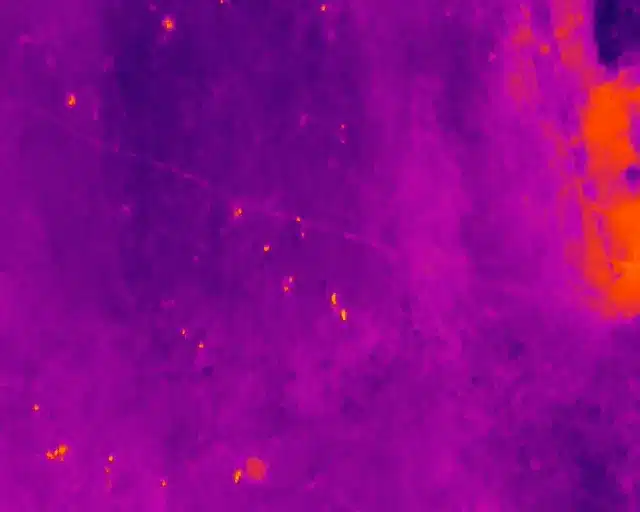
High-resolution RGB cameras capture detailed visual imagery for evidence recording, site documentation, and photogrammetric 3D modelling. Multispectral sensors record data across multiple wavelength bands, enabling vegetation health analysis, habitat classification, and water quality assessment. Thermal cameras detect temperature differences that indicate moisture ingress, effluent discharge, or the presence of wildlife. LiDAR scanners produce precise elevation data for terrain modelling, even through vegetation canopies. Gas detection sensors measure concentrations of methane, CO2, H2S, and VOCs with GPS-tagged spatial logging.
We advise on the right sensor combination for your project during the initial consultation. If your monitoring requirement involves a specialist payload we do not currently carry, we can source and integrate it or recommend an appropriate partner.
Frequently Asked Questions
Yes. Drone-captured multispectral data and high-resolution aerial imagery provide the habitat extent mapping, vegetation classification, and change detection evidence that ecologists need for Appropriate Assessment screening and Natura Impact Statements under the Habitats Directive.
Drones contribute baseline data to several EIAR chapters including biodiversity (habitat mapping, species surveys), landscape and visual impact (aerial context photography, 3D site models), water (topographical surveys for hydrology assessment), and land use (existing conditions documentation). During construction, drones monitor environmental compliance.
Multispectral and high-resolution RGB imagery can identify certain invasive species based on their spectral signatures, leaf shape, and flowering patterns. Rhododendron ponticum, Japanese knotweed, and Spartina anglica are among the species that have been successfully mapped using drone surveys in Ireland. Detection accuracy depends on the species, time of year, and surrounding vegetation.
This depends on the monitoring objective and any regulatory requirements. Coastal erosion surveys are typically flown annually or after significant storm events. Habitat monitoring for Habitats Directive reporting may be seasonal or tied to the six-year assessment cycle. Construction phase monitoring is usually monthly or as specified in the project’s environmental management plan.
Yes. We regularly work alongside environmental consultants, ecologists, and planning professionals who need drone-captured data to support their assessments and reports. We handle all flight planning, airspace permissions, and data capture, and deliver processed outputs in the formats your team requires.