Drone Telecoms Tower and Mast Inspection

Drone Services Ireland provides specialist drone inspection and survey services for the telecommunications sector across the Republic of Ireland and Northern Ireland. We inspect lattice towers, guyed masts, monopoles, rooftop installations, and associated ground infrastructure for tower companies, mobile network operators, engineering consultancies, and infrastructure owners.

Our telecoms credentials are built on long-term operational relationships, not occasional one-off projects. We have worked exclusively with Shared Access in the Republic of Ireland for approximately eight years, providing ongoing drone inspection and survey services across their Irish tower portfolio. Shared Access is an independent wireless infrastructure company that has designed, built, and acquired over 1,000 mast locations across the UK, Ireland, and Spain, and our long-standing partnership reflects the consistency and reliability that telecoms infrastructure programmes demand.

Alongside our Shared Access work, we provide telecoms surveys and condition inspections for engineering firms, carry out mast inspections directly for asset owners, and subcontract on larger telecoms infrastructure projects.

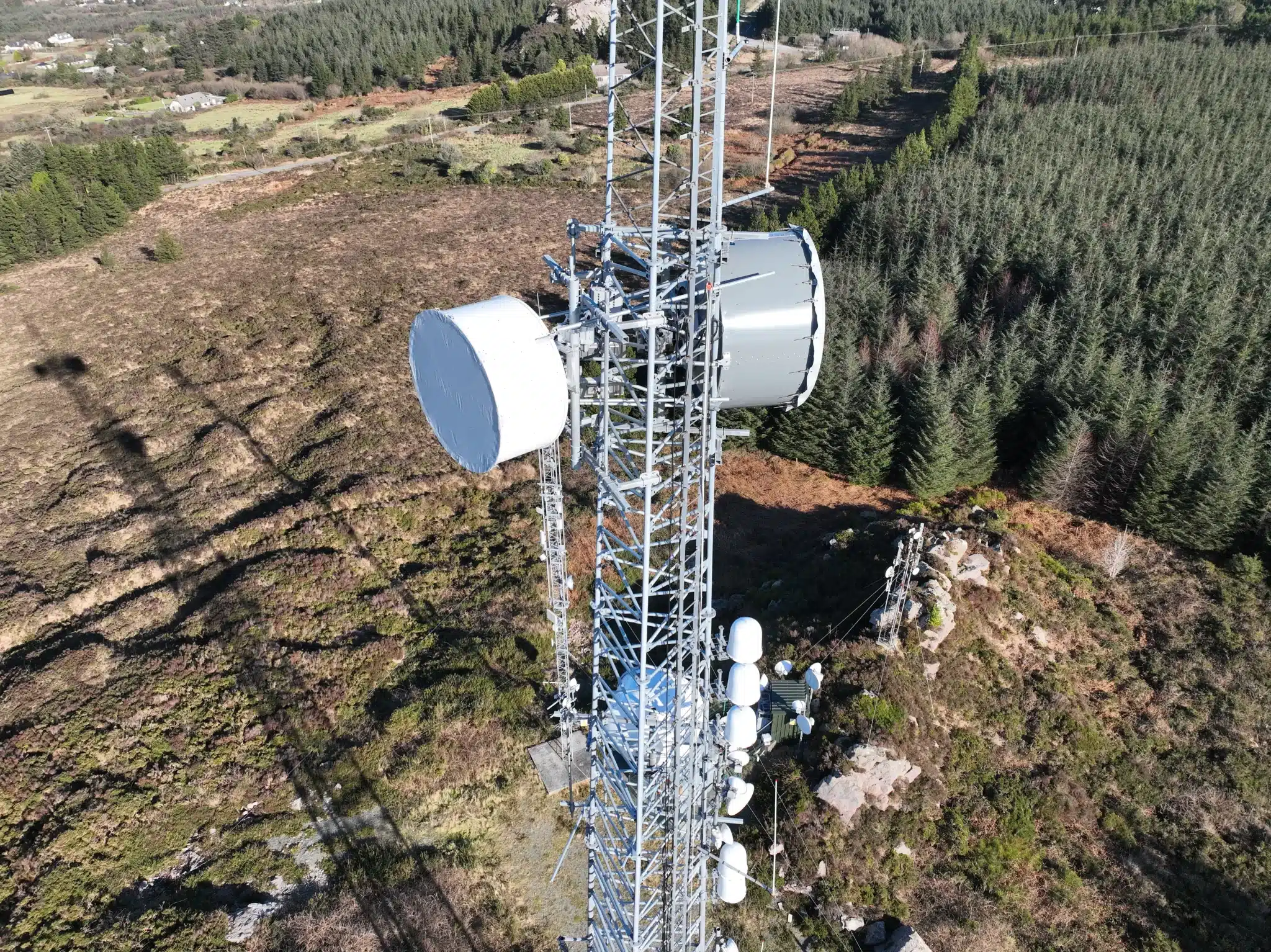
Drone inspecting a telecoms tower with multiple antenna arrays in Ireland
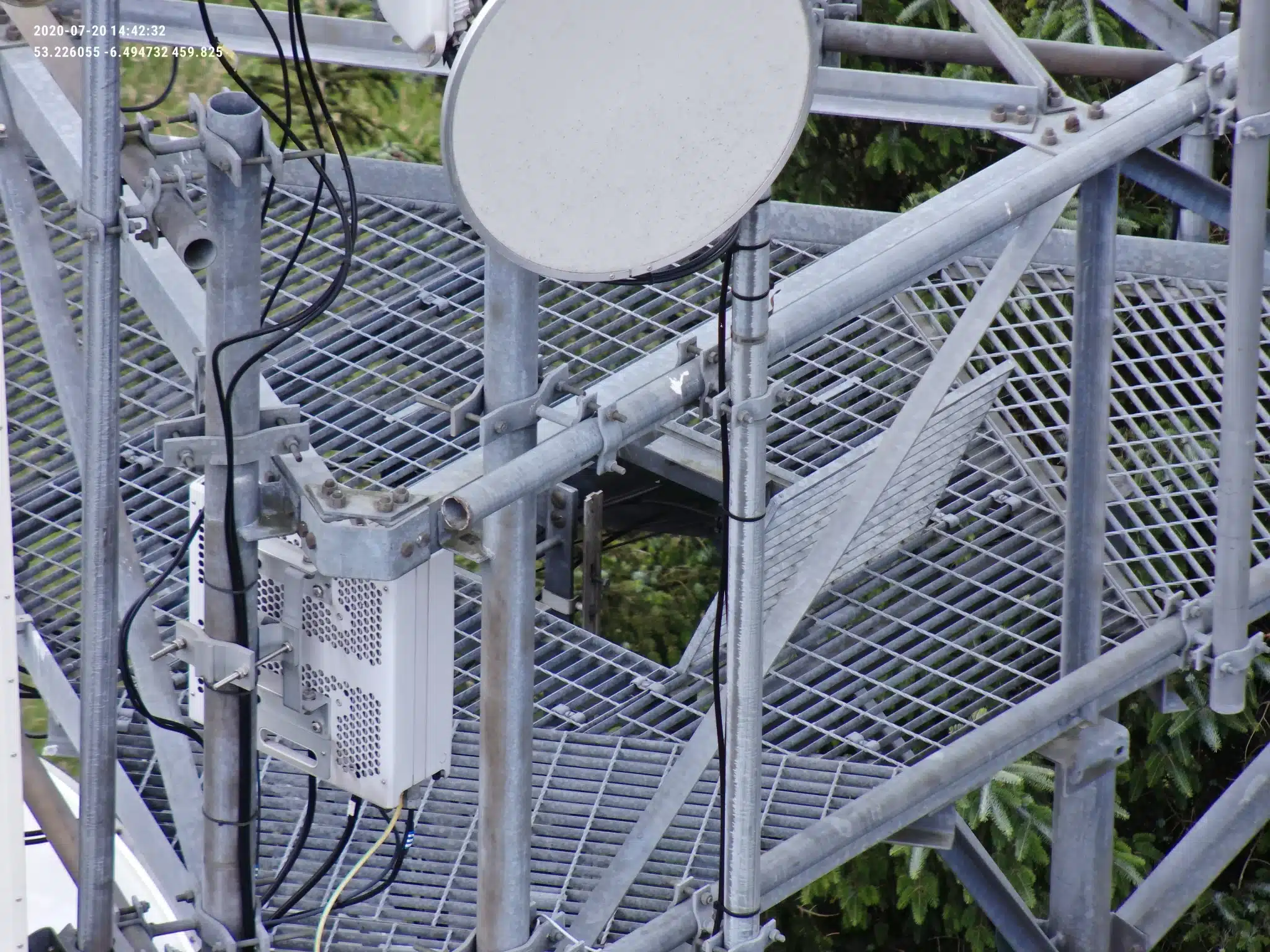
High-resolution drone image of telecoms tower fixings showing condition detail for engineering assessment
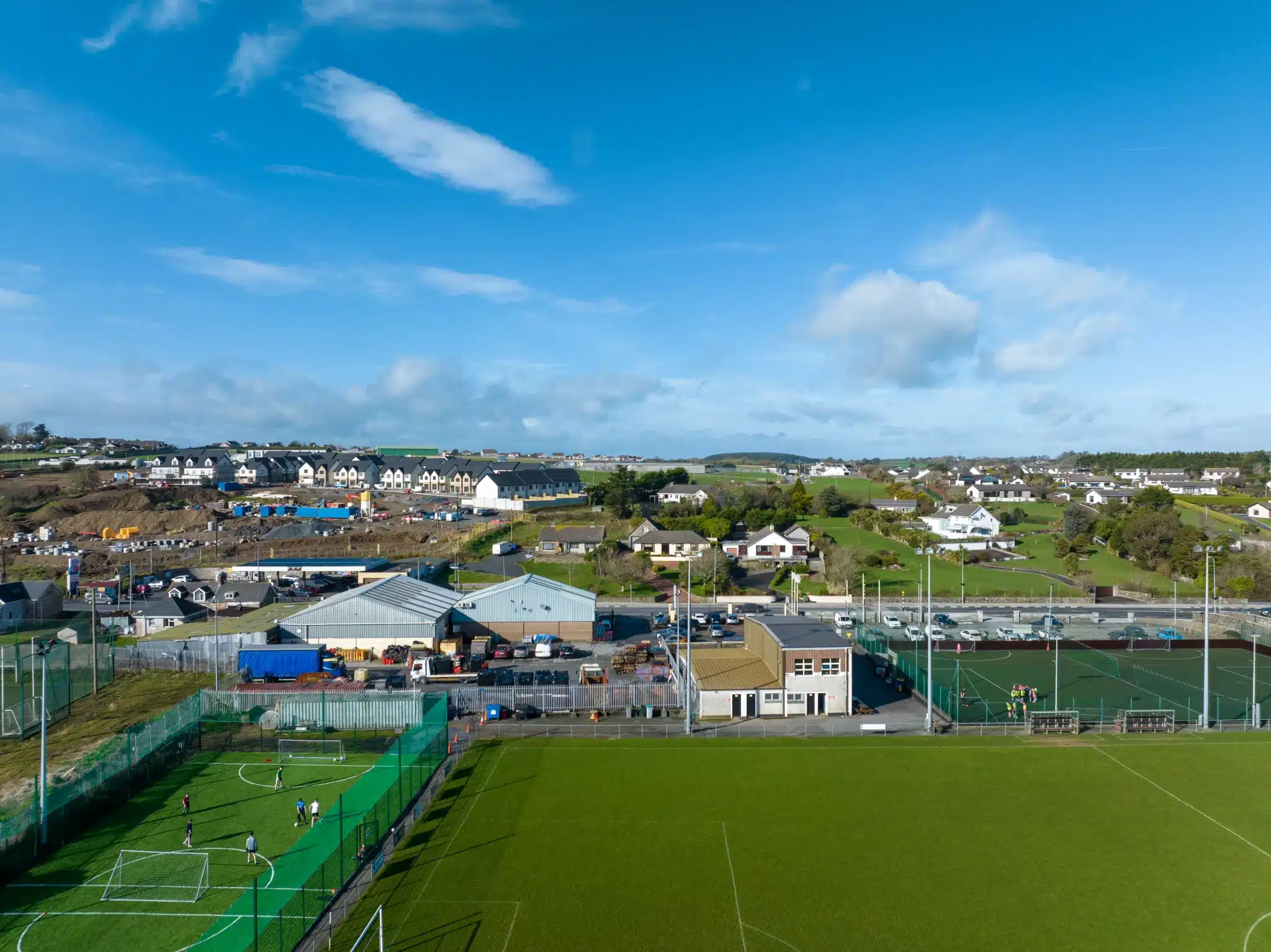
Panoramic survey captured from telecoms tower antenna height for planning application in Ireland

What We Deliver

Our telecoms drone services cover three core areas: planning surveys, condition inspection, and 3D modelling.

Panoramic surveys (PANs) capture 360-degree imagery from the proposed or existing antenna mounting height on a tower or mast. PANs are a standard requirement for telecoms planning applications, providing the local authority and ComReg with visual evidence of the site’s visual context, surrounding land use, and relationship to nearby properties and sensitive receptors. We capture PANs at specified heights to match the proposed antenna configuration, delivering stitched panoramic images that meet planning submission requirements.

Line-of-sight (LoS) surveys verify clear radio-frequency paths between a proposed tower site and target locations, such as existing masts, exchanges, or coverage areas. LoS verification is essential for planning microwave backhaul links, point-to-point connections, and confirming that terrain, vegetation, or built obstructions do not block the signal path. By hovering the drone at the proposed antenna height, we can visually confirm LoS and capture imagery documenting the clear path or identifying obstructions, without needing a crane, cherry picker, or temporary mast.

Condition inspection provides a detailed visual record of the tower structure, antennas, mounts, cabling, feeders, connectors, safety-climb systems, and ground-compound infrastructure. High-resolution imagery identifies corrosion, structural cracking, loose or damaged fixings, cable degradation, antenna misalignment, paint failure, and any signs of structural distress. Condition reports support maintenance planning, asset lifecycle management, lease renewal assessments, and regulatory compliance.

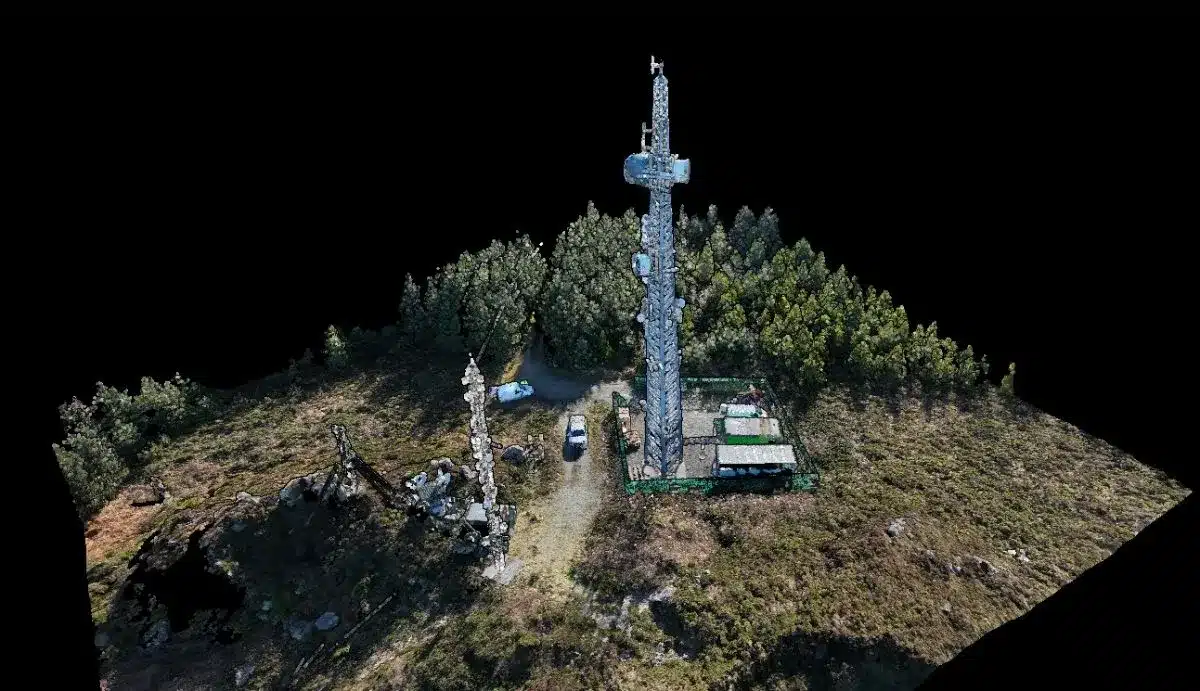
3D models and digital twins are created from structured drone imagery captured in orbital flight paths around the tower. The resulting photogrammetric model provides a dimensionally accurate, textured 3D representation of the structure and all mounted equipment. On a recent project for an engineering firm, we identified a structural twist in a telecoms mast due to an oversized panel load. We created a 3D model of the structure that the engineering firm used to demonstrate the deformation to its client and to plan remediation. This type of deliverable goes well beyond a standard photo inspection, giving engineers and asset managers a measurable, navigable digital record of the structure.

Equipment

We deploy enterprise-grade platforms configured for close-proximity tower inspection work.

DJI Matrice 300 RTK with Zenmuse H20T is our primary telecoms inspection platform. The H20T combines a 20 MP zoom camera with 23x hybrid optical zoom, a 12 MP wide-angle camera, and a radiometric thermal camera. The zoom capability allows detailed inspection of fixings, connectors, and corrosion from a safe standoff distance, without approaching the structure. The thermal channel identifies hotspots in cabling, connectors, and active equipment that may indicate electrical faults or failing components.

DJI Matrice 300 RTK with Zenmuse P1 (45 MP full-frame camera) is used for 3D modelling work where maximum image resolution is required. The P1 captures the fine detail needed to produce accurate photogrammetric models of complex tower structures with multiple antenna arrays, cable trays, and mounting hardware.

DJI Matrice 4 Enterprise and Mavic 3 Enterprise are deployed for PANs, LoS surveys, and rapid site assessments where a lighter, faster platform is appropriate. These platforms are particularly effective for rooftop installations and lower-height monopoles where a full enterprise platform is not required.

All operations use RTK positioning where available. We carry €6.5 million public liability insurance and operate under full EASA and IAA authorisation for Specific Category operations, including flights in close proximity to structures.

DJI M300 with P1 Payload
Drone Insopection of Telecoms Lattice Tower from 30m

Telecoms Planning Support

Planning applications for new telecoms masts and upgrades to existing installations require specific documentation that a drone survey can provide efficiently.

Visual impact assessment imagery captured from multiple directions and distances around the proposed site documents how the structure will relate to its surroundings. Combined with PANs from the proposed antenna height, this imagery provides planners with a comprehensive visual record of the site context.

Topographical survey of the proposed site and its immediate surroundings supports site layout design, access planning, and environmental assessment. We deliver CAD-ready contour maps, digital terrain models, and orthomosaic imagery in the IRENET95 (ITM) coordinate system.

Existing site documentation for upgrade applications captures the current state of the tower, compound, and all mounted equipment. This baseline record supports the engineering assessment of whether the existing structure can accommodate additional loading from new antennas or equipment.

Structural Condition and Engineering Support

Engineering firms working on telecoms structures require accurate, detailed inspection data to assess structural condition, verify loading, and plan modifications. Our drone inspection delivers the imagery and 3D data that support this engineering work.

The structural twist case study is a good example. During a routine inspection, our imagery revealed that a telecoms mast had developed a visible twist in its upper section. The cause was traced to a panel installation that exceeded the intended loading. We captured a full orbital image set and processed a 3D model of the structure that clearly showed the deformation. The engineering firm used this model to quantify the twist, present the issue to their client, and develop the remediation specification. Without the 3D model, demonstrating the extent of the deformation to a non-technical client would have been significantly more difficult.

For condition surveys, we provide systematically captured imagery covering all structural members, connections, guy wires (where present), foundations, and ground compound infrastructure. Imagery is organised by elevation, orientation, and component type so that the reviewing engineer can efficiently assess the structure without visiting the site.

Coverage

We operate across the Republic of Ireland and Northern Ireland. Our eight-year working relationship with Shared Access has taken us to tower sites across the country, from urban rooftop installations in Dublin city centre to rural lattice towers in the west and border regions.

For multi-site inspection programmes, we plan efficient site-to-site routing to minimise mobilisation costs and maximise the number of inspections completed per day. On programme work, we typically inspect three to five tower sites per day, depending on tower type, access conditions, and the scope of inspection required at each location.

Why Choose Drone Services Ireland

Eight years of continuous work with one of the leading independent tower companies in the UK and Ireland is a credential that speaks for itself. Our relationship with Shared Access was not won on a single tender and forgotten. It has been maintained through consistent delivery, reliable scheduling, and outputs that meet the standards of their engineering and operations teams.

We understand the telecoms workflow. We know what PANs and LoS deliverables need to contain for planning submissions. We know how condition imagery needs to be organised for engineering review. We know how to work safely around live antenna arrays, and we understand the access and coordination requirements for sites operated by multiple tenants.

Our broader capability across surveying and mapping, LiDAR, corridor surveying, and thermal imaging enables us to support telecoms clients with related services such as power line corridor mapping, site topographical surveys, and thermal assessments of active equipment, alongside standard tower inspection and planning work.

We have been providing commercial drone services across Ireland since 2016 and hold industry leadership positions as Secretary of Drone Professionals Ireland, former Chair of the IPDPA, and former Co-Chair of the UAAI.

Frequently Asked Questions

Telecoms Tower Inspection
How long does a telecoms tower inspection take?

A standard condition inspection of a single tower typically takes 30 to 60 minutes of flight time, depending on the height, complexity, and number of antenna arrays. Including setup and repositioning, we inspect three to five sites per day on programme work. PANs and LoS surveys are faster, typically 15 to 30 minutes per site.

Yes. We operate at a safe standoff distance from the structure and do not make physical contact with the tower or any mounted equipment. Our Zoom capabilities allow detailed inspection from a distance. We follow all relevant EMF safety guidance and coordinate with site operators regarding any specific exclusion zones around active equipment.

A panoramic survey (PAN) captures 360-degree imagery from the proposed antenna mounting height. It is a standard requirement for telecoms planning applications, showing the local authority the visual context of the site, including surrounding properties, land use, and any visually sensitive receptors. We capture PANs at specified heights using RTK positioning for accuracy.

Yes. We capture structured orbital imagery around the tower and process it into a photogrammetric 3D model (a textured mesh and a point cloud). These models are used for engineering assessment, loading analysis, modification planning, and client presentations. Our structural twist case study demonstrates this capability in practice.

We operate across the Republic of Ireland and Northern Ireland. Our Shared Access work has taken us to every part of the country over eight years. We are experienced in both urban rooftop installations and rural tower sites.

Yes. Our H20T payload includes a radiometric thermal camera that identifies temperature anomalies in cabling, connectors, combiners, and active equipment. Thermal data is captured alongside visual inspection imagery and can be delivered as a standalone thermal report or integrated into the overall condition inspection.