Do I need to register a drone in Ireland? Yes - if your drone has a camera or weighs 250 g or more, you must register as a drone operator with the Irish Aviation Authority (IAA) before flying. You register yourself, not the drone: one Operator ID (format IRLxxxxxxxxxxxxxx) covers every drone you own. Registration costs €41 and is valid for two years.
| Requirement | Detail |
|---|---|
| Who must register | Any drone with a camera, or weighing ≥250 g - covers almost all consumer drones (incl. DJI Mini) |
| Registration fee | €41, valid 2 years |
| A1/A3 training certificate | €51, valid 5 years - required only for drones over 250 g |
| Sub-250 g with camera | Register as operator only (no training certificate since 1 Jan 2024) |
| Where to register | IAA MySRS portal (mysrs.iaa.ie) |
| You receive | Operator ID (IRLxxxxxxxxxxxxxx) to display on your drone(s) |
Whether you are procuring drone services for your organisation or operating drones in-house, understanding drone registration requirements in Ireland is essential for compliance and risk management. Under current EASA regulations, enforced in Ireland by the Irish Aviation Authority (IAA), all commercial drone operators and most recreational operators must register – and clients commissioning drone work should verify their operator’s registration status before any flight takes place.
This guide covers drone registration requirements in Ireland: who needs to register, what categories and certifications exist, what training is required, and – critically – what to verify when hiring a commercial drone operator for your project. As Ireland’s most experienced commercial drone company, operating since 2016 and regularly featured in national media on drone regulations, we deal with these regulations every day and are here to help you understand them clearly.
Table of Contents
Do I Need to Register My Drone in Ireland?
This is the most common question we are asked, and it often causes confusion. The short answer is: yes, almost certainly.
Under the current EASA regulations (EU Regulation 2019/947), you must register as a drone operator with the IAA if your drone:
- Weighs more than 250g, OR
- Has a camera or other sensor capable of detecting personal data
Many people overlook the second part of that rule. Even if your drone weighs under 250g, if it has a camera (which almost all consumer drones do), you are legally required to register as an operator. The only exception is if your drone is classified as a toy under EU Directive 2009/48/EC.
Important: You no longer register the drone itself. You register yourself as a drone operator. Think of it like becoming a mini drone airline. One registration covers every drone you own or operate.
Which Drones Require Registration in Ireland?
To help clear up any confusion, here is a breakdown of popular drone models and what is required for each. For a more detailed look at the professional equipment we use for commercial drone operations in Ireland, visit our drone equipment page.
Drones Requiring Operator Registration Only (Sub-250g with Camera)
These drones weigh under 250g but have cameras, so you must register as an operator. Since 1 January 2024, you no longer need to complete A1/A3 online training for sub-250g drones. Reading the manufacturer’s manual is sufficient.
- DJI Mini / Mini 2 / Mini 4K
- DJI Mini 3 / Mini 3 Pro
- DJI Mini 4 / Mini 4 Pro
- DJI Mini 5 Pro
- DJI Neo / DJI Neo 2
Drones Requiring Operator Registration and A1/A3 Training
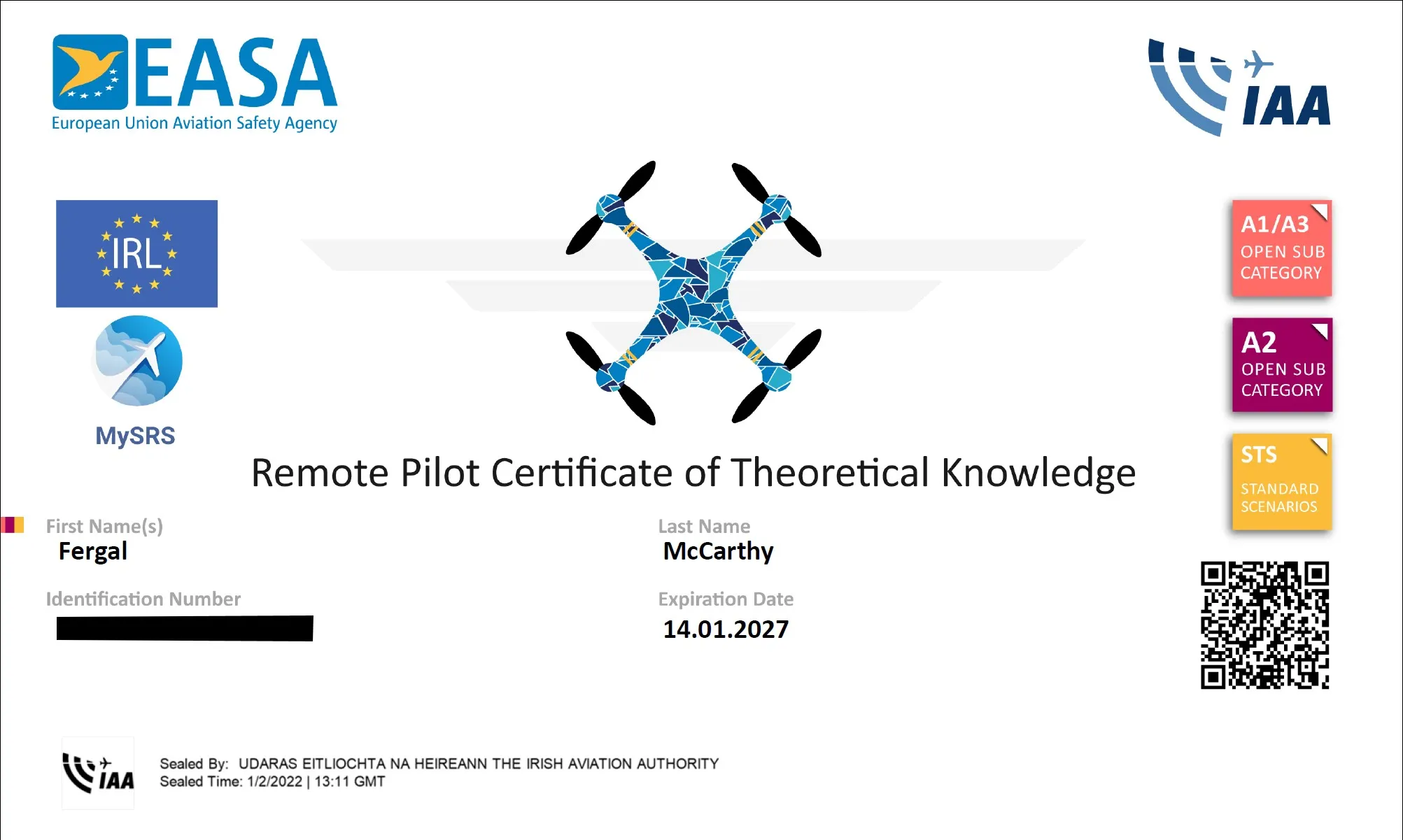
These drones weigh over 250g and require both operator registration and completion of the IAA’s free online A1/A3 training course on MySRS.
- DJI Air / Air 2S / Air 3 / Air 3S
- DJI Mavic Series (Mavic Pro, Mavic 2 Pro, Mavic 2 Zoom, Mavic 3, Mavic 4 Pro)
- DJI FPV / DJI Avata / DJI Avata 2
- DJI Phantom series
- Autel EVO series
- Any drone weighing over 250g
How to Register as a Drone Operator in Ireland
Registering as a drone operator is straightforward and is completed entirely online through the IAA’s MySRS platform. Here is the step-by-step process:
Step 1: Create a MySRS account. Visit iaa.mysrs.ie and sign up with your email address.
Step 2: Verify your identity. Upload your identification as prompted. You only need to do this once, and it streamlines all future interactions with the IAA.
Step 3: Complete online training (if required). If your drone weighs over 250g, you must complete the UAS Proof of Online Training before registering. This takes approximately 15 minutes and involves watching a short video followed by 40 multiple-choice questions. You need a score of 75% to pass. The A1/A3 training certificate costs €51 and is valid for five years (as of January 2026). For sub-250g drones with cameras, reading the manufacturer’s manual is sufficient as of January 2024, but you still need to register as an operator.
Step 4: Register as an operator. Apply for your Operator ID through the MySRS platform. Registration costs €41 and is valid for two years (as per the IAA Schedule of Charges effective 1 January 2026).
Step 5: Label your drone. Once registered, you will receive an Operator ID number (format: IRLxxxxxxxxxxxxxx). You must display this number on every drone you operate. It should be visible from the outside or within a compartment that can be accessed without tools. You must also upload your Operator ID into the remote identification system of your drone, where applicable. To understand more about how Remote ID works in practice, read our article on the reality of Direct Remote ID for drones.
How Much Does Drone Registration Cost in Ireland?
Here is a summary of the costs involved, based on the IAA Schedule of Charges effective 1 January 2026:
| Requirement | Cost | Validity |
|---|---|---|
| Drone Operator Registration | €41 | 2 years |
| A1/A3 Online Training (UAS Proof of Online Training) | €51 | 5 years |
| A2 Remote Pilot Competency Certificate (Open A2) | €128 | 5 years |
| Specific Category STS Theoretical Knowledge Certificate | €205 | 5 years |
| Operational Declaration (Standard Scenario) | €514 | 2 years |
| SORA Operational Authorisation (SAIL I/II) | €3,595 | 2 years |
The operator registration covers you for an unlimited number of drones. Whether you own one DJI Mini or ten commercial aircraft, you only pay the single €41 registration fee. Prices are reviewed annually by the IAA. Check the IAA’s current Schedule of Charges to confirm the latest fees.
Understanding Drone Categories in Ireland
EASA regulations divide drone operations into three categories based on risk level. Understanding which category your flying falls into is essential for compliance.
Open Category (Low Risk)
The Open Category is designed for most recreational and low-risk commercial operations. Your drone must weigh less than 25kg, and you must fly within visual line of sight (VLOS) at a maximum height of 120 metres above ground level.
The Open Category has three subcategories:
A1 (Fly Over People): Allows flight over uninvolved people with very light drones (under 250g or with C0/C1 class marking). Requires operator registration and online training (€51 for the A1/A3 certificate for drones over 250g; manufacturer’s manual only for sub-250g drones).
A2 (Fly Close to People): Allows flight within 4kg drones (C2 class marking) to be flown closer to uninvolved people. Requires A1/A3 training plus an additional Remote Pilot Competency Certificate (€128) obtained through a Designated UAS Training Organisation (DUTO).
A3 (Fly Far from People): Allows flight with heavier drones (up to 25kg) but only in areas where no uninvolved people are expected to be within 150 metres. Requires operator registration (€41) and A1/A3 online training (€51).
Specific Category (Medium Risk)
The Specific Category covers operations that go beyond the limits of the Open Category, such as beyond-visual-line-of-sight (BVLOS) flights, operations in controlled airspace, or flights with heavier drones. These require an Operational Authorisation from the IAA, which involves submitting a risk assessment (typically using the SORA methodology) or operating under a Standard Scenario (STS).
At Drone Services Ireland, we hold a Specific Category Operational Authorisation, which allows us to carry out complex operations, including drone infrastructure inspections in controlled airspace, construction site monitoring in urban areas, and large-scale aerial survey and mapping projects that go beyond the Open Category limits. You can read more about how we use this in practice on our drones in construction industry page.
Certified Category (High Risk)
The Certified Category applies to the highest-risk operations, such as passenger-carrying or large-cargo drones. These require full type certification of the drone, a licensed remote pilot, and detailed regulatory approval, similar to that in manned aviation.
Where Can I Fly My Drone in Ireland?
Before every flight, you should check the Ireland drone airspace map to identify any restrictions in your intended flying area. We have published a detailed guide on where you can legally fly your drone in Ireland, which covers specific zones, altitude limits, and city-by-city restrictions, including the complex airspace around Dublin.
Key rules to remember include:
- Maximum altitude: 120 metres above ground level in the Open Category
- Visual line of sight: You must be able to see your drone at all times (Open Category)
- Airports: Never fly within the restricted zones around airports or heliports without permission
- No-fly zones: Prisons, military installations, and certain sensitive sites are restricted
- People and property: Maintain safe distances as required by your subcategory
- Night flying: This is permitted in the Open Category
Professional operators plan every flight carefully. Our mission planning process includes full airspace assessment, risk analysis, and ATC coordination where required.
Do I Need Drone Insurance in Ireland?
Drone insurance is not legally required for recreational flights with drones weighing under 20kg. However, the IAA strongly recommends that all drone operators carry third-party liability insurance.
If you are flying commercially or your drone weighs over 20kg, third-party liability insurance is mandatory under EU Regulation 785/2004. As a professional drone operator, we carry €13 million in public liability insurance for all operations. Insurance is one of the critical things to verify before hiring any drone company. Our guide on what to ask when hiring a drone operator in Ireland covers insurance, qualifications, and other essentials in detail. You can also see how drone technology is being used in the insurance sector for claims assessment and property inspections.
GDPR and Data Protection for Drone Operators
If you operate a drone fitted with a camera or listening device that is capable of recording images or video of identifiable people, you may be classified as a data controller under the General Data Protection Regulation (GDPR).
This means you have legal obligations regarding how you capture, store, and process personal data. This applies to both recreational and commercial operators. If in doubt, review the guidance available from the Data Protection Commission or consult a data protection professional. Our privacy policy outlines how we handle data captured during drone operations.
Drone Registration for Visitors to Ireland
EU Residents
If you are already registered as a drone operator in another EU member state, you do not need to re-register in Ireland. Your existing registration is valid across all EASA member states. However, you must familiarise yourself with any Ireland-specific airspace restrictions and geographical zones before flying. We recommend checking our interactive drone airspace map as your first step.
If you wish to conduct operations in the Specific Category in Ireland, you will need to apply for cross-border operational authorisation from the IAA.
UK Residents (Post-Brexit)
Since Brexit, the United Kingdom is classified as a third country under EU Regulation 2019/945. This means mutual recognition of drone qualifications no longer applies. If Ireland is your first EASA member state of operation, you must register through the IAA’s MySRS platform and hold appropriate certifications from an EASA member state.
Non-EU Residents
If you are visiting Ireland from outside the EU, you must register as a drone operator with the IAA if Ireland is the first EU country where you intend to fly. Once registered in Ireland, your registration is valid across all EASA member states.
What Happens If I Fly Without Registering?
The IAA takes enforcement seriously. If you operate a drone without proper registration, the consequences can include:
- Drone detention: The IAA or An Garda Siochana can confiscate your drone
- Court proceedings: The IAA can bring summary proceedings in the District Court
- Criminal prosecution: Serious cases may be referred to the Director of Public Prosecutions
- Fines: Penalties of up to €5,000 or more for unauthorised flights in restricted airspace
- Imprisonment: In extreme cases involving airport disruption or endangerment, sentences of up to 7 years are possible under existing aviation law
Flying responsibly and legally is not just about avoiding penalties. It is about keeping people safe and ensuring that the drone industry in Ireland continues to grow and be trusted by the public.
Registering a Company or Organisation
If your company uses drones, the organisation itself should register as a drone operator. The process involves:
- An authorised representative (Accountable Manager) creates a personal MySRS account
- The company is verified on MySRS using its Company Registration Office (CRO) number
- The Accountable Manager applies for an Operator ID on behalf of the company
- Individual staff members who fly the drones must complete the appropriate training and hold valid competency certificates
Government agencies or state bodies without a CRO number should follow the IAA’s UAM 02 guidance note for registration.
If you are a business looking to understand how drones can benefit your operations rather than setting up your own team, our drone consultancy service can help you evaluate the options. We also offer custom drone solutions tailored to specific business requirements.
Frequently Asked Questions About Drone Registration in Ireland
Can I register before I buy a drone?Yes. You can register as a drone operator on MySRS before purchasing your drone.
Does one registration cover multiple drones?Yes. Your Operator ID covers every drone you own or operate. There is no limit on the number of drones.
Do model aircraft need to register?Yes. Model aircraft are treated the same as drones under the current EASA regulations. Members of model aircraft clubs should check with the Model Aeronautics Council of Ireland (MACI) for additional guidance.
How do I renew my registration?Registration is renewed through the MySRS platform every two years. The current renewal fee is €41 (as of January 2026).
What is Remote Identification?Remote ID is a system that allows drones to broadcast identification and location information during flight. Newer drones sold with EU class markings (C1, C2, C3, etc.) are required to have Remote ID capability. You must upload your Operator ID into the drone’s Remote ID system. We have written a detailed analysis of how Direct Remote ID works and its current limitations.
Can I fly my drone commercially without a special licence?You do not need separate commercial permission to fly a drone for work purposes, provided you operate within the limits of the Open Category. However, if your commercial operations fall outside Open Category limits, you will need an Operational Authorisation from the IAA under the Specific Category. Read our guide to commercial drone use in Ireland for more detail.
Where can I and can’t I fly my drone?Irish airspace has many restricted zones, particularly around airports, military installations, and urban centres. Our detailed guide on where you can legally fly your drone in Ireland explains the rules in detail, and our interactive airspace map lets you check restrictions for any location before you fly.
Need Professional Drone Services?
If your project requires professional drone operations, whether that is aerial surveys and mapping, LiDAR surveying, building and roof inspections, construction monitoring, or drone photography and video, our team at Drone Services Ireland is here to help.
As Ireland’s most experienced commercial drone company, established in 2016, we hold all required IAA and EASA authorisations and carry detailed insurance for every operation. We work with clients across every sector, from architecture and construction to insurance and quarrying.
We provide drone services nationwide, with dedicated coverage in Dublin, Cork, Galway, Limerick, and Mayo.
See examples of our work in our case studies, including a power line LiDAR survey, an emergency stockpile volume survey, and a 300-acre solar farm mapped in 10 days.
Need help with your commercial drone registration? We guide operators through the full MySRS process and can advise on the training pathway that fits your operation. Call 087 205 2331 or email [email protected].
Useful Links and Resources
- IAA Drone Information – Official IAA drone pages
- IAA MySRS Registration Portal – Register as a drone operator
- IAA Schedule of Charges (UAS) – Current fees (effective January 2026)
- EASA Drone Information – EU-wide drone regulations
- Drone Airspace Map Ireland – Check where you can fly
- Where Can I Fly My Drone in Ireland? – Detailed rules and restrictions
- What is Direct Remote ID? – How Remote ID works in practice
- Commercial Drone Use in Ireland – Guide to commercial operations
- What to Ask When Hiring a Drone Operator – Essential hiring checklist
- Citizens Information – Drones – Government guidance
- DSI Blog – Latest news and articles on drones in Ireland
Last updated: February 2026
Need a Professional Drone Service?
Drone Services Ireland are EASA-certified, IAA licensed operators with 500+ projects completed across all 32 counties. Get a free consultation today.
Related reading: Registration is separate from pilot competency – see our complete guide to the drone licence in Ireland.