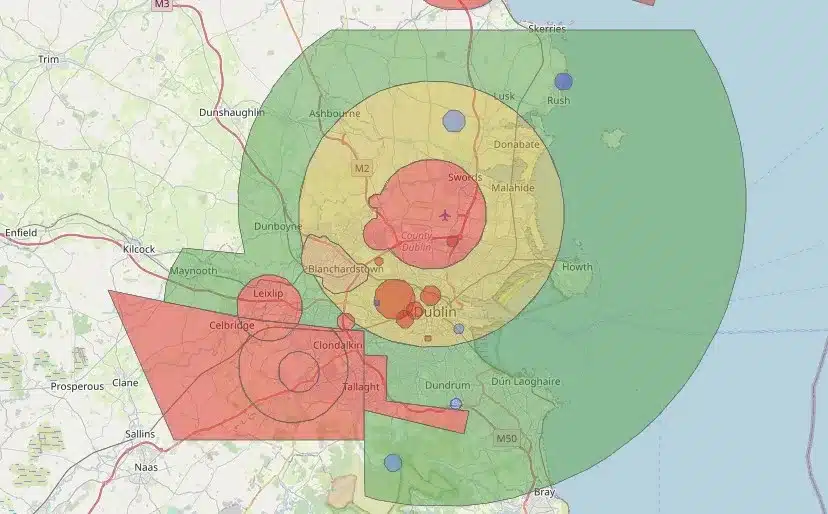
Where can I fly a drone in Ireland? You can fly in most uncontrolled airspace if you stay below 120 m (400 ft), keep the drone within visual line of sight, stay clear of people and property you don’t control, and avoid restricted zones (airports, controlled airspace, military, prisons). Register as an IAA operator first if your drone has a camera or weighs 250 g or more, and check the free IAA drone airspace map before every flight.
| Rule | Detail |
|---|---|
| Maximum height | 120 m (400 ft) above ground level |
| Registration | Required if the drone has a camera or weighs ≥250 g |
| Sub-250 g (C0) | Open Category A1 - may fly closer to people (never over crowds) |
| Legacy / heavier drones | Open Category A3 - stay 150 m from residential, commercial & recreational areas |
| No-fly zones | Airports, controlled airspace, military & prisons - check the IAA airspace map |
| Private property / GDPR | Landowner permission advisable; respect data-protection law when filming people |
If you are commissioning drone work for a construction project, survey, or inspection, understanding Irish airspace rules is essential for project planning and scheduling. Drone operations in Ireland are governed by the Irish Aviation Authority (IAA) under EU-wide EASA regulations – and these rules directly affect where, when, and how aerial surveys can be conducted on your site.
This guide covers the key regulatory considerations that affect commercial drone operations in Ireland: airspace restrictions, flight permissions, registration requirements, and what your drone operator should be handling on your behalf. We update this page regularly to reflect the latest changes.
Drone Services Ireland has operated commercially across all 32 counties since 2016. As Secretary of Drone Professionals Ireland and a regular contributor to national media on drone regulation, we are well placed to break down these rules for you. If you are looking for a professional drone operator rather than flying yourself, we can help with that, too.
Table of Contents
The Short Answer
You can fly a drone in most of rural Ireland without any special permission, as long as you follow a few key rules. Here is the quick version:
You CAN fly if you…
- Stay below 120 metres (400 ft) above the ground.
- Keep the drone within your line of sight at all times.
- Stay away from airports, airfields, and helipads.
- Avoid flying over crowds or gatherings of people.
- Have registered as a drone operator with the IAA (if your drone weighs 250 g or more, or has a camera).
- Have the landowner’s permission to take off and land.
You CANNOT fly…
- In controlled airspace (around airports and cities) without clearance.
- Over assemblies of people.
- In no-fly zones such as prisons, military bases, and certain national parks.
If you are unsure about a specific location, use the free IAA drone airspace map before every flight – it shows exactly where restrictions apply.
How to Register Your Drone in Ireland
Before you fly, you need to register as a drone operator with the IAA. This applies if your drone weighs 250 g or more or has a camera or any sensor capable of capturing personal data. Even a lightweight drone like the DJI Mini 4 Pro (249 g) requires registration because it has a camera.
Step-by-step registration:
- Go to the IAA’s MySRS portal at iaa.mysrs.ie and create an account. 2. Complete the online drone operator registration form. The fee is €41, valid for two years (per the IAA Schedule of Charges, January 2026). 3. Complete the required training: sub-250 g drones with a C0 class label need only read the manufacturer’s manual, while heavier drones must pass the A1/A3 online test and hold the certificate (€51, valid five years). 4. Once registered, you receive a unique operator number. Stick this number on every drone you fly. 5. Upload your operator number into your drone’s Remote ID system.
For more details, read our dedicated guide: Do I Need to Register to Fly My Drone in Ireland?
What is Remote ID?
Remote ID is like a digital number plate for your drone. While you are flying, it broadcasts your drone’s location, altitude, speed, and your operator number. People nearby can read this information using free smartphone apps such as DroneScanner or OpenDroneID. It helps the authorities and the public know who is flying and whether the drone is being operated safely.
Rules for Sub-250 g Drones (DJI Mini Series and Similar)
Lightweight drones under 250 g, such as the DJI Mini 5 Pro, DJI Mini 4 Pro, DJI Mini 3, and DJI Mini 2 SE, are the most popular consumer drones sold in Ireland. They do benefit from relaxed rules, but they are not exempt from regulation.
What sub-250 g drone owners must do:
Register as a drone operator with the IAA (because these drones have cameras). Read the manufacturer’s manual (this counts as your training for sub-250 g drones since January 2024, so you do not need to sit the full A1/A3 exam). Label the drone with your operator number and enable Remote ID.
What sub-250 g drone owners can do that heavier drones cannot:
Fly closer to people (though never directly over uninvolved crowds). Fly in Open Category A1, which allows flight over uninvolved persons as long as you do not hover or fly repeatedly over them. These drones face fewer restrictions in urban areas compared to heavier models.
However, airspace restrictions still apply. A DJI Mini is subject to the same no-fly zones, altitude limits, and controlled airspace rules as any other drone. Always check the airspace map before flying, regardless of your drone’s weight.
Legacy Drones: What Changed on 1 January 2024
If you own an older drone without a C-class label (for example, the DJI Phantom 4, Mavic 2 Pro, Mavic Air 2, or any drone bought before 2024 that does not carry a C0, C1, C2, C3, or C4 marking), it is classified as a “legacy drone” under EU regulations.
Since 1 January 2024, legacy drones face tighter restrictions:
They can only fly in Open Category A3, which means you must stay at least 150 metres away from residential, commercial, industrial, and recreational areas. In practice, this limits legacy drones to open countryside well away from any buildings or people. The only way to fly a legacy drone closer to built-up areas is to hold an Operational Authorisation under the Specific Category from the IAA, which requires formal training, a risk assessment, and an approved operations manual.
If your legacy drone no longer meets your needs under these rules, it may be worth upgrading to a C-class labelled model. Alternatively, if you need professional drone work carried out near buildings or infrastructure, a certified commercial operator like Drone Services Ireland holds the authorisations to fly in these restricted areas.
Understanding Irish Airspace: Where Can and Cannot You Fly
Class G Airspace (most of rural Ireland)
The majority of Ireland, outside cities and airports, falls within Class G airspace, the least restrictive category. In Class G airspace, you can generally fly your drone up to 120 metres above the ground without prior permission. This covers most of the countryside, farmland, coastal areas, and smaller towns.
Even in Class G, you still need landowner permission to take off and land, you must keep a visual line of sight, and you must avoid flying over gatherings of people.
Controlled Airspace (cities and airports)
Airspace around airports and major cities is controlled, meaning you need clearance from Air Traffic Control (ATC) to fly above certain heights, or you may be unable to fly at all. Dublin, Cork, Shannon, and Knock airports all have controlled zones around them. In many parts of Dublin, for example, the maximum altitude without ATC clearance is just 30 metres.
No-Fly Zones
Some areas are completely off-limits to drones. These include prisons, military installations such as Casement Aerodrome, certain government buildings, and active emergency scenes. Flying in a no-fly zone can result in your drone being confiscated by the Gardaí and potential prosecution.
Before every flight, check the official IAA drone airspace map to see exactly what restrictions apply at your location.
Flying a Drone in Dublin
Dublin is the most complex airspace in Ireland for drone operators. Multiple restrictions overlap across the county due to Dublin Airport flight paths, hospital helipads, Phoenix Park (a prohibited zone), military facilities, and the Garda Air Support Unit.
Altitude limits in Dublin:
Most of Dublin county has a maximum altitude of 30 metres (about 100 ft) without ATC clearance. Some areas allow up to 60 or 90 metres. Above these limits, you need clearance from AirNav Ireland, and you must hold Specific Category authorisation from the IAA.
Geographical Zones
Two special geographical zones affect Dublin operations. EIU97 around Blanchardstown supports drone delivery trials. Open Category operators can apply to AirNav Ireland for permission to fly within this zone, but must receive written approval in advance and ring for take-off clearance on the day. EIU98, introduced in October 2024, reduced the altitude limit in parts of south-west Dublin from 90 metres to 60 metres to accommodate military flight paths to and from Casement Aerodrome.
If you need drone work carried out in Dublin’s controlled airspace, Drone Services Ireland holds full Specific Category authorisation and regularly operates in controlled airspace across Dublin. We handle all ATC coordination as part of our service.
Drones in National Parks, Beaches, and Heritage Sites
National Parks
Ireland’s six national parks (Killarney, Glenveagh, Connemara, The Burren, Wicklow Mountains, and Ballycroy) each set their own drone policies. Most require advance permission from the National Parks and Wildlife Service (NPWS), and some prohibit drones entirely during certain seasons to protect nesting birds and wildlife. Always contact the park directly before planning a flight.
OPW Heritage Sites
The Office of Public Works (OPW) prohibits drone flights at all of its heritage sites. This covers dozens of popular locations, including Newgrange, the Rock of Cashel, Clonmacnoise, and Kilmainham Gaol. There are no exceptions for recreational flyers.
Beaches and Coastal Areas
There is no blanket ban on flying drones at Irish beaches. However, you must still follow all standard rules: stay below 120 metres, keep visual line of sight, avoid flying over people (beach-goers count as uninvolved persons), and check whether the beach falls within controlled airspace or a Special Area of Conservation. Many popular beaches in Dublin, Cork, and Galway sit within airport control zones, so check the airspace map first. Some local authorities have introduced seasonal bye-laws restricting drones on certain beaches during peak summer, so check with the relevant county council.
Flying a Drone in Ireland as a Tourist
If you are visiting from another EU country:
Your drone operator registration from your home country is valid in Ireland. You do not need to register again. Your A1/A3 or A2 certificate is also recognised. Simply follow Irish airspace rules and check the airspace map before each flight.
If you are visiting from the UK, USA, or another non-EU country:
You must register as a drone operator with the IAA before you fly. This can be done online at iaa.mysrs.ie. Post-Brexit, UK registrations are not automatically recognised, so UK visitors must register in Ireland as if it were their first EU registration. The same applies to visitors from the USA, Canada, Australia, and all other non-EU countries. Your home country pilot licence (such as FAA Part 107) does not replace the requirement to register and complete the EASA online training.
Popular Places to Fly a Drone in Ireland
Ireland has spectacular scenery and large stretches of open countryside that are ideal for drone flying. Here are a few popular locations, but always verify the current airspace status on the drone map before you go.
Wild Atlantic Way: Much of the Wild Atlantic Way coastline from Donegal to West Cork falls within unrestricted Class G airspace. Remote beaches, cliff walks, and headlands offer incredible footage opportunities with minimal airspace complexity.
Boyne Valley, County Meath: Rolling farmland and river valleys. Outside the Newgrange OPW exclusion zone, much of the valley is unrestricted. (This is our home area, so we know it well.)
The Burren, County Clare: Unique karst landscape with very few airspace restrictions outside the national park boundary.
Aran Islands: Dramatic cliffs and historic sites. Check for seasonal wildlife restrictions, particularly near seabird nesting colonies.
Always secure landowner permission, watch for livestock, and be considerate of other visitors. The countryside may look empty, but farmers notice drones.
What Happens If You Fly a Drone Illegally in Ireland?
Irish drone regulations carry real consequences. If you fly in breach of the rules:
The Gardaí or the IAA can confiscate your drone on the spot if they believe you are likely to continue breaching the regulations. You could face prosecution under the Irish Aviation Authority Act and EU Regulation 2019/947, with potential fines. Flying a drone dangerously near an airport or aircraft is a criminal offence that can result in significant fines and even imprisonment. If your unregistered or illegally operated drone causes injury or property damage, you face civil liability without the protection of insurance.
The message is straightforward: register, check the map, follow the rules, and enjoy flying safely.
Privacy, GDPR, and Landowner Permission
If your drone has a camera (and nearly all of them do), you are capturing personal data the moment you record identifiable people, vehicles, or properties. Under GDPR, this makes you a data controller with obligations to process data lawfully, to inform people you are recording, to store footage securely, and to delete it when it is no longer needed.
You also need the landowner’s permission to take off and land on private property. Flying over private land at low altitude without permission can constitute trespass. If someone complains about your drone over their property, they may contact the Gardaí. If you are operating commercially and need to capture data over property, working with a professional operator like Drone Services Ireland ensures all GDPR, insurance, and landowner notification requirements are handled correctly.
Do You Need Drone Insurance in Ireland?
For recreational flying with a drone under 20 kg, insurance is not legally required but is strongly recommended by the IAA. Accidents happen, and third-party liability insurance typically costs EUR 50 to EUR 100 per year for hobbyists.
For commercial operations, insurance is mandatory. You need a minimum of third-party public liability insurance to operate professionally. Drone Services Ireland carries detailed public liability and professional indemnity cover for every project we undertake.
Quick Reference: Can I Fly Here?
| Location | Rules |
|---|---|
| Open countryside | Generally permitted up to 120 m. Fewest restrictions. Still need landowner permission and must avoid assemblies. |
| Small towns and villages | Possible but check your drone category. Legacy drones must stay 150 m from built-up areas. Sub-250 g and C-class drones have fewer restrictions. |
| Dublin and major cities | Significant restrictions. Often limited to 30-90 m altitude. ATC clearance needed above limits. Specific Category authorisation required for most professional work. |
| Near airports | Prohibited without authorisation. Possible with ATC clearance and Specific Category approval. Requires advance planning. |
| National parks | Varies by park. Most require advance permission from NPWS. Some prohibit drones entirely during nesting seasons. |
| OPW heritage sites | Drones are prohibited at all OPW heritage sites. No exceptions. |
| Beaches | No blanket ban, but standard rules apply. Check for controlled airspace, wildlife restrictions, and local bye-laws. |
Frequently Asked Questions
Do I need a licence to fly a drone in Ireland?
You do not need a traditional pilot’s licence for recreational drone flying. However, you must register as a drone operator with the IAA (€41, valid for two years) and complete the relevant online training. For drones under 250 g with a camera, reading the manufacturer’s manual is sufficient since January 2024. For heavier drones, you must pass the A1/A3 online exam. Commercial operators who need to fly outside Open Category limits must hold Specific Category authorisation, which requires formal training and an approved operations manual.
Can I fly a drone in my back garden in Ireland?
Yes, you can fly in your own garden as long as you are a registered operator and you follow the altitude and airspace rules for your location. However, you must not fly over neighbouring properties without the landowner’s consent, and you should avoid capturing footage of neighbours or their property to stay on the right side of GDPR.
Can I fly a DJI Mini without registering?
No. Although the DJI Mini series weighs under 250 g, it has a camera, which means you must register as a drone operator with the IAA. The good news is that since January 2024, you do not need to sit the full A1/A3 exam for sub-250 g drones. Reading the manufacturer’s manual is sufficient.
Can I fly my drone at the beach in Ireland?
There is no general ban on flying drones at Irish beaches. However, you must follow all standard rules: stay below 120 m, keep visual line of sight, and avoid flying over people on the beach. Check whether the beach sits within controlled airspace on the IAA airspace map, and check with the local county council for any seasonal bye-laws restricting drones.
Can tourists fly drones in Ireland?
Yes. EU visitors can use their existing home-country drone operator registration in Ireland. Non-EU visitors (including UK residents post-Brexit) must register with the IAA at iaa.mysrs.ie before flying. All visitors must follow Irish airspace rules.
What are the penalties for flying a drone illegally in Ireland?
The Gardai or the IAA can confiscate your drone on the spot. You may face prosecution under the Irish Aviation Authority Act and EU regulations, with potential fines. Dangerous drone use near airports or aircraft is a criminal offence.
Can I fly a drone near Dublin Airport?
Not without specific authorisation. Dublin Airport has a large controlled zone around it. In most of this zone, you are limited to 30 metres altitude without ATC clearance. Flying above this limit, or within certain prohibited areas, requires Specific Category authorisation and coordination with AirNav Ireland.
Is drone insurance required in Ireland?
Insurance is not legally required for recreational drone flying with a drone under 20 kg, but the IAA strongly recommends it. For commercial drone operations, third-party liability insurance is mandatory.
Can I fly a drone in Phoenix Park?
No. Phoenix Park is a prohibited zone for drone operations. This restriction applies to all drone categories and cannot be overridden by standard operator registration.
What happened to the DJI Phantom 4 and Mavic 2 Pro under new rules?
These are classified as legacy drones because they lack C-class identification labels. Since 1 January 2024, they are restricted to Open Category A3, meaning you must stay at least 150 metres from residential, commercial, and recreational areas. To fly them closer to built-up areas, you need Specific Category authorisation from the IAA.
How high can I fly my drone in Ireland?
The maximum altitude in the Open Category is 120 metres (approximately 400 ft) above ground level. In controlled airspace areas (such as near airports and in cities), the limit may be much lower, sometimes as low as 15 or 30 metres. Always check the IAA drone airspace map for your specific location.
Do I need to display my registration number on my drone?
Yes. You must physically attach your IAA operator registration number to every drone you fly, typically using a sticker. You must also upload this number into your drone’s Remote ID system so it is broadcast digitally during flight.
Checklist Before Every Flight
- Check the IAA drone airspace map for your location.
- Confirm your drone operator registration is current and your operator number is on the drone.
- Verify Remote ID is active and broadcasting.
- Get landowner permission for take-off and landing.
- Check the weather, particularly wind speed and visibility.
- Ensure your drone’s battery is fully charged and firmware is up to date.
- Scan the area for people, animals, vehicles, and overhead obstructions. 8. Fly within the visual line of sight at all times.
Need Professional Drone Services?
If your project requires flights in controlled airspace, over buildings, near infrastructure, or in conditions that exceed Open Category limits, you need a certified commercial operator. Drone Services Ireland holds full EASA and IAA Specific Category authorisation and has operated in every county in Ireland since 2016. Our services include aerial surveying and mapping, building and roof inspections, LiDAR surveying, construction monitoring, thermal imaging, and drone photography and video.
Contact us to discuss your project, or call 087 205 2331.
Last Updated: February 2026
Related reading: Need a licence to fly? See our drone licence guide for Ireland.