Supplement Your Surveys with Drone Data, LiDAR & Photogrammetry
How land surveyors and consulting engineers in Ireland are pairing aerial capture with traditional ground survey to deliver more data, in less time, with the same survey-grade accuracy.
Last updated: April 2026
Drone Doesn’t Replace the Total Station – It Multiplies It
A theodolite, a total station and an RTK rover capture the points that matter most. A drone captures everything in between – the 24 hectares of detail you’d otherwise walk, climb or skip.
For survey teams in Ireland, drone supplementation has stopped being a nice-to-have and become a project-economics decision. A modern UAV survey delivers the same ±5 cm accuracy as walked detail when properly controlled, captures 50× the surface area in a single mobilisation, and produces deliverables your CAD office can use the same day.
That doesn’t replace the surveyor – it gives the surveyor a better instrument. Use the total station where high-density precise points need recording – invert levels, kerb lines, awkward built features, control. Use the drone for everything that’s wide, vegetated, busy with traffic, or just plain too big to walk in a day.


Eight Deliverables That Drop Into Your CAD Office
Every output is referenced to ITM (Irish Transverse Mercator) and Malin Head Vertical Datum, and shipped in the formats your design team uses today – DWG, GeoTIFF, LAS/LAZ and ASCII grids.
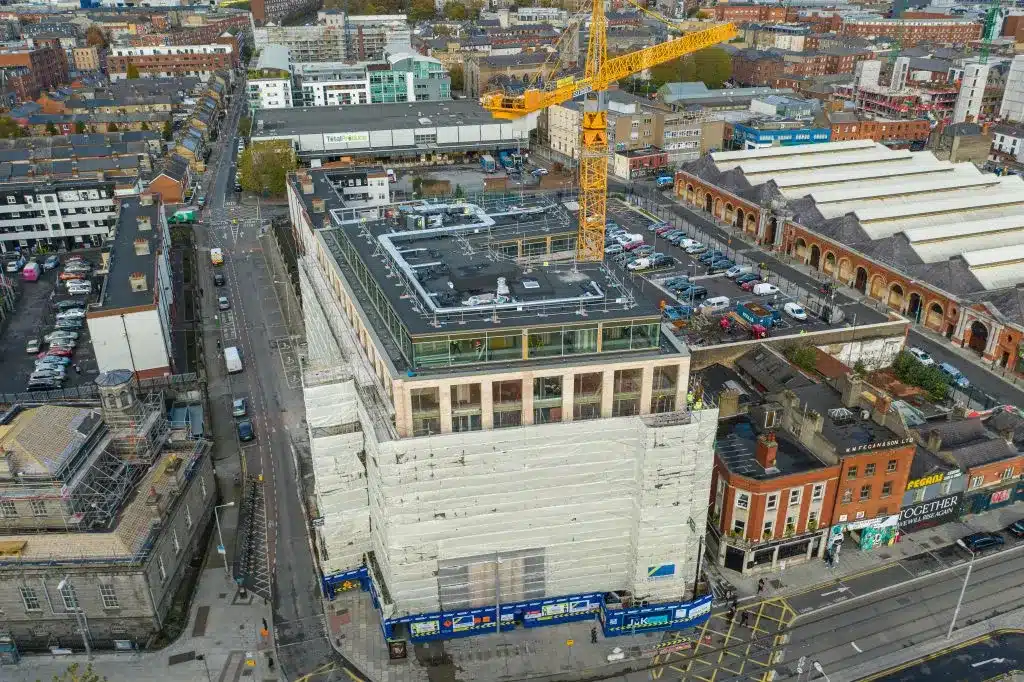
Orthomosaic
Georeferenced, distortion-corrected aerial in GeoTIFF. 1–3 cm GSD. Drops in as a CAD background or GIS basemap.
DTM & DSM
Bare-earth Digital Terrain Model and Digital Surface Model at 5–10 cm grid. ASCII Grid, GeoTIFF and LandXML.
Contour Maps
Smoothed contours at 0.25 m / 0.5 m / 1.0 m intervals as DWG/DXF, layered to your office standard.
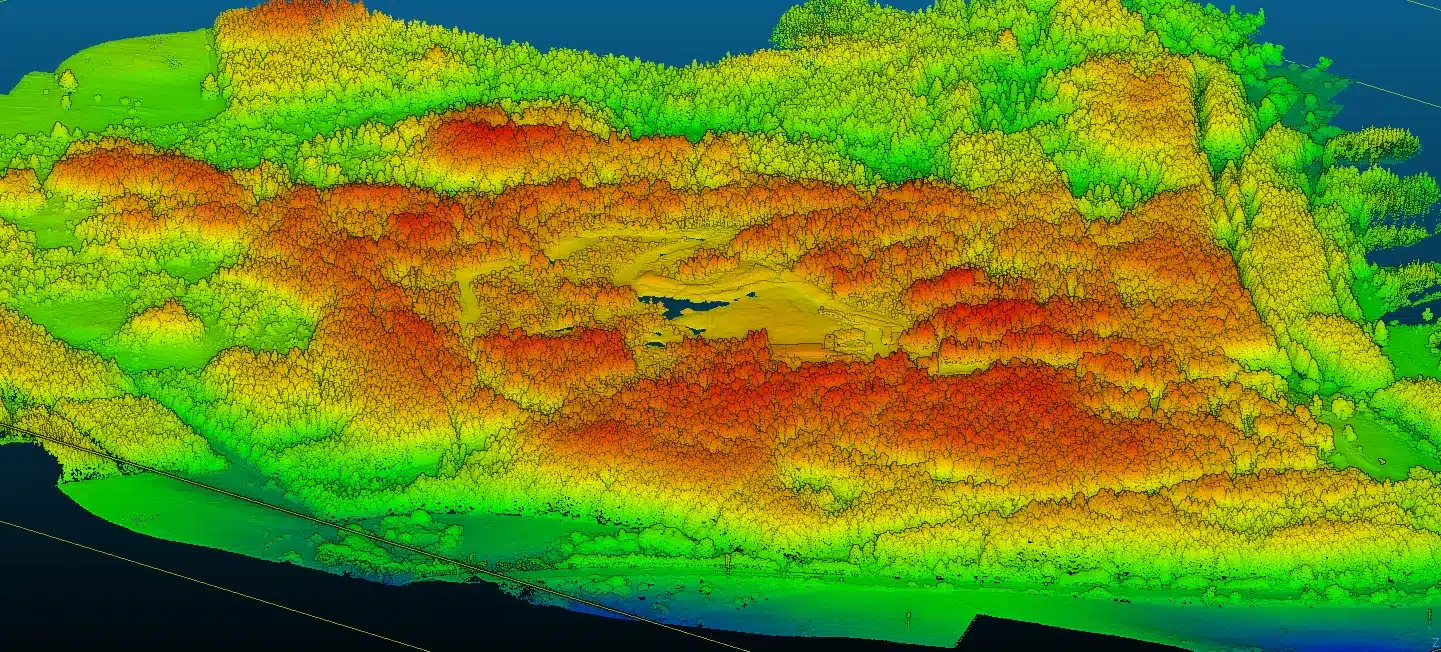
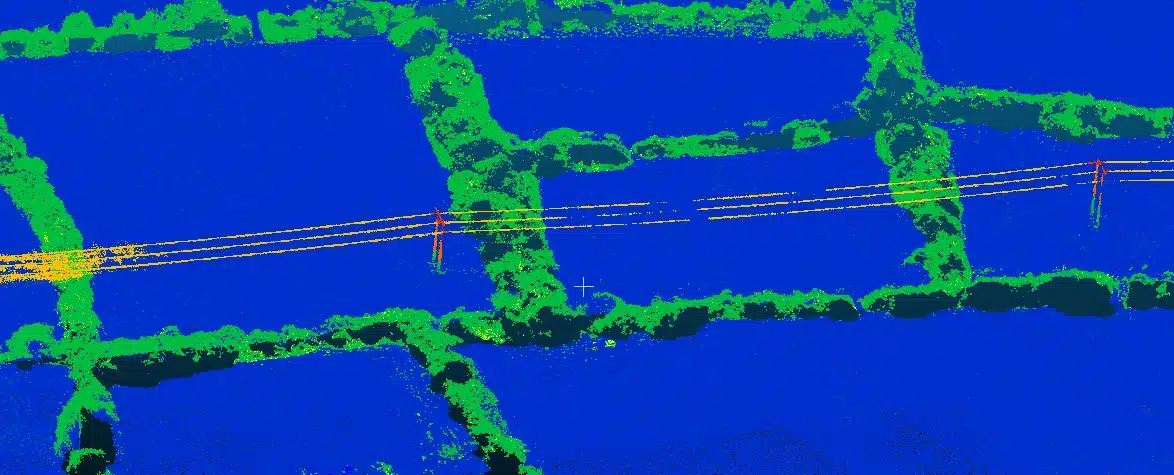
Point Cloud
LAS/LAZ 1.4. ASPRS-classified (ground, vegetation, building). Ready for Civil 3D, Revit and BIM workflows.
Cross-Sections
Cut to your chainage interval and offsets. DWG cross-section sheets and LandXML pipeline.
CAD Topo
Layered DWG topographical drawing – kerbs, surfaces, vegetation, structures – to your office or RIAI conventions.
Volumetric Reports
Cut/fill m³ with method statement. Stockpile, earthworks and progress volumetrics with monthly delta.
Reality Data
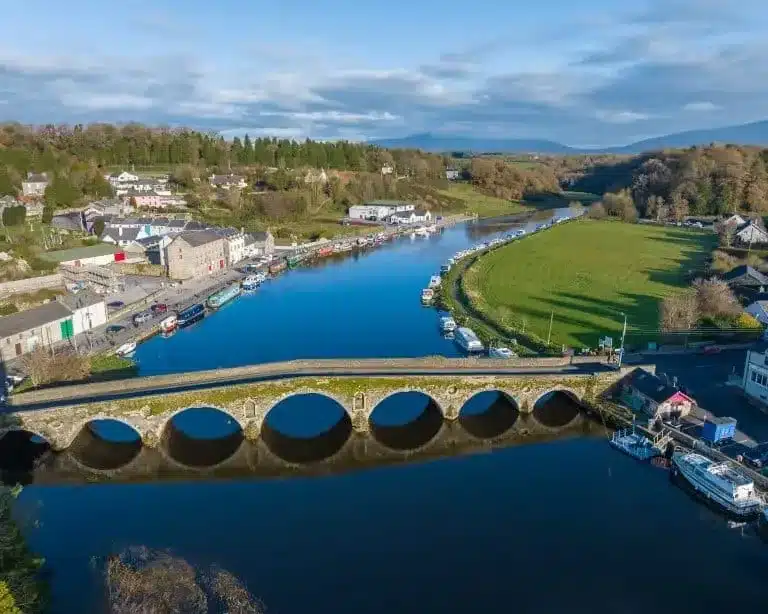
360° imagery, oblique aerials and 3D mesh for design reviews, client meetings and stakeholder reporting.
For a full reference of every deliverable format and how to use them in CAD or GIS, see our Drone Survey Deliverables Guide for Engineers.
How We Achieve Survey-Grade Accuracy
Survey accuracy isn’t a marketing claim – it’s a documented chain of equipment, control and quality reporting. Here’s the chain we run on every project.
RTK Capture
DJI Matrice 350 RTK with Zenmuse L2 (LiDAR) or P1 (35 mm photogrammetry). Real-time corrections from CORSnet-IE / OSi Active GNSS Network.
Permanent Ground Control
5–8 distributed GCPs surveyed with Emlid RS3 GNSS. Established outside active works so they don’t move during the project.
Independent Check Points
Separate CPs not used in processing. Residuals reported per project – typically RMSE 0.02–0.04 m horizontal, 0.03–0.05 m vertical.
Coordinate System
ITM (Irish Transverse Mercator) horizontal, Malin Head Vertical Datum.
Need to verify it for tender or assurance? Use our GCP Layout & Residuals Report Template as the QA deliverable, or drop the language straight from our Drone Survey Specification Template into your scope of works.


When to Bring Us In
Six concrete project conditions where drone capture pays back inside the first mobilisation.
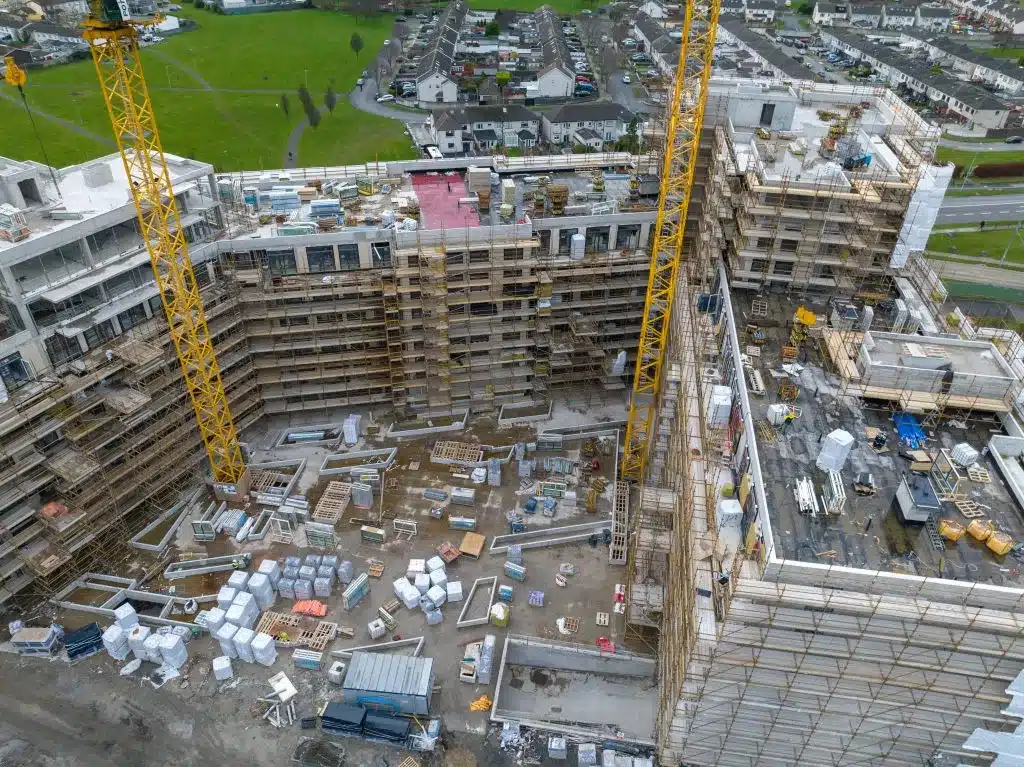
Earthworks & bulk volumetrics
Stockpile reconciliation, cut/fill verification, monthly volumes. ±2–3 % volume accuracy on properly controlled flights.
Pre-design topographical
Sites larger than ~1 ha, vegetated terrain, awkward access, or live traffic. Same accuracy, fraction of the time.
Construction progress monitoring
Recurring monthly captures. Disputes drop, programme verification gets easier. See our Construction Monitoring service.
Floodplain & drainage modelling
Where ground access is impossible or vegetation defeats traditional capture, LiDAR delivers the bare-earth surface.
As-built verification
Independent check of completed works. Geometry, levels, alignment – all verifiable from the same flight.
Hazardous or inaccessible terrain
Steep slopes, contaminated land, water bodies, live rail. No-one walks, no permit-to-work needed for the survey itself.
When Drone Supplementation Isn’t Enough
Drone capture is a force multiplier for ground survey, not a replacement. There are jobs where the drone genuinely isn’t the right tool, and we’ll tell you so on the phone.
Drainage invert levels. Manhole covers must be lifted and the invert physically measured by a surveyor. Drone data shows surface levels only. We can pair our aerial capture with a sub-contracted walked invert survey on the same day.
Sub-millimetre structural deformation. Use a robotic total station or precise levelling. Drone vertical tolerance is ±4–5 cm; structural deformation monitoring needs ±5 mm or better.
Legal boundary determination. Land Registry-compliant boundaries require a chartered surveyor’s certified output. Our drone data is supplementary evidence; the signed-off boundary survey is a separate instruction – see can a drone survey replace a land surveyor? for where the two roles meet.
Internal building floor plans. Drone surveys are exterior only. Interiors need a measured building survey or terrestrial laser scanner.
Our recommendation
Use drone capture as the site-wide record. Bring us in for the wide, vegetated, or rapid-mobilisation work. Keep the total station, level, or GPR for invert levels, structural setting-out, and underground services. We’ll co-ordinate the handoff so both sets of data share the same control network and coordinate system.
Frequently Asked Questions
Everything survey teams typically ask before bringing drone capture into a project.
Bring Us In on Your Next Project
A typical brief takes 24 hours from spec to quote, and a small site can be flown, processed and delivered inside a week. Drop us your scope and we’ll come back with a detailed methodology and price.
Operating since 2016 • IAA licensed • EASA Specific Category • OSi Active GNSS subscriber • Malin Head Vertical Datum