The 30-second answer. A DSM (Digital Surface Model) shows everything visible from above – treetops, rooftops, parked machinery. A DTM (Digital Terrain Model) shows the bare ground with all of that stripped away. A DEM (Digital Elevation Model) is the umbrella term – and depending who you ask, it can mean either of the other two. If a deliverable just says “DEM”, always ask which one is meant.
| Model | What it shows | Typical Irish use |
|---|---|---|
| DSM – Digital Surface Model | Top of everything: vegetation, buildings, structures | Solar shading studies, telecoms line-of-sight, visual impact assessment |
| DTM – Digital Terrain Model | Bare-earth ground only | Flood risk assessment, drainage design, cut/fill earthworks, road design |
| DEM – Digital Elevation Model | Umbrella term – ambiguous | Avoid in specifications; state DSM or DTM explicitly |
An analogy that makes it stick
Picture a heavy snowfall over a site in the Wicklow hills. The DSM is the snow blanket – it drapes over the hedgerows, the site cabins, the stockpiles, the oak tree in the corner, and takes the shape of whatever it lands on. The DTM is the field underneath the snow – the actual ground you would build on once everything sitting on it is removed.
Both are useful. They just answer different questions. “Will that hill block the view of the proposed turbine?” is a snow-blanket (DSM) question. “Where will rainwater actually flow across this site?” is a field-underneath (DTM) question.
Why the confusion exists
The industry never fully agreed on what “DEM” means. In much of Europe – Ireland included – DEM is used as the family name for any gridded elevation dataset, with DSM and DTM as the two specific types. In American usage, “DEM” often means the bare-earth model specifically, making it a synonym for DTM. Software vendors split both ways.
The practical consequence: if a planning consultant, engineer or contractor asks for “the DEM” without qualification, two parties can deliver two different products and both believe they were right. On a flood study or an earthworks bill of quantities, that mix-up is expensive. The fix costs nothing – specify DSM or DTM by name in every brief, and never just “DEM”.
What each model is, in practical terms
DSM – the surface you can see
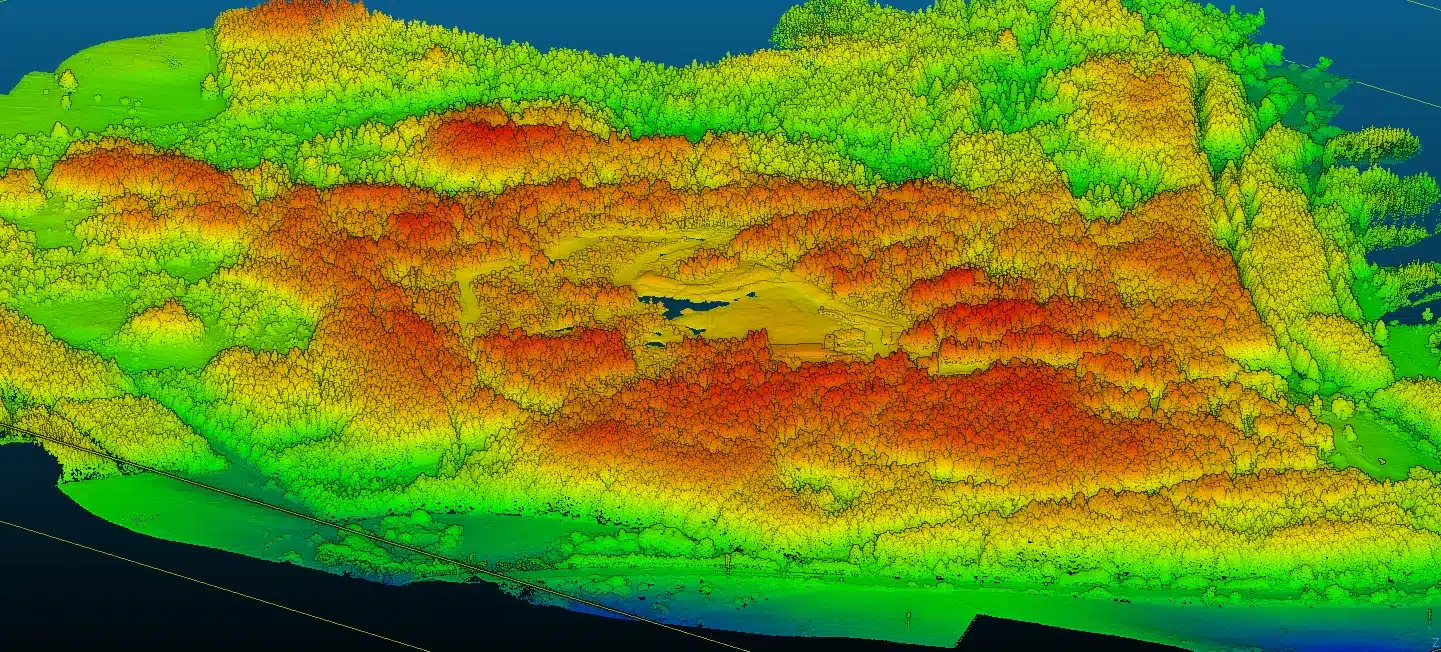
A Digital Surface Model is the elevation of the first thing a sensor sees looking straight down: canopy, roof ridges, hedgerows, parked plant. It is the natural output of drone photogrammetry, because a camera can only photograph what is visible.
Where a DSM is the right tool in Ireland:
- Solar farm design – shading analysis needs the height of every tree line and building that could cast a shadow across the array.
- Telecoms and utilities – line-of-sight checks between masts only work if the model includes the forestry in between.
- Visual impact and planning – zone-of-theoretical-visibility (ZTV) studies for wind and large developments are DSM exercises.
- Roof and building analysis – roof plane areas, ridge heights and fall directions come from the surface model.
DTM – the ground you build on
A Digital Terrain Model removes vegetation, buildings and temporary objects to leave bare earth. This is the model engineering actually runs on: water flows on the ground, not on the treetops, and earthworks are dug in soil, not in canopy.
Where a DTM is the right tool in Ireland:
- Flood risk assessment – site-specific FRAs under the OPW guidelines hinge on precise ground levels; in a flat floodplain, 10 cm of elevation can separate Flood Zone A from Flood Zone B.
- Drainage and SuDS design – flow paths, watershed delineation and pond siting all run on bare-earth hydrology.
- Cut/fill and earthworks – volume calculations against a design surface need the true existing ground, not the scrub sitting on it.
- Road and infrastructure design – vertical alignments and cross-sections are taken from terrain, with contours and sections delivered CAD-ready.
DEM – the term to pin down
Treat “DEM” as a question, not an answer. When it appears in a brief, a tender or a dataset name, confirm whether the surface or the terrain is intended. National open datasets are a good example of why: some Irish public elevation data is published as a DSM, some as a DTM, and the file names don’t always make the distinction obvious.
How drones produce each model – and why the method matters
This is the part most briefs miss: which model you can get depends on how the site is captured.
Photogrammetry: DSM natively, DTM where the ground is visible
A photogrammetric drone survey builds the model from hundreds of overlapping photographs. It produces an excellent DSM and a true-colour orthomosaic, and on open sites – quarries, agricultural land, construction sites stripped of vegetation – the ground is visible, so an accurate DTM can be classified out of the same data. With RTK/PPK positioning and ground control we deliver this at survey grade, to ±5 cm, typically within 1–2 working days.
Photogrammetry’s limit is simple: a camera cannot see through vegetation. Photograph a gorse-covered hillside in Kerry and the “ground” in the model is actually the top of the gorse – sometimes a metre or more above the real surface. Interpolating a DTM under dense cover from photos alone is guesswork.
LiDAR: the true DTM machine
Drone LiDAR fires hundreds of thousands of laser pulses per second, and enough of them slip through gaps in the canopy to return from the actual ground. Classification software then separates vegetation returns from ground returns – producing a genuine bare-earth DTM and a DSM from a single flight.
The numbers for our DJI Zenmuse L2 system, flown on the Matrice 300 RTK:
- ±2 cm vertical on hard surfaces, ±5 cm in vegetation (verified against ground control)
- 150–500+ points per square metre – against the 2–4 points/m² typical of national airborne LiDAR datasets, fine enough to pick up drainage ditches, field drains and culvert inverts
- Deliverables in 2 working days: classified LAS/LAZ point cloud, DTM and DSM as GeoTIFF, DWG/DXF contours
The rule of thumb we give clients: open ground – photogrammetry does the job at lower cost; vegetated, wooded or scrub-covered ground where the DTM matters – LiDAR is the only honest way to get one. For a deeper comparison, see our guide to choosing between LiDAR and photogrammetry.

A note on Irish coordinates and heights
Whichever model you commission, make sure it lands in the right reference system. We deliver in Irish Transverse Mercator (ITM / EPSG 2157) with heights on the OSGM15 geoid model – the combination Irish engineering design, GIS and planning workflows expect. A technically perfect DTM in the wrong datum still costs your design team a morning of rework, so it’s worth stating in the brief.
Which one should you specify?
- Flood risk assessment, drainage, SuDS → DTM (LiDAR if the site is vegetated)
- Earthworks volumes, cut/fill, quarry stock → DTM
- Road, rail or utility corridor design → DTM, usually with the DSM as a secondary deliverable
- Solar shading, wind ZTV, visual impact → DSM
- Telecoms line-of-sight → DSM
- Roof and building studies → DSM
- Not sure → ask for both. From a single LiDAR flight, DTM and DSM come from the same point cloud – specifying both at the outset costs far less than re-flying later.
Frequently Asked Questions
Is a DEM the same as a DTM?
Sometimes – and that’s the problem. In American-influenced usage, DEM means the bare-earth model and is interchangeable with DTM. In European and Irish usage, DEM is the umbrella term covering both DTM and DSM. Never rely on the word DEM alone in a specification: name the DTM or DSM explicitly.
Can you get a DTM from photogrammetry, or do I need LiDAR?
On open ground – bare construction sites, quarries, tillage – photogrammetry produces an accurate DTM, because the camera can see the ground. Under vegetation it cannot: the model follows the top of the canopy or scrub. If the bare-earth surface matters on a vegetated site, LiDAR is the only method that genuinely measures it.
What accuracy can a drone DTM achieve in Ireland?
With RTK/PPK positioning and ground control, our LiDAR DTMs verify at ±2 cm vertical on hard surfaces and ±5 cm in vegetated areas. Photogrammetric models on open ground deliver ±5 cm. Both are delivered in ITM / EPSG 2157 with OSGM15 heights.
What file formats do DSMs and DTMs come in?
The standard deliverables are GeoTIFF raster grids for the DTM and DSM, the classified LAS/LAZ point cloud they were derived from, and DWG/DXF contours or cross-sections for CAD. We match the format list to your design software – Civil 3D, MicroStation, QGIS and ArcGIS are the common destinations.
Do I need both a DTM and a DSM?
Often, yes – and the marginal cost is small. Both models are extracted from the same LiDAR point cloud or photogrammetric reconstruction, so requesting both in the original brief is far cheaper than commissioning a second survey when the other model turns out to be needed. The difference between them is also useful in itself: subtracting the DTM from the DSM gives a canopy height or building height model.
Need the right model for your site?
We’ve delivered survey-grade DSMs and DTMs across all 32 counties since 2016 – from single-field drainage studies to multi-kilometre corridor surveys. Tell us what decision the data needs to support, and we’ll recommend the capture method and model honestly: drone surveying & mapping from €450, or drone LiDAR where vegetation demands it. Request a fixed-price quote – answered within 24 hours.