Why routine roof inspection matters for Irish FMs
Most roofs in Ireland only get inspected when they start leaking. That is a problem for facility managers. By the time water is visibly coming through a ceiling tile, the membrane has usually failed in multiple places, the insulation below is saturated, and the repair bill is an order of magnitude larger than it would have been three months earlier.
This guide is written for facility managers and FM companies responsible for commercial, institutional or historic building stock in Ireland. It covers what routine drone roof inspection actually does, what it costs, where the cost savings come from, and – critically – how Irish commercial property insurance treats buildings that have, and have not, been inspected regularly. The picture for protected structures and heritage buildings is particularly acute, and is covered in its own section below.
Drone Services Ireland has been running aerial surveys and inspections since 2016. This is a direct vendor-perspective view, not a neutral think-piece. But the numbers, regulations and insurance patterns are real and worth knowing whether you commission inspections from us or anyone else.
Need the inspection rather than the guide? Our drone roof survey service covers all 32 counties from €400, with an annotated, severity-graded defect report within 48 hours and no scaffolding. See the drone roof inspections service: pricing, scope and sample reports

The real cost of reactive roof maintenance
The reactive roof maintenance cycle in Ireland typically looks like this: a tenant or occupant reports water ingress; an FM dispatches a contractor within 24 to 48 hours to identify the leak; a temporary repair is made with bitumen patches, tarpaulin or emergency sealant; a full investigation is scheduled with rope access, a cherry picker or scaffolding (which can take 2 to 6 weeks to arrange); remedial works are quoted, scoped and, if budget permits, executed; and finally internal damage to ceilings, carpets, stock and electronics is assessed and claimed.
The cumulative cost of that cycle, for a single 2,000 m² commercial roof, typically runs to €15,000-€45,000 depending on the scale of the failure. The repair itself is usually the smallest line item. The bulk of the cost sits in:
- Business interruption – lost rent, tenant compensation or facility closure days.
- Internal damage – soaked ceiling tiles, damaged stock, electrical fault remediation.
- Accelerated structural work – insulation replacement, timber drying, fungal treatment where moisture has been trapped for weeks before the leak became visible.
- Access infrastructure – scaffolding erected just for the inspection and repair, not amortised across a planned maintenance visit.
The fundamental issue is that roofs are high-risk, hard-to-access assets that most FMs cannot see with their own eyes more than once or twice a year, if that. And the Irish climate is unforgiving. Annual rainfall of 1,000-1,400 mm across most regions, 8-12 named storms per winter season affecting Ireland on average, and prolonged wind-driven rain that finds any compromised seal or flashing. You cannot maintain what you cannot inspect. And you cannot inspect what you cannot reach.
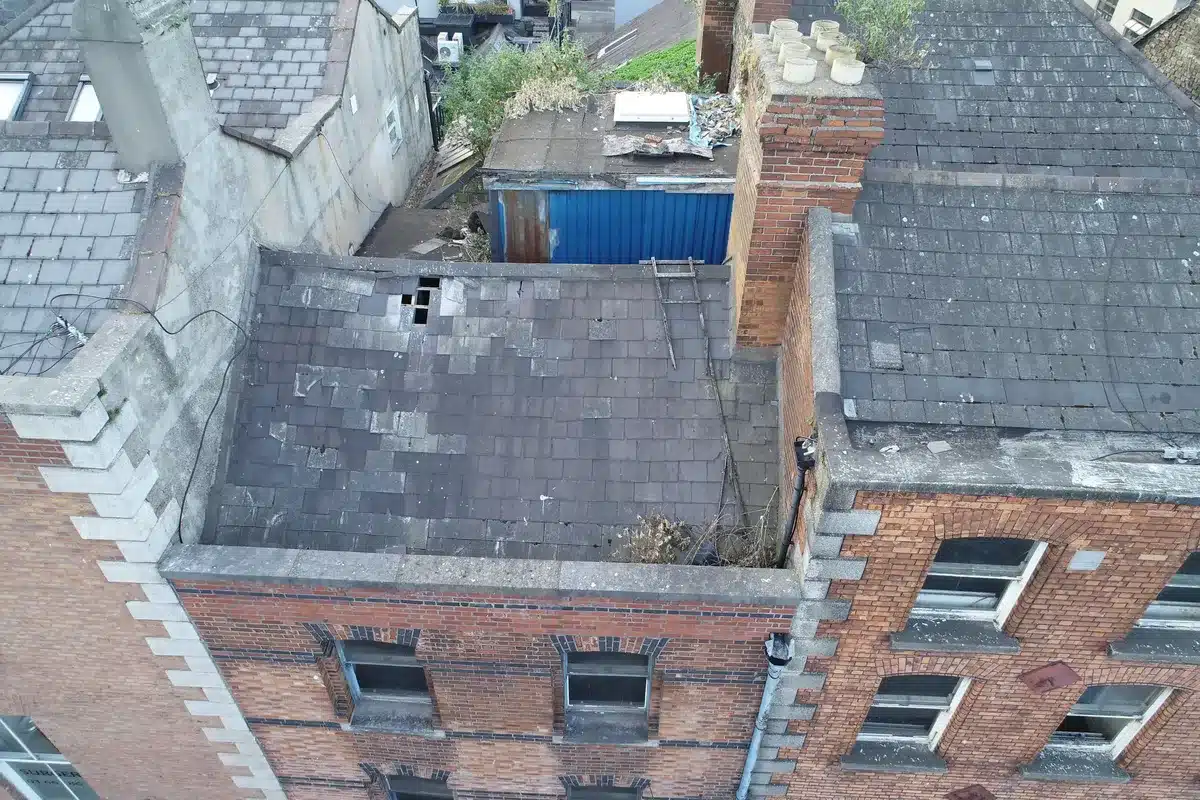
What routine drone inspection actually delivers
A routine drone roof inspection replaces the “emergency rope access after a leak” model with a scheduled, documented, data-backed assessment. The deliverable set for a standard FM-focused inspection typically includes:
- Full-resolution visual imagery – 45-megapixel stills on a DJI Matrice 300 with Zenmuse P1 camera, covering every square metre of the roof plane with geotagged defect photos.
- Thermal imagery – radiometric thermal captures identifying moisture ingress, heat loss, insulation failure and trapped water under membranes. Thermal is where most FM value sits; it finds problems visual inspection misses. More on this in our thermal imaging service page.
- Defect log – spreadsheet format, categorised by severity (immediate / within 12 months / monitor), with GPS-referenced photo evidence for every item.
- Trend report for clients on a recurring schedule – comparing defect progression across captures. A crack that was 30 mm wide in Q1 and 45 mm in Q3 is a different engineering problem than a new crack.
- PDF report suitable for insurer submission – compliant with typical “evidence of maintenance” documentation requirements used by Irish commercial insurers.
All of this is delivered within 48 working hours of the flight. No scaffolding. No rope access. No cherry pickers. No road closures or access permits.
How often should an FM inspect?
Frequency depends on building type, age and exposure. A rough guide:
- New-build commercial (under 5 years) – annual inspection plus post-storm captures.
- Standard commercial (5-20 years) – bi-annual, spring and autumn.
- Older commercial or industrial (20+ years) – quarterly plus post-storm.
- Historic or listed structures – quarterly minimum.
- Large portfolios of 10+ buildings – a rolling quarterly schedule works well, with post-storm rapid response built into the contract.
Post-storm captures are the single highest-value routine item. A 25-minute flight within 48 hours of a named storm gives you definitive visual and thermal evidence of pre-existing versus storm-caused damage. This is critical for insurance claims, covered below. For a broader view of storm response capability, see our storm damage assessment service.

Drone versus traditional inspection methods
The practical comparison for a typical 2,000 m² commercial roof in Ireland:
- Drone inspection – typical cost €450-€950, mobilisation 1-2 days, data delivered as HD imagery + thermal + defect log, zero site disruption, no working-at-height exposure.
- Rope access – €2,500-€4,500, 1-2 weeks to mobilise, photos + written report, elevated safety cost.
- Cherry picker – €1,800-€3,200, 3-5 days mobilisation, photos + written report, usually requires road or footpath closure permits.
- Scaffolding – €5,000-€15,000+, 2-6 weeks mobilisation, significant site disruption, same data output as rope access.
The cost differential is typically 4-10×. The evidence quality differential is larger still. A drone capture is something an insurer, engineer or conservation officer can analyse directly. A written rope-access report is one person’s narrative description of what they saw.
The cost savings – actual Irish numbers
For a single building, annual drone inspection costs €450-€1,200 depending on size. Small office: €450. Typical commercial: €650-€950. Large distribution centre or industrial unit: €950-€1,800. Quarterly programmes on a portfolio basis come down considerably. Typical rate is €300-€500 per building per visit on a four-visits-per-year contract.
Compare that against what a single unplanned roof failure costs. Anonymised examples from Irish commercial stock in the last 24 months:
- Dublin city centre office, 2023. Water ingress on a Monday morning, ceiling collapse in a stairwell by Tuesday. Total cost including emergency repair, internal damage, business interruption and permanent repair: €38,400. A routine inspection three months earlier had caught a similar fault on a neighbouring wing and repaired it for €1,100. Same building, two different outcomes.
- Cork manufacturing facility, 2024. Post-storm roof failure, claim value €84,000. Insurer required documented proof that the building was regularly maintained, to avoid a “lack of reasonable care” reduction. The FM had no drone inspection record. Claim was settled at 70% (€25,000 deduction) because the insurer argued the original membrane failure predated the storm.
- Tralee retail unit, 2024. Storm wind lifted flashing. Tenant closed for 8 days. Rent abatement €12,500 plus repair €7,800 plus internal damage €15,200 equals €35,500. A post-storm drone inspection within 48 hours would have identified the flashing compromise and allowed preventive action.
On a 10-building portfolio, a quarterly drone inspection programme costs €12,000-€20,000 per year. The industry rule of thumb is that every €1 spent on preventive roof inspection saves €3-€5 in reactive maintenance and insurance outcomes. For a portfolio of 10 buildings that is typically €36,000-€100,000 of cost avoidance annually. And the tail risk of a single catastrophic claim being underpaid is orders of magnitude larger than the programme cost.
The non-financial savings matter too. FM teams spend fewer hours coordinating emergency contractors. Tenants report fewer ceiling-drop surprises. Insurers calibrate premiums more favourably. Many Irish commercial insurers now offer 5-10% premium discounts for documented annual roof inspection programmes. Ask your broker.
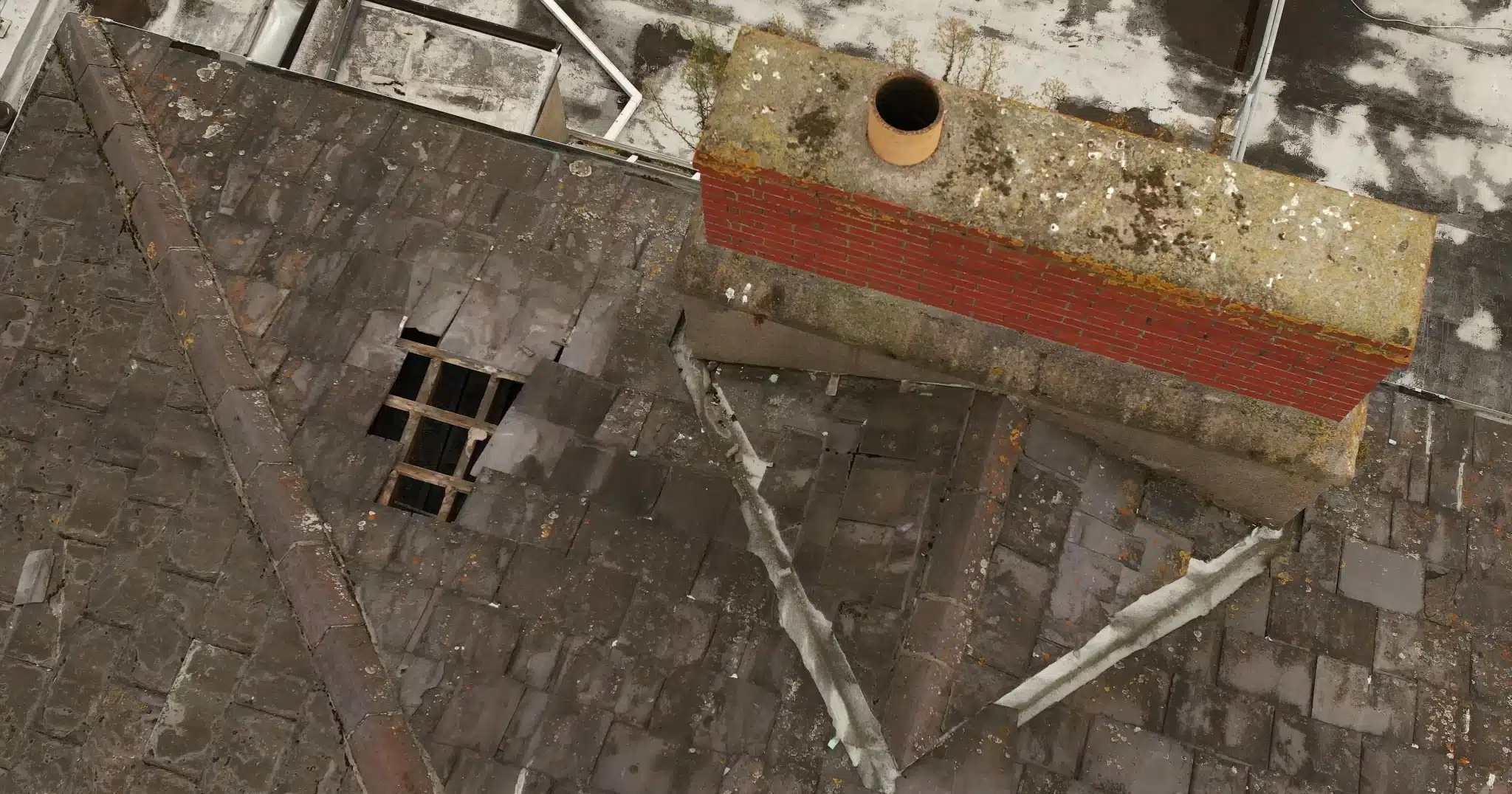
Insurance: where not inspecting gets expensive
Irish commercial property insurance policies – Aviva, Allianz, AXA, RSA, Zurich and the London-market specialists – share a common structural pattern. The policy will cover defined perils (fire, storm, escape of water, impact) subject to conditions and exclusions. Two conditions matter for routine roof inspection.
1. The “reasonable care” condition
Every commercial policy we have reviewed contains some version of a “reasonable care” or “duty of care” clause. The insured is required to take reasonable steps to maintain the insured property in good condition. This is not a guideline. It is a contract condition. If the insurer can demonstrate that a loss was caused or exacerbated by inadequate maintenance, they can reduce or deny a claim.
In practice, loss adjusters look for evidence of reasonable care after a claim is filed. If you have a documented quarterly inspection programme with timestamped imagery and defect logs, that evidence is trivial to produce. If you have nothing in writing, you are arguing from memory against a professional loss adjuster whose job is to minimise the payout.
2. The pre-existing damage exclusion
Storm damage claims in particular are aggressively scrutinised for pre-existing damage. If a section of membrane had already failed before the storm, the claim may be denied on the basis that the loss was not caused by the insured peril. Without pre-storm imagery, you cannot rebut this argument. You are relying on the insurer’s own post-loss inspection, and they have a financial incentive to find pre-existing faults.
Routine drone inspection turns this on its head. Pre-storm imagery – even just the last captured set – is definitive evidence of the roof’s condition immediately before the storm. A storm damage claim backed by “here’s what it looked like on 12 January; here’s what the storm on 15 January did” is settled very differently to one without.
The documentation trail
Most Irish commercial insurers now actively request maintenance records when writing new policies or renewing existing ones. Specifically, the questions that appear on large-commercial proposal forms include: how frequently is the roof inspected, and by whom; is a written record of inspections maintained; have any known defects been identified, and if so what is the remediation schedule. “No written record” is an answer that drives premiums up, sometimes substantially. For FMs managing multiple buildings, the cumulative premium impact of inspection documentation alone frequently exceeds the cost of the inspection programme.
If you commission drone inspections on a recurring schedule, ask the operator to provide PDF reports formatted for insurer submission. We include this as standard on all FM contracts – the report includes the GPS boundary, capture timestamps, the EASA operational authorisation reference, and a structured defect log that loss adjusters can consume directly. Our drone services for insurers page covers the adjuster-side workflow in more detail.

Historic and listed buildings – specific requirements
Irish law treats protected structures differently to ordinary commercial stock. If your portfolio includes any building on the local authority’s Record of Protected Structures (RPS), or within an Architectural Conservation Area (ACA), the stakes on routine roof inspection are higher on three dimensions.
1. Insurance
Heritage buildings are typically insured through specialist providers – Ecclesiastical Insurance Ireland, certain Lloyd’s syndicates and heritage-focused mutual schemes. These insurers apply stricter maintenance conditions than standard commercial cover. Policies frequently require:
- Annual building condition reports from qualified inspectors.
- Documented evidence of reasonable maintenance specific to heritage materials (slate, lead flashing, stone copings, timber gutters).
- Pre-approved remediation standards (original materials, traditional techniques).
- Immediate notification of any defect identified.
Failure to meet these conditions does not just risk claim reduction, it can lead to policy cancellation mid-term. We have seen this happen. A protected structure in the midlands had its policy cancelled after a broker audit found no documented roof inspections for three years. The owner was uninsurable with mainstream carriers for nine months while a specialist was sourced.
2. Planning and conservation
Most significant works to a protected structure require a Section 57 declaration from the local planning authority under the Planning and Development Act 2000, sometimes followed by a full planning application. Routine inspection does not trigger this, but documentation is expected. Conservation officers and council heritage officers prefer working with owners who have a photographic record of the building’s condition over time. A drone inspection archive spanning several years becomes a heritage maintenance record that supports any future works application and demonstrates care for the asset. See our heritage recording service for projects that combine condition inspection with full 3D documentation for conservation purposes.
For buildings within designated Architectural Conservation Areas, the same principle applies. An FM managing a portfolio with heritage elements should expect conservation officers to ask for maintenance records when reviewing planning applications on adjacent or future works.
3. Access – drones versus traditional methods
Traditional roof inspection on heritage buildings is disproportionately expensive and invasive. Scaffolding against a listed facade typically requires conservation-compliant methods, protective wrapping and often a Section 57 declaration just for the access infrastructure. Rope access on fragile slate or stone carries non-trivial risk of damage to original fabric. Cherry pickers are often impossible due to ground conditions, access constraints or proximity to the listed fabric.
A drone inspection avoids all of these issues. No contact with the building, no scaffolding permissions required, no disruption to visitor access (important for public heritage buildings), and captures typically complete within 30-45 minutes. We hold the EASA Specific Category authorisation required for flight near and above protected structures, and coordinate with the IAA for any operations requiring airspace clearance near controlled zones.
For portfolios with mixed heritage and modern stock, a standardised drone inspection programme is often the only cost-effective way to apply the same maintenance discipline across the entire portfolio. Heritage buildings get inspected at the same frequency and with the same evidence trail as modern units – which is usually the first time they have had that level of documented oversight. Our services for local authorities page covers similar considerations for council-owned heritage stock.
What a routine programme looks like
A well-designed FM drone inspection programme has three layers.
Scheduled periodic inspections. Quarterly for higher-risk and heritage buildings, bi-annual for standard commercial stock. Each visit produces the standard deliverable set. Visits are scheduled 12 months in advance so FM teams and building occupants know when to expect them.
Post-storm rapid response. Pre-agreed activation within 24-48 hours of named storms. Same deliverable set, compared against the most recent base capture. This is where most of the insurance value materialises – definitive before/after evidence that a specific storm caused specific damage.
Annual trend analysis. Once per year, a cross-portfolio review that compares all buildings against each other and against the previous year. Identifies patterns (e.g. a specific product or contractor whose work is failing across multiple buildings), prioritises capex for the next fiscal year, and feeds the insurance renewal conversation.
For a typical 10-building portfolio across Ireland, an annual programme looks like this: 4 visits per building × 10 buildings = 40 scheduled flights per year, approximately €14,000-€20,000 in direct inspection costs. Add post-storm callouts (typically 4-8 per year for Irish portfolios): €3,000-€6,000. Annual strategic review: €1,500-€2,500. Total €18,500-€28,500, against typical reactive maintenance and insurance outcome differentials of €40,000-€120,000 per portfolio per year. Most FM clients recoup the programme cost within the first avoided incident.
Frequently asked questions
How often should we inspect commercial roofs in Ireland?
The answer depends on building age and exposure. A five-year-old membrane roof with good drainage and low-exposure location can get by with annual inspection plus post-storm captures. A 25-year-old industrial unit on the west coast, or any building over 15 years old, should be on a quarterly schedule. Historic and listed buildings: quarterly minimum, often monthly during winter.
Can drones fly in bad Irish weather?
Flight thresholds are wind speeds below 35 km/h and no heavy rain. Light drizzle and overcast conditions are fine, and often produce better photogrammetric and thermal results than bright sun. If weather prevents a scheduled flight, we reschedule at no cost. Irish conditions typically allow 60-70% of scheduled dates to proceed on the planned day; the rest reschedule within the following week.
What airspace permissions do we need?
We handle all airspace permissions as part of the service. Most commercial roof inspections in Ireland are in uncontrolled airspace and require only standard EASA Specific Category operation under our existing authorisation. Dublin city centre, Cork city and sites near major airports (Shannon, Knock, Cork) require additional ATC coordination which we arrange in advance. No permissions work is required from the client.
We already have a roofing contractor on retainer – is this duplication?
No, it is complementary. Your roofing contractor is a specialist tradesperson. A drone inspection is asset assessment, not trade work. Most roofing contractors now request the drone inspection report before quoting remediation work because it saves them 2-3 hours of site survey time. The combination of drone inspection plus contractor remediation is faster and cheaper than contractor-led inspection alone.
What file formats do you deliver?
Full-resolution JPEG for imagery, GeoTIFF for orthomosaic maps, PDF for defect reports. Thermal imagery as radiometric TIFF and analysed JPEG. Raw files available on request for forensic analysis. All data is delivered via secure cloud link or SFTP to your nominated repository.
How do we submit inspection data to our insurer?
We format the PDF report to match typical insurer documentation standards – GPS boundary, capture timestamps, EASA operational authorisation reference, structured defect log, severity rating. Most Irish commercial insurers accept this format directly. If your insurer has a specific template, we can populate it.
Do historic buildings need a specialist drone operator?
Yes. For any protected structure or ACA building, you need an operator with EASA Specific Category authorisation for heritage-adjacent operations, and ideally with a documented track record of conservation-sensitive captures. We hold both, and regularly work on protected structures across Ireland including church roofs, heritage commercial, and publicly-owned listed buildings.
Can drone inspection reduce our insurance premium?
Often, yes. Many Irish commercial insurers offer 5-10% premium discounts for documented annual roof inspection programmes on mid-to-large commercial policies. The savings are typically larger on heritage and historic policies, where specialist insurers weight maintenance documentation heavily. Talk to your broker before your next renewal and reference the specific deliverables you will be receiving (frequency, thermal imagery, defect log, PDF report suitable for insurer submission).
Getting started
If you manage a portfolio of commercial or heritage buildings in Ireland and do not currently have a routine drone roof inspection programme, the best first step is a portfolio audit. Send us your building list (address, size, age, any known issues). We will come back within 48 hours with a recommended inspection schedule, a first-year cost estimate, and a prioritised list of buildings that should be captured first.
If you already have a maintenance contract or rope access provider, we are happy to review it. Often the right answer is a hybrid programme where drone captures replace the routine inspection visits and specialist contractors are engaged only for confirmed remedial work.
Get in touch for a free portfolio assessment. Call 087 205 2331 or send through our contact form. No obligation, no hidden costs, and we will send you sample inspection reports from three comparable buildings so you can see what the deliverable looks like before you commit. More on the underlying service: drone building and roof inspection.
Frequently asked questions
How often should we inspect commercial roofs in Ireland?
The answer depends on building age and exposure. A five-year-old membrane roof with good drainage and low-exposure location can get by with annual inspection plus post-storm captures. A 25-year-old industrial unit on the west coast, or any building over 15 years old, should be on a quarterly schedule. Historic and listed buildings: quarterly minimum, often monthly during winter.
Can drones fly in bad Irish weather?
Flight thresholds are wind speeds below 35 km/h and no heavy rain. Light drizzle and overcast conditions are fine, and often produce better photogrammetric and thermal results than bright sun. If weather prevents a scheduled flight, we reschedule at no cost.
What airspace permissions do we need for drone roof inspection?
We handle all airspace permissions as part of the service. Most commercial roof inspections in Ireland are in uncontrolled airspace and require only standard EASA Specific Category operation. Dublin city centre, Cork city and sites near major airports require additional ATC coordination which we arrange in advance.
Do historic buildings need a specialist drone operator?
Yes. For any protected structure or ACA building, you need an operator with EASA Specific Category authorisation for heritage-adjacent operations, and ideally with a documented track record of conservation-sensitive captures.
Can drone inspection reduce our commercial property insurance premium?
Often yes. Many Irish commercial insurers offer 5-10% premium discounts for documented annual roof inspection programmes on mid-to-large commercial policies. The savings are typically larger on heritage and historic policies, where specialist insurers weight maintenance documentation heavily.