Table of Contents
Both Can Achieve the Same Accuracy – the Difference Is in Cost, Speed, and Coverage
The question we hear most often from engineers and developers in Ireland is whether drone survey data is “as good” as a traditional ground survey. The short answer is yes, for the vast majority of projects. A drone topographic survey carried out by a certified operator using survey-grade equipment achieves the same ±5cm accuracy as a traditional survey team – at roughly 30–40% of the cost and in a fraction of the time.
But there are genuine cases where a traditional surveyor is the right choice. This guide covers both honestly, so you can make an informed decision for your specific project.
Where Drone Surveys Win
Speed
A drone can capture a 10-acre site in 30–45 minutes of flight time. Add ground control point setup and you are looking at a half-day site visit in most cases. A traditional survey team covering the same area might take 1–2 full days. For larger sites – 50 acres, 100 acres, or more – the difference becomes more pronounced. We have completed 300-acre surveys in a single day that would have taken a traditional team over a week.
Cost
Drone surveys typically cost 60–70% less than equivalent ground surveys. For a standard 5-hectare topographic survey, the difference can be thousands of euros. The savings come from reduced field time, fewer personnel required, and faster processing. For projects with tight budgets or where repeat surveys are needed (construction monitoring, earthworks progress), the cost advantage compounds significantly.
Data Density
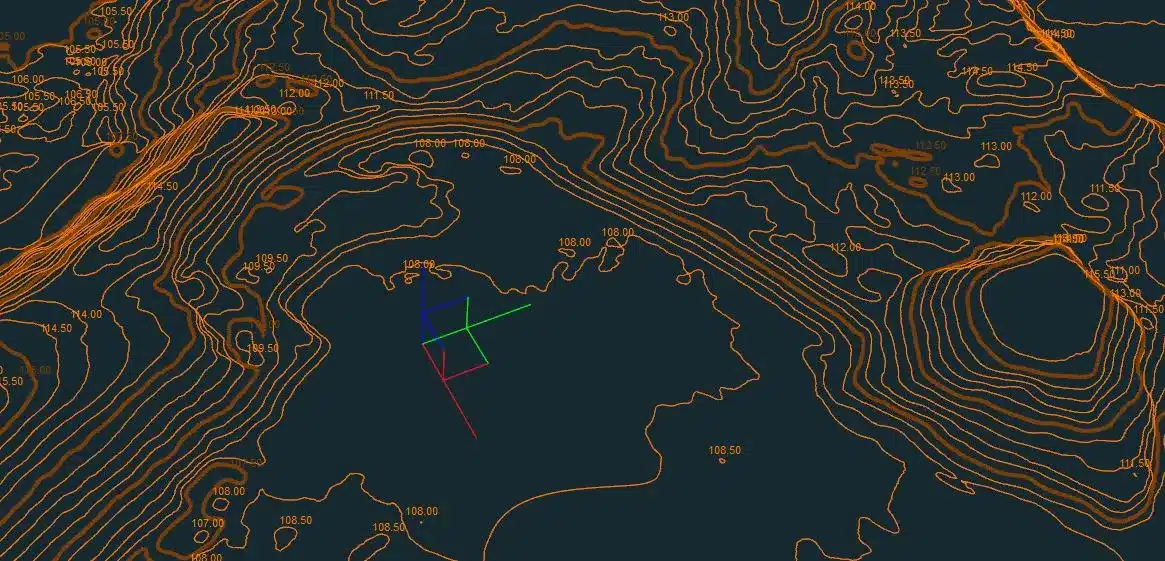
A traditional surveyor measures discrete points and specific features. A drone captures millions of points across the entire site in a single flight. This produces a continuous surface model rather than an interpolated one – every contour and spot level is derived from real data, not estimated between measured points. For earthworks calculations, drainage design, and 3D modelling, the additional data density is genuinely useful.
Visual Record
A drone survey automatically produces a high-resolution orthomosaic – a georeferenced aerial photograph of the entire site, accurate enough to take measurements from. This becomes a visual record of the site at the time of the survey, which is useful for documentation, insurance, planning applications, and stakeholder communication. A traditional ground survey produces no visual output.
Difficult Terrain
Steep slopes, waterlogged ground, active construction sites, and dense undergrowth are all obstacles for a survey team on foot. A drone flies over these conditions without difficulty. This can be the deciding factor on sites where traditional methods are genuinely unsafe or impractical.
Where Traditional Survey Is Still the Right Choice
Legal Boundary Surveys
Boundary surveys with legal standing must be carried out by a licensed surveyor. A drone can capture the physical features of a site precisely – walls, fences, hedges – but it cannot determine legal boundaries. If you are dealing with a boundary dispute, a title registration, or a land transfer, you need a licensed land surveyor regardless of how the data is captured.
Very Small Sites
For a single building footprint or a site under about half an acre, a traditional surveyor with a total station can often complete the work faster than the flight planning, ground control setup, and processing overhead of a drone survey. The crossover point is typically around half an acre to one acre, depending on complexity.
Sub-Centimetre Accuracy Requirements
While drone surveys consistently achieve ±5cm, some engineering applications require sub-centimetre accuracy on specific points – machine control for precision earthmoving, for example, or precise deformation monitoring of structures. For these applications, traditional total station or terrestrial laser scanning methods are more appropriate.
Dense Tree Canopy Over the Entire Site
Drone photogrammetry works from aerial images, so it can only capture what the camera can see from above. If your site is entirely covered by dense tree canopy, photogrammetric processing will model the top of the canopy rather than the ground beneath it. In this situation, drone LiDAR surveying is the solution – LiDAR pulses can penetrate gaps in the canopy to reach the ground, producing a bare-earth DTM even in heavily wooded areas. Drone LiDAR is more expensive than photogrammetry but significantly cheaper than terrestrial LiDAR or full ground survey in these conditions.
Accuracy Comparison: By the Numbers
To put the accuracy question in practical terms, here is how both methods perform against the requirements of common Irish survey applications:
- Topographic surveys for planning applications: Both meet requirements. ±5cm is more than sufficient for planning submissions to any Irish local authority.
- Earthworks volumetric calculations: Both meet requirements. ±5cm accuracy produces volumetric calculations within 1–2% tolerance for most stockpile and cut/fill scenarios.
- Road design and drainage: Both meet requirements. ±5cm ground levels are suitable for road and drainage design in the vast majority of cases.
- BIM existing conditions: Both meet requirements. ±5cm point cloud data is suitable for import into Revit, Navisworks, and similar BIM platforms as existing conditions reference.
- Setting-out: Traditional survey required. Setting-out (placing design points physically on the ground) requires a total station and a licensed surveyor.
- Legal boundary determination: Traditional survey required.
The Honest Summary
For the majority of topographic surveys, earthworks projects, planning applications, and construction monitoring applications in Ireland, a drone survey is the better choice – faster, cheaper, and with greater data density. The cases where traditional ground survey is genuinely necessary are narrower than most people assume: legal boundary work, sub-centimetre precision requirements, very small sites, and setting-out are the main ones.
If you are not sure which approach your project needs, send us the site location and a brief description of what the data will be used for. We will tell you honestly whether a drone survey is the right tool, and if a traditional survey is better suited, we will say so. We would rather give you the right answer than win the wrong job.
Contact us for a no-obligation quote or to discuss which survey method is right for your project.
Frequently asked questions
Is a drone survey as accurate as a traditional ground survey?
For topographic work on open ground, yes. A properly flown drone survey with RTK or PPK positioning and good ground control delivers 15 to 25 millimetre horizontal and 20 to 35 millimetre vertical accuracy, which is well inside the tolerance engineers need for earthworks, volumes, drainage and road alignment. For specialist tasks like monitoring a structure to sub-millimetre level, a total station or precise level is still the correct tool. Drone and ground survey are not rivals, they are complementary.
Where does drone survey save the most time and money against traditional methods?
On large, open or hazardous sites. A single drone flight can cover 20 to 40 hectares in a morning and capture every point on the surface, not just the points a surveyor chose to pick up. On quarries, solar farms, landfill sites, linear infrastructure and active construction, that typically means 60 to 80 per cent time savings against a ground crew, plus a full record of the site that you can measure again later without a revisit.
When is a ground survey still the better choice?
On small, cluttered or heavily vegetated sites where the cost of mobilising a drone outweighs the gain, on sites where a total station already needs to be on site for setting out, and on projects where sub-centimetre accuracy on specific control points is the whole deliverable. We tell clients honestly if a traditional survey is the right call. The goal is useful data, not selling drone hours.
Can drone survey data be handed directly to a civil engineer?
Yes. DSI delivers drone survey outputs in the formats Irish engineering consultancies already use: DWG and DXF for AutoCAD and Civil 3D, LandXML for Trimble and TBC, LAS and LAZ for point cloud workflows, and PDF and TIFF for orthomosaics and contour plans. The data lands in the same coordinate frame, with the same residuals report a ground survey would carry, so it slots straight into design without reprocessing.