Table of Contents
The problem with traditional stockpile measurement
If you’ve ever watched someone measure a stockpile with a tape and a formula, you know the drill. Walk around it, estimate the shape, plug numbers into a cone or wedge equation, and hope for the best. It’s rough. GNSS grid surveys are better – maybe 50 to 100 points on a large pile – but you’re still relying on interpolation to fill in everything between those points. On an irregular stockpile with steep faces and an uneven top, that interpolation can be way off.
What drone data actually gives you
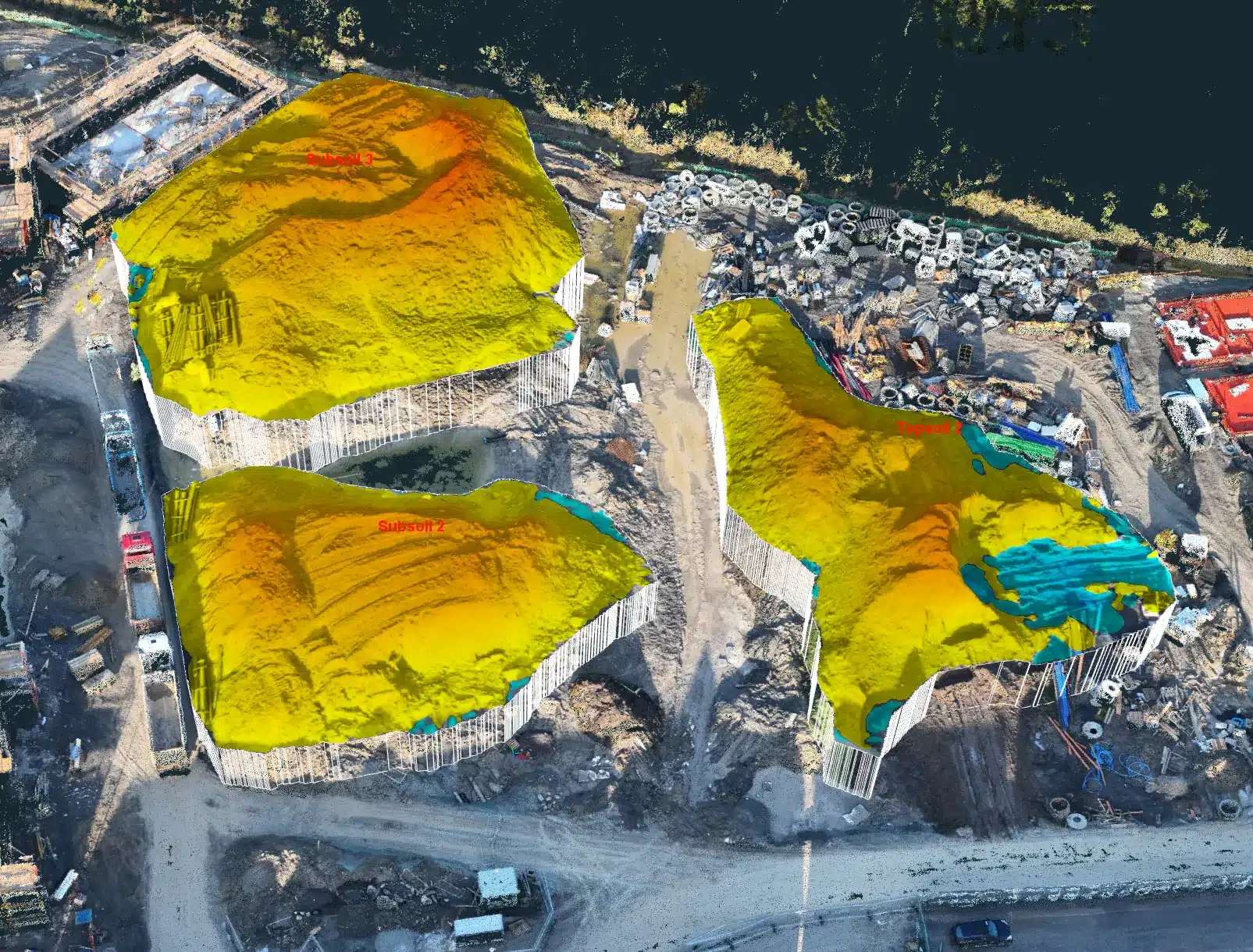
A drone volumetric survey captures the complete surface of every stockpile on site in one flight. Instead of 50 spot heights, you get millions of measured points – typically 100 to 500 per square metre. The digital surface model represents every contour, slope, and irregularity on the pile.
The accuracy difference is real
From our own project experience and independent testing:
- Volume accuracy within 1 to 3% of verified reference volumes, versus 5 to 15% with tape-and-formula methods
- Surface RMSE of plus or minus 3 to 5 cm with GCPs
- Repeated surveys of the same undisturbed pile produce volumes within 1 to 2% of each other – the measurement is repeatable
You get more than just a number
A traditional survey gives you one volume figure. A drone survey delivers:
- A georeferenced orthomosaic – a true-to-scale aerial photo of every pile, handy for identification and reporting
- A 3D surface model – full point cloud and mesh of each stockpile
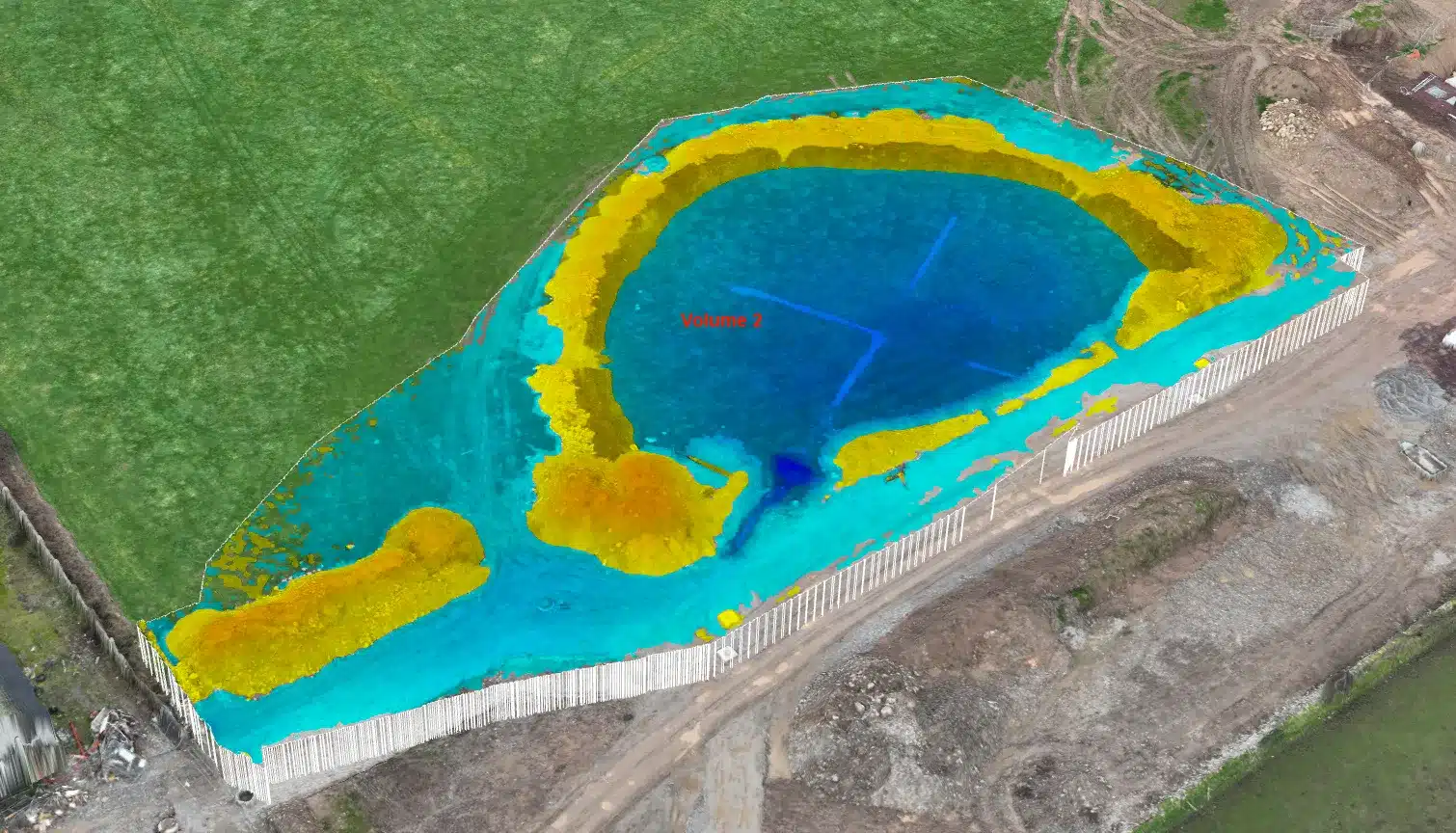
- Individual volume calculations, each pile labelled and measured with the base plane clearly defined
- A volume report with stockpile ID, material type (as you’ve labelled them), volume in cubic metres, and estimated tonnage at agreed bulk densities
- Colour-coded elevation maps showing pile heights – useful for spotting uneven settlement or degradation
Speed comparison
Traditional
A surveyor with GNSS measuring 10 to 15 piles on a busy quarry or depot needs most of a day. They have to work around active plant, observe safety exclusion zones, and physically walk around (or climb) each pile.
Drone
Same 10 to 15 piles, 20 to 40 minutes of flight time. No need to access the piles directly, no interference with site operations, no climbing anything. Results back within 2 to 3 working days.
When traditional methods still make sense
To be fair, there are times when a drone survey is overkill:
- One small, regular pile: If it’s a single neat cone of gravel, a quick GNSS survey is faster and cheaper
- Indoor stockpiles: Drone photogrammetry needs open sky. Piles inside sheds need terrestrial scanning or manual measurement
- Restricted airspace: Sites near airports may need specific authorisations that add lead time
For everything else – multiple piles, irregular shapes, regular measurement schedules, or sites where safety is a concern – the drone approach wins on accuracy, speed, and the richness of data you get back. More on our stockpile survey service and how we work with quarry operators.
Inventory reconciliation and auditing
If you’re holding significant material stock – aggregate suppliers, waste facilities, port terminals – regular drone surveys give you an objective, auditable record of what’s actually there. We have clients using this for:
- Monthly or quarterly inventory reconciliation
- Financial reporting and stock valuation
- Spotting discrepancies between dispatched/received quantities and measured stock
- Insurance valuations and claims
Several of our construction and quarrying clients have switched to scheduled drone surveys as their primary inventory audit tool. It’s replaced or supplemented the traditional QS visit.
Get a quote
Whether it’s a single depot or a network of material storage sites across Ireland, we can set up a measurement programme to fit your schedule and accuracy needs. Get in touch for a free consultation, or check our cost guide.