Table of Contents
How drone positioning actually works
When an engineer commissions a drone topographic survey, the accuracy of what they get back depends on how precisely the drone knew where it was when each photo was taken. Two technologies handle this: Real-Time Kinematic (RTK) and Post-Processed Kinematic (PPK). Both get you centimetre-level positioning, but they go about it differently, and the practical implications are worth understanding.
RTK in a nutshell
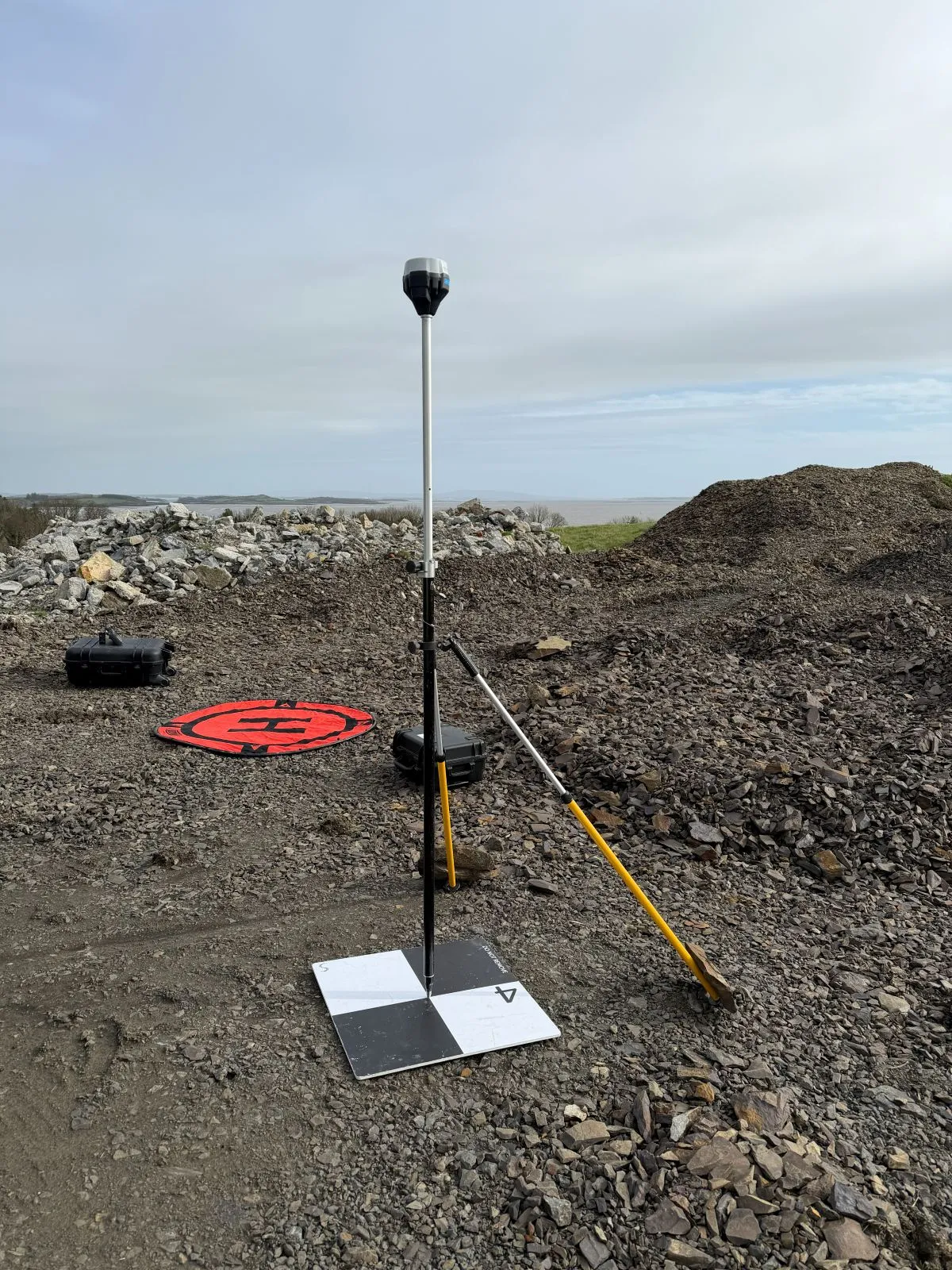
RTK corrects the drone’s GNSS position in real time during flight. A base station – either a physical unit on site or a virtual station from a CORS network like SMARTNET – sends correction data to the drone via radio or mobile data link. The drone applies corrections on the fly, hitting plus or minus 1 to 2 cm horizontal and 2 to 3 cm vertical while airborne.
What’s good about RTK
- You know during the flight whether positioning is working properly
- Image positions are already corrected – no GNSS post-processing needed
- Faster turnaround from flight to deliverable
What can go wrong
- If the correction signal drops – mobile blackspot, radio interference, too far from the base – the drone falls back to standalone GNSS accuracy (1 to 2 metres). Any images captured during that dropout are poorly positioned.
- You need either a physical base station in range or reliable mobile coverage for network RTK
- If corrections were poor during flight, you can’t fix it afterwards
PPK in a nutshell
PPK records raw GNSS observations on the drone during flight, with precise timestamps for each image. After landing, these raw observations get processed against base station data (from a site base or CORS network) using GNSS processing software. The corrections are applied retrospectively, and you get the same or better accuracy as RTK – typically plus or minus 1 to 2 cm horizontal, 2 to 3 cm vertical.
What’s good about PPK
- No data link needed during flight. This is the big one. The single biggest failure point of RTK is eliminated.
- Full control in post-processing – you can pick the best base station data, adjust parameters, verify solution quality after the fact
- Works everywhere, including remote sites, valleys, coastal areas, and anywhere mobile coverage is patchy
- Every image position can be checked and, if needed, re-processed
The downsides
- No real-time feedback – you don’t know during the flight if something went wrong with the GNSS. That only shows up in processing.
- An extra processing step before photogrammetry can begin
- You need base station data recorded simultaneously (though OSi CORS data is freely available in Ireland)
What we actually do
Our survey-grade platforms support both. Standard practice: we fly with RTK active and PPK recording at the same time. That gives us real-time confidence during the flight and a PPK safety net for any images where the RTK fix dropped or degraded. For anything that matters, we verify the GNSS solution quality in post-processing regardless.
Do you still need ground control points?
This is the question we get most. Short answer: for engineering work, yes – but fewer than without RTK/PPK.
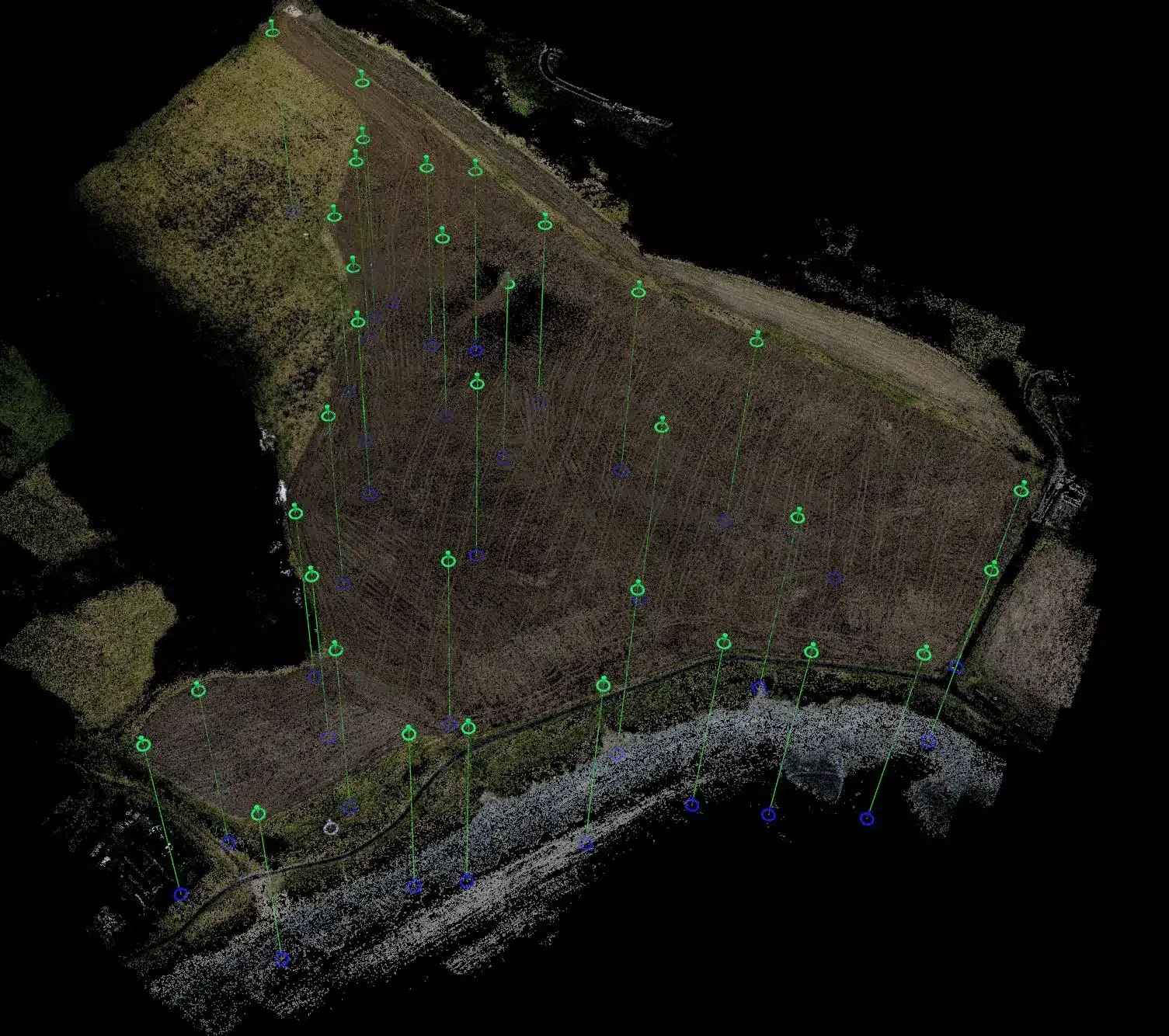
Direct georeferencing alone can hit plus or minus 2 to 3 cm without any GCPs. But for projects where the data feeds into design, earthworks calculations, or contractual measurement, we always recommend at least 3 to 5 GCPs as independent check points. They don’t need to be used in the photogrammetric adjustment – they’re there to independently verify that the survey accuracy meets your spec.
If you need the tightest accuracy (plus or minus 1 to 2 cm), GCPs are still necessary. They correct for residual systematic errors in the GNSS solution and the camera calibration. More on this in our accuracy guide.
Practical advice for engineers
When writing tender specs
Don’t specify RTK or PPK – specify the accuracy you need and let the operator figure out the methodology. “Achieve plus or minus X cm RMSE at independent check points” is technology-neutral and focuses on what actually matters.
When reading survey reports
Ask for the GNSS processing report showing fix quality for each image. In a PPK report, you want to see “Fixed” solutions (integer ambiguity resolved) on all images. “Float” solutions mean lower confidence and potentially reduced accuracy in those areas.
When comparing quotes
A cheaper quote using smartphone-grade GNSS with heavy GCP reliance can still produce good results, but it needs more ground survey and is more sensitive to GCP placement. Survey-grade RTK/PPK costs more in equipment but reduces the ground work. The right choice depends on site size, access, and how tight your accuracy spec is.
Need advice on the best approach for a specific project? Talk to our survey team.
RTK vs PPK head-to-head, with the DSI approach
Most comparison tables on the internet stop at two columns: what RTK does, what PPK does. That is not useful if you are trying to decide which approach to specify for an Irish engineering project. The table below adds a third column, the approach we actually run in the field on DSI projects, so you can calibrate a template against how it gets used on live work in Ireland.
| Factor | RTK (Real Time Kinematic) | PPK (Post-Processed Kinematic) | DSI approach on live projects |
|---|---|---|---|
| Correction timing | Applied to the drone position in real time, during the flight | Applied in the office after the flight, against a logged base file | We fly RTK for the live fix and log raw observations in parallel for PPK backup on every project |
| Connectivity requirement | Continuous NTRIP link required throughout the flight | No live connection needed, raw data is captured to the onboard log | NTRIP is used where stable, but our workflow assumes any rural Irish site may drop out mid-flight |
| Resilience to signal dropout | Affected positions degrade to standard GNSS accuracy until link is restored | Unaffected, raw log is corrected against the CORSnet base file in the office | If residuals show any RTK drift at all, we reprocess the flight through PPK and use that as the authoritative dataset |
| Typical horizontal accuracy | 15 to 30 mm with good NTRIP and ground control | 15 to 30 mm with good base file and ground control | 15 to 25 mm against check points on every DSI deliverable, documented in the residuals report |
| Typical vertical accuracy | 20 to 40 mm with good NTRIP and ground control | 20 to 40 mm with good base file and ground control | 20 to 35 mm against check points, with the residuals table attached to every survey report |
| On-site verification | Live fix status visible to the pilot, but the number can only be confirmed after processing | No live accuracy indicator, all verification happens after the flight | Every DSI flight is verified against independent check shots captured with a Trimble RTK rover before the pilot leaves site |
| Best use case | Sites with reliable mobile coverage where speed of processing matters | Rural and signal-marginal sites, and any project where the data has to be defended later | Both are available on every flight, and we pick the authoritative solution based on residuals, not on preference |
CORSnet, Malin Head and why the datum matters on Irish projects
The NTRIP correction source we rely on is Ordnance Survey Ireland’s CORSnet network, the national system of continuously operating reference stations. CORSnet corrections are referenced to the Irish Transverse Mercator grid and the Malin Head vertical datum (OSGM15 geoid model), which is the same coordinate framework Irish engineering consultancies work in for road design, drainage, land registry submissions, and planning applications. Using CORSnet as the correction source means our drone positions land directly in the frame the design team is already working in, with no datum shift, no local projection awkwardness, and no post-hoc coordinate gymnastics.
For an engineering-grade reference on where the technology sits in the Irish market, Engineers Ireland published a sponsored article on RTK drone mapping in March 2026 that covers the same ground at a higher altitude. If you want a second-source view for an internal briefing note or tender response, it is worth bookmarking.
Frequently asked questions
What is the practical difference between RTK and PPK for drone survey?
RTK corrects the drone’s position in real time using a live NTRIP feed, typically from Ordnance Survey Ireland’s CORSnet network or a local base station. PPK logs raw GNSS observations during the flight and applies corrections afterwards in the office. The end accuracy on a clean site is similar, but the failure modes are different. RTK depends on continuous connectivity throughout the flight. PPK does not need any live link at all.
Which is more reliable on Irish survey sites?
In rural Ireland, PPK is the safer workflow. Mobile coverage drops in and out of valleys, NTRIP corrections time out, and if the link fails mid-flight on an RTK-only setup you lose positional accuracy for the affected images. PPK captures every raw observation to the onboard log and we correct against the CORSnet base file back in the office, so a dropout has no effect on the final dataset. On urban and peri-urban work where coverage is solid, RTK is quicker to process.
How does DSI handle this on live projects?
We fly RTK for the live fix and log the raw PPK observations in parallel. If the NTRIP link is stable we use the RTK solution. If there is any dropout, corruption or visible drift in the residuals, we fall back to the PPK correction. This dual approach is the reason our survey residuals have held up in construction adjudication and planning appeals since 2016.
Do I need ground control points if I am flying RTK or PPK?
Yes, for any deliverable that has to be defended in front of an engineer, planner or quantity surveyor. RTK and PPK both give you very good relative and absolute positioning, but ground control is what lets you prove the accuracy figure. For survey-grade work we target four to eight photo-identifiable markers per hectare, distributed across the site and at a spread of elevations.
What is CORSnet and why does DSI use it?
CORSnet is the Ordnance Survey Ireland network of continuously operating GNSS reference stations. It provides network RTK corrections referenced to the Irish Transverse Mercator grid and the Malin Head vertical datum (OSGM15 geoid model), which is the coordinate framework Irish engineers and planners work in. Using CORSnet means our drone positions come out in the same frame as the rest of the design team’s data, with no awkward datum shift later.
Free reference · ungated
Drone Survey Deliverables: Guide for Engineers
12-page reference covering every file format, coordinate systems, file size expectations, and Civil 3D + Revit import walkthroughs. Print it, share it, keep it on your desktop.