Table of Contents
You can’t survey what you can’t see
Ireland’s climate means dense vegetation on any ground that hasn’t been managed for a few seasons. For engineers, planners, and environmental consultants, this is a constant headache: how do you map the ground surface when it’s buried under trees, scrub, or rushes?
Ground survey teams can work under canopy, but it’s slow, hard going, and limited by access and safety. Photogrammetric drone surveys are worse – the camera only sees the canopy top, so bare-earth mapping under vegetation is a non-starter. Drone LiDAR solves this because laser pulses pass through gaps in the canopy and hit the ground.
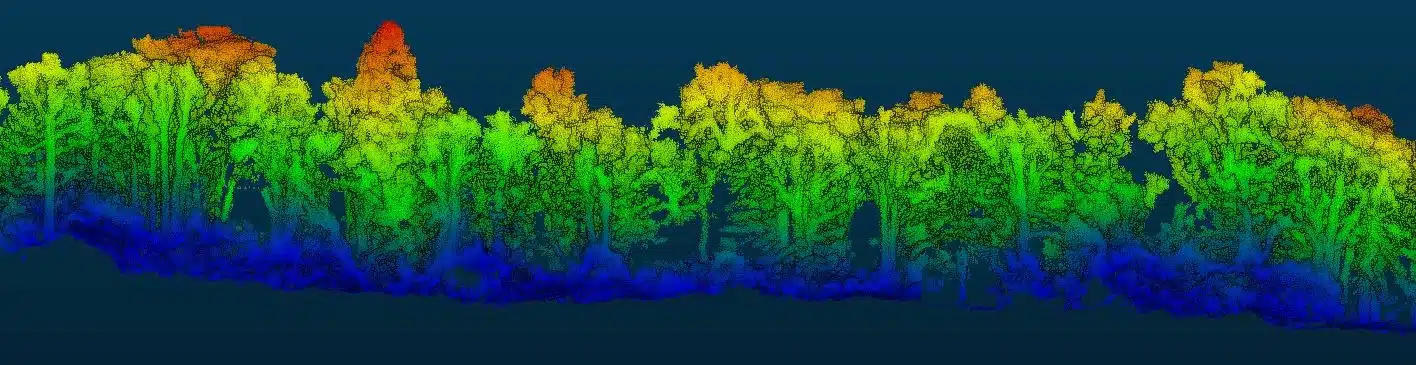
How it works
A drone LiDAR sensor fires hundreds of thousands of laser pulses per second. Each pulse is a narrow beam that travels downward. When it hits something – a leaf, a branch, the ground – part of the energy bounces back. The key thing: if the beam hits a partially transparent surface like a tree canopy, some energy reflects off the canopy while the rest continues downward and may reflect off surfaces below.
Modern sensors record multiple returns per pulse – typically 3 to 7 distinct returns. In woodland, a single pulse might give you:
- First return: top of canopy
- Middle returns: understorey, lower branches
- Last return: the ground
By classifying these returns, we separate ground from vegetation and produce a bare-earth DTM of the actual ground surface beneath the trees.
What penetration rates look like in Irish conditions
Deciduous woodland (leaf-off, November to March)
This is the sweet spot. With leaves gone, we typically get 60 to 80% of pulses through to the ground. Excellent point density for DTM generation.
Deciduous woodland (leaf-on)
Summer with full canopy drops penetration to 20 to 40% depending on species and density. Still enough for DTM generation in most cases, though ground point density is lower. Oak, ash, and beech are denser than birch or alder.
Coniferous plantation
Sitka spruce and the other conifers that dominate Irish commercial forestry are the toughest. In mature, closed-canopy stands, penetration runs at 10 to 30%. That’s workable for terrain modelling in many cases, but very dense mature plantation may need lower-altitude, higher-pulse-rate flights to get enough ground returns.
Scrub and gorse
Dense gorse – you see it everywhere on hillsides, bog margins, and abandoned farmland – is a hard surface for LiDAR. The tight interlocking branches act almost like a solid roof. We get 5 to 20% penetration, which means ground modelling through heavy gorse requires careful processing and may have some gaps.
Grassland and rushes
Long grass and rushes on wet agricultural land are effectively opaque to LiDAR. But the vegetation height is only 0.5 to 1.5 m, so the error from mapping the vegetation surface rather than ground is relatively small and can be estimated.

Where this gets used in Ireland
Forestry
Forestry surveys with LiDAR capture canopy height models (for timber volume estimation) and bare-earth DTMs (for access road design, drainage, and terrain assessment). Coillte and private forestry companies use this for planning harvesting, access routes, and replanting.
Flood risk assessment
OPW and local authority flood assessments need bare-earth DTMs for hydraulic modelling. In river corridors where riparian vegetation is heaviest, LiDAR is the only practical way to get accurate ground levels. The data feeds directly into MIKE, Tuflow, and HEC-RAS models.
Archaeological survey
LiDAR has been a game-changer for archaeology. Ground features hidden under vegetation – ringforts, field systems, earthworks, medieval settlements – show up clearly in LiDAR-derived hillshade models. Several notable archaeological discoveries in Ireland have come from LiDAR data analysis.
Power line and utility corridors
Electricity transmission line surveys need both conductor positions and vegetation clearance distances. LiDAR captures the line geometry and surrounding vegetation in one flight, enabling clearance analysis and encroachment risk identification. ESB Networks and EirGrid projects use drone LiDAR regularly for this.
Renewable energy
Wind and solar farm sites often involve terrain assessment on hillsides and farmland with varying cover. LiDAR gives you the bare-earth DTM for foundation design, access road routing, and cable trench design, even when the site is vegetated.
When to fly
For maximum penetration on deciduous sites, survey during the leaf-off period (November to March). For conifers, timing doesn’t matter much – the canopy is dense year-round.
If you need both vegetation assessment and ground survey (forestry inventory, for example), a leaf-on survey captures canopy structure and ground surface in the same flight – though with reduced ground penetration.
Talk to us
If your project involves surveying under vegetation – engineering design, flood modelling, forestry, archaeology, whatever it is – get in touch and we’ll advise on timing, expected penetration for your site, and deliverable formats. More on our LiDAR capabilities and equipment.
Vegetation type, survey timing and expected LiDAR performance
The table below is the working reference we use internally at DSI when scoping a drone LiDAR job on vegetated Irish ground. It is compiled from our own field experience since 2016 across forestry, archaeological, flood risk and utility projects, and it is the closest thing to an Irish ground-truth guide for drone LiDAR penetration that we have seen in the market.
| Vegetation type | Recommended survey timing | Expected ground return rate | Expected vertical accuracy on bare earth |
|---|---|---|---|
| Mature deciduous canopy (oak, ash, beech, birch) | November to March, leaf-off | 25 to 40 per cent | 30 to 50 mm |
| Mature deciduous canopy, leaf-on | Avoid for DTM work if possible | 5 to 15 per cent | 60 to 120 mm, quality depends on understorey |
| Dense conifer plantation (Sitka spruce, Norway spruce) | Year-round, performance is similar | 10 to 20 per cent | 50 to 100 mm |
| Mixed woodland | November to March for DTM priority | 20 to 35 per cent | 40 to 70 mm |
| Scrub, gorse and bracken | Year-round, winter preferred | 40 to 60 per cent | 30 to 50 mm |
| Rough grazing, heath, bog and cutaway | Year-round | 70 to 90 per cent | 20 to 35 mm |
| Improved grassland and pasture | Year-round | 90 to 100 per cent | 20 to 35 mm |
| Bare earth, stripped ground, quarry and stockpile | Year-round | Near 100 per cent | 15 to 30 mm |
For flood risk, drainage design and any catchment-scale DTM work, the practical implication is simple: where the programme allows it, schedule flights between November and March. Leaf-off conditions move deciduous woodland from almost unusable for DTM work to solid 30 to 50 millimetre vertical performance, which is the threshold at which drone LiDAR becomes the better tool than the national OPW dataset.
Real Irish client contexts: who commissions this work
Drone LiDAR through vegetation is a niche capability, and the clients who commission it fall into a few recognisable groups. Naming them helps engineers and planning consultants recognise when they need this service.
- Coillte, the state forestry company, commissions drone LiDAR for forest road design, wind farm access corridor planning, harvesting planning and catchment-scale biomass surveys. Irish forestry is one of the cleanest fits for drone LiDAR work because the alternative is physically walking the stand with a total station, which is slow, dangerous and produces far less information.
- NPWS (National Parks and Wildlife Service), working through the Department of Housing, Local Government and Heritage, commissions drone LiDAR for archaeological prospection, habitat mapping and condition monitoring on protected sites. Drone LiDAR is how hidden ringforts, field systems, fulachtaí fia and medieval boundaries get found under mature vegetation on Irish ground, and it is now a standard tool alongside traditional archaeological field survey.
- Engineering consultancies on OPW arterial drainage projects, where the reach of the works is bounded by hedgerow, riparian vegetation and tree cover. Drone LiDAR produces the bare-earth DTM that Section 50 consent applications rely on, in a single flight, with the full vegetation canopy logged as a separate classification that can be used for ecological impact assessment alongside the drainage design.
- Private clients on forested or heavily vegetated landholdings who need a topographic survey for planning, design or property transaction purposes, where a ground crew with a total station would take weeks and still miss whole sections of the property.
For a worked Irish example of drone LiDAR used to find buried archaeology under mature vegetation, our Loughmain Ringfort case study on the blog documents exactly what the bare-earth model delivered on a real site, and what traditional field survey would have missed entirely.