Table of Contents
The Short Answer: ±5cm – When Done Correctly
A properly executed drone survey in Ireland achieves ±5cm horizontal and vertical accuracy. That means every point in the delivered dataset is within 5 centimetres of its true ground position. For most construction, engineering, and planning applications, this matches or exceeds the accuracy produced by a traditional ground survey team using total stations and levelling equipment.
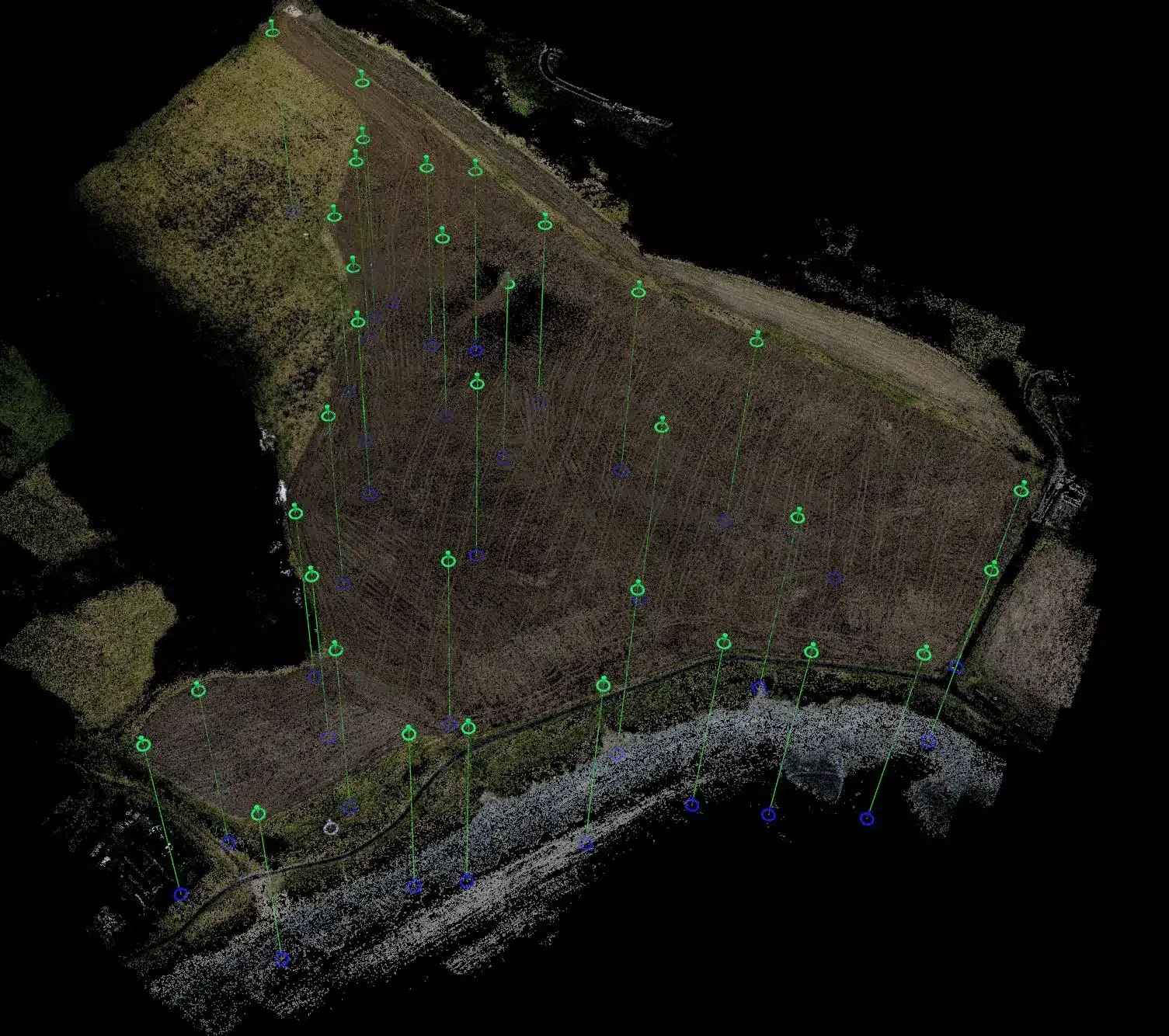
 ground control points plotted on site Ireland” loading=”lazy” style=”width:100%;height:auto;border-radius:8px;margin:24px 0;”>
The caveat is important: when done correctly. Drone accuracy is not automatic. It depends on the right combination of equipment, ground control methodology, and processing workflow. This guide explains what that means in practice, so you know what to ask before hiring any drone survey company.
What Controls Drone Survey Accuracy?
Four factors determine how accurate your drone survey data will be:
1. GNSS Positioning Method (RTK or PPK)
Consumer drones use basic GPS, which is accurate to a few metres – nowhere near survey grade. Survey-grade drones use RTK (Real-Time Kinematic) or PPK (Post-Processed Kinematic) GNSS technology to achieve centimetre positioning.
- RTK corrects the drone’s position in real time during the flight, using a correction signal from a base station.
- PPK applies the same corrections after the flight, using raw GNSS data logged during the flight and matched against base station records.
Both methods achieve similar accuracy. RTK is more immediate; PPK is more reliable in areas where radio signal is unreliable. Serious survey companies use both, with physical ground control points to verify the result.
2. Ground Control Points (GCPs)
Ground control points are pre-measured reference markers placed on the ground before the flight. A survey-grade GNSS receiver – typically an RTK base and rover unit like an Emlid RS3 – is used to measure each GCP to sub-centimetre accuracy. During photogrammetric processing, the software identifies these GCPs in the aerial images and uses them to anchor the 3D model to real-world coordinates.
Without GCPs, even an RTK drone can produce datasets with systematic errors of 5–20cm or more. With properly placed and measured GCPs, you consistently achieve ±5cm. The number of GCPs needed depends on site size: typically 5–8 for a 10-acre site, positioned at the perimeter and centre for optimal geometric correction.
3. Camera and Flying Height
Accuracy also depends on the resolution of the aerial imagery. A higher-resolution camera flown at lower altitude produces a smaller Ground Sample Distance (GSD) – the size of the area represented by one image pixel. For ±5cm survey accuracy, you typically need a GSD of 2–3cm. A 45-megapixel full-frame camera like the Zenmuse P1 flown at 60m altitude achieves this comfortably. Consumer cameras or phones do not.
4. Photogrammetric Processing
Raw aerial images are processed through photogrammetry software (typically Agisoft Metashape Professional or DJI Terra) to reconstruct the 3D model. The quality of this processing – including how well GCPs are identified, how the point cloud is classified, and how the final outputs are checked – determines whether the theoretical accuracy is actually achieved in the delivered data.
A credible drone survey company will provide a survey report showing the RMSE (Root Mean Square Error) against GCPs and independent check points, so you can verify the accuracy yourself rather than taking it on trust.
Drone Survey Accuracy vs. Traditional Ground Survey Accuracy
Both methods, done correctly, achieve ±5cm. The difference is in cost, speed, and the type of data produced.
A traditional survey team with total stations and levelling equipment will typically measure discrete points and lines – the surveyor walks the site and measures specific features. A drone survey captures millions of points across the entire site simultaneously, producing a continuous surface model. For topographic surveys, earthworks calculations, and large-site coverage, the drone approach is faster and more thorough.
Where traditional survey has an advantage is in very small sites (a single building footprint), areas under dense tree canopy (where LiDAR is needed instead of photogrammetry), and legal boundary surveys, which require a licensed land surveyor regardless of the data capture method.
Accuracy Requirements for Common Irish Survey Types
Topographic surveys for planning applications
±5cm is more than sufficient. Local authorities across Ireland accept drone topographic survey data for planning submissions without qualification. The data is delivered in Irish Transverse Mercator (ITM) and compatible with all standard design software.
Construction setting-out
Setting-out (placing physical stakes at exact design positions) requires a licensed surveyor and a total station – this is not a drone survey task. But a drone topographic survey provides the existing conditions data that design engineers need before setting-out begins.
Earthworks volumetrics
±5cm accuracy produces volumetric calculations accurate to within 1–2% for most stockpile and cut/fill scenarios. This is within the tolerance range accepted by most quantity surveyors and project managers for tender and payment purposes.
BIM and digital twin applications
±5cm point cloud data is suitable for use as existing conditions reference in Revit, Navisworks, and similar BIM platforms. For detailed structural modelling of individual building components, closer-range photogrammetry or terrestrial laser scanning may be needed.
How to Check if a Drone Survey Company Is Actually Achieving ±5cm
Ask three questions before commissioning a drone survey:
- How many GCPs will you place, and how will you measure them? The answer should specify a survey-grade GNSS instrument and a minimum of 5 GCPs for a small site.
- Will you provide a survey report showing RMSE on independent check points? Check points are GCPs not used in the model processing – they provide an independent verification of accuracy.
- What software and methodology do you use for processing? Professional-grade photogrammetry software and documented methodology are signs of a serious operator.
If a company cannot answer these questions clearly, the ±5cm figure is marketing rather than measurement.
Summary
A properly controlled drone survey consistently achieves ±5cm accuracy when carried out by qualified operators using survey-grade equipment, proper GCP methodology, and professional photogrammetric processing. This meets the accuracy requirements for the majority of topographic, construction, planning, and volumetric survey applications. The accuracy is not automatic – it requires the right workflow – but when done correctly, drone survey data is every bit as reliable as traditionally acquired survey data, and significantly faster and more cost-effective to produce.
If you would like to discuss the accuracy requirements for a specific project, contact our survey team and we will confirm whether drone survey is the right approach for what you need.
Frequently asked questions
How accurate is a drone survey in real working conditions?
On a typical DSI project using RTK positioning, ground control points and a calibrated sensor, we deliver horizontal accuracy of 15 to 25 millimetres and vertical accuracy of 20 to 35 millimetres against independent check shots. That is the figure we are comfortable writing into a survey report. Results depend on ground control density, flight altitude, GNSS conditions and the state of the site, so we always cross-check a sample of points with a total station or RTK rover before sign-off.
What accuracy can I expect without ground control points?
Network RTK alone can get you into the 30 to 50 millimetre range horizontally on a good day, but vertical accuracy drifts without check shots, and there is nothing to prove the result if a figure is challenged. For any project where the numbers matter (earthworks payments, planning submissions, flood risk design) we always place ground control, usually four to eight targets per hectare, and we log the coordinates so the survey can be audited later.
Is drone survey accuracy good enough for engineering design?
Yes, for the majority of civil and infrastructure work. Drone photogrammetry and drone LiDAR both sit comfortably inside the tolerances set out for topographic surveys in the TII and Irish Water standards we work to. The exception is specialist tasks like monitoring structural deflection at millimetre level, where terrestrial scanners or precise levelling are still the right tool.
How do you prove the accuracy figure on a DSI survey report?
Every DSI survey includes a residuals report. That is a table of the check points we held back from the processing, showing the difference between the known coordinate and the surveyed coordinate on each axis. Engineers and quantity surveyors can read it, verify it, and attach it to their own deliverables. We have been running this format on Irish projects since 2016 and it is what regulators and adjudicators look for when a figure is questioned.