
Table of Contents
Why getting cut-and-fill right matters
On any earthworks contract, the volume numbers drive the money. A 5% error on a medium road scheme can mean tens of thousands of euro in over- or under-payment. That’s not a rounding error anyone wants to explain at final account stage.
Cut-and-fill measurement disputes are the single biggest cause of Irish construction adjudication claims. The 8th Annual Report of the Construction Contracts Adjudication Panel Chairperson records 101 annual adjudicator appointments covering €227.7 million in disputed value over the 2019 to 2024 period. Most of those disputes start with earthworks quantities that nobody on site had a defensible way to prove. That is the problem drone cut-and-fill surveys were built to solve.
Traditional methods – total station cross-sections or GNSS grid surveys – capture a limited number of spot heights. The gaps between those points get filled by interpolation, and interpolation is just educated guessing. Drone topographic surveys change this fundamentally. Instead of a few hundred spot heights, you’re working with millions of measured surface points. The terrain model actually looks like the ground, not a smoothed approximation of it.
How we do it
1. Baseline survey (before anything moves)
Before earthworks start, we fly the site to capture existing ground levels. GCPs get placed and surveyed with GNSS to tie everything to ITM coordinates and Malin Head datum. This DTM becomes the contractual baseline – the surface everything gets measured against.
2. Progress surveys
At agreed intervals, usually monthly or at programme milestones, we come back and re-survey. Each progress survey captures the current surface and compares it against the baseline (or design surface) to calculate how much has been moved. These numbers feed directly into interim payment certs and earthworks tracking.
3. Final survey (as-built)
When earthworks are finished, the final drone survey confirms whether formation levels match design. Any discrepancies get identified and measured before the contractor packs up. That avoids the “he said, she said” at final account.
The technical workflow
Here’s what we actually do on a cut-and-fill project:
- GCP placement: Minimum 5 for sites under 5 hectares, roughly 1 per 2 hectares beyond that, plus independent check points
- Flight planning: Typically 60 to 80 m altitude with 75% frontal and 65% side overlap, giving us 1.5 to 2.5 cm/pixel
- Positioning: Our survey-grade drones use RTK or PPK, with GCPs providing independent accuracy verification
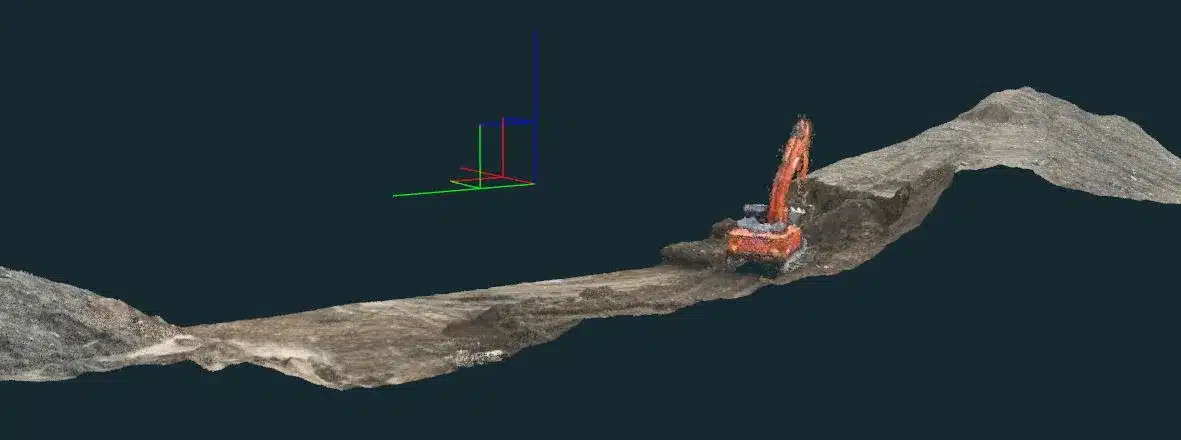
- Processing: Structure-from-Motion photogrammetry generates a dense point cloud. We classify it to isolate ground points from vegetation, machinery, and temporary works
- Surface generation: A TIN surface from the ground-classified points
- Volume calculation: Cut and fill computed by comparing surfaces – baseline vs current, or current vs design
The accuracy you can rely on
On a properly controlled survey with GCPs over exposed ground, here’s what we achieve:
- Surface accuracy: plus or minus 3 to 5 cm RMSE vertically on bare earth and formation
- Volumetric accuracy: Typically within 1 to 3% of traditionally surveyed volumes on open sites
- Point density: 100 to 500 points per square metre, compared to maybe 1 point per 5 to 25 square metres with GNSS grid surveys
The volumetric advantage comes down to point density. Where a traditional survey captures 200 spot heights across a hectare, we capture millions. That eliminates the interpolation errors that creep into cross-section methods, especially on undulating or complex ground. More detail in our accuracy guide.
Common mistakes that affect cut-and-fill accuracy
After hundreds of earthworks projects, I can tell you the biggest source of error isn’t the drone or the software. It’s the assumptions made during processing. Here are the issues we see most often:
Vegetation bias. If ground classification isn’t done properly, grass and scrub get included in the surface model. On a site with 300mm of rough grass, that’s 300mm of phantom “fill” across the entire area. We manually check classification on every project and use LiDAR on vegetated sites where photogrammetry would struggle to distinguish ground from vegetation.
Insufficient GCP density. We’ve seen operators deliver cut-and-fill data from flights with no ground control at all, relying on RTK positioning alone. RTK gives you good relative accuracy within a single flight, but without GCPs you can’t verify the absolute accuracy or detect systematic shifts. On earthworks where money changes hands based on volume numbers, that’s not a risk worth taking.
Timing mismatch. If your baseline survey was flown in October and the “before” design surface was drawn from a survey done the previous March, six months of erosion, settlement, or site activity might have changed the ground. We always recommend the baseline flight happens as close to the earthworks start date as practically possible.
Ignoring soft ground. On peatland or waterlogged sites, the surface can compress under the weight of machinery before any material is actually removed. A 200mm settlement across a hectare shows up as 2,000 cubic metres of phantom “cut” in the volume report. On sites with known soft ground, we flag this and recommend a geotechnical assessment alongside the survey data.
Drone vs traditional for earthworks
Speed and disruption
A 10-hectare site that might take a two-person survey team 2 to 3 days with GNSS can be flown in about 45 minutes. The contractor doesn’t need to stop work during the flight (though we ask that moving plant stays clear of the survey area). Results are typically back within 2 to 3 working days.
Safety
Nobody needs to walk into active excavations, stand near live traffic, or work on unstable slopes. On sites governed by the Safety, Health and Welfare at Work (Construction) Regulations, that’s a genuine practical advantage.
Cost
For sites over about 2 hectares, drone surveys generally cost less than traditional methods for volume calculations. The break-even depends on site complexity and access.
What you receive
For cut-and-fill projects, we deliver:
- Georeferenced point cloud (.LAS) in ITM coordinates
- Digital Terrain Model / TIN surface (.DWG / .XML) for Civil 3D or TBC
- Orthomosaic base map (.TIFF)
- Cut-and-fill volume report with colour-coded heat maps
- Comparison surfaces showing depth of cut/fill across the site
- Survey accuracy report with RMSE at check points
For ongoing monitoring projects, we include a cumulative volume tracking spreadsheet so you can track progress survey-over-survey and certify interim payments straightforwardly.
Where drone volumetrics works best
- Road schemes and site development earthworks
- Quarry and borrow pit volume tracking
- Stockpile measurement
- Landfill void space calculations
- Flood relief scheme earthworks under local authority and OPW contracts
If you’ve got earthworks to measure, give us a shout for a free consultation and quote.
Worked example: a 14 hectare site development in the Midlands
To make the accuracy figures concrete, here is a recent DSI project reduced to the numbers a quantity surveyor or site engineer can check.
- Site area: 14.2 hectares of greenfield stripped for a commercial development.
- Flight setup: DJI Matrice 4 Enterprise, RTK with parallel PPK logging against CORSnet, 85 metre flight altitude, 80/70 overlap.
- Ground control: 72 photo-identifiable targets distributed across the site and across the full elevation range, coordinated with a Trimble RTK rover on a 2 second occupation each.
- Data captured: baseline DTM before strip, progress DTM after 9 days of work, as-built DTM at week 4.
- Volume calculated: 41,850 cubic metres of cut and 38,620 cubic metres of fill, net export of 3,230 cubic metres.
- Accuracy achieved: 18 millimetres horizontal and 24 millimetres vertical against 12 independent check shots held back from the control set, documented in the residuals report that went with the delivery.
- Time on site: 3 hours per flight. The equivalent ground survey for the same density of points would take a two-person total station crew roughly 4 to 5 days per survey round, which is the figure we benchmarked against on a previous phase of the same project.
- What the client did with it: the volume figures fed directly into an interim payment application to the main contractor, backed by the residuals report. The application was certified without challenge. That is the practical test of a survey: can the number be defended in front of a quantity surveyor who is looking for a reason to reduce it.
Frequently asked questions
How accurate are drone cut-and-fill surveys compared to a traditional crew?
With ground control and RTK or PPK positioning, DSI delivers 15 to 25 millimetre horizontal and 20 to 35 millimetre vertical accuracy on cut-and-fill projects, measured against independent check points held back from the processing. A traditional total station crew working at survey-grade will match that on the specific points they pick up, but a drone survey captures every point on the surface rather than a selected sample, which is what kills disputes over missed gullies, soft spots and vegetation bias.
How often should earthworks be surveyed during construction?
On a typical Irish site we recommend a baseline survey before any strip begins, a progress survey at every major milestone or at least monthly on active phases, and an as-built survey before sign-off. The cost of a single dispute over a missing progress figure is an order of magnitude higher than the cost of a second flight. Monthly is the industry norm we see on OPW, TII and private commercial work we support.
Will drone volume figures hold up in a construction adjudication?
Yes, when the survey is documented correctly. Adjudicators under the Construction Contracts Act 2013 look for four things: a qualified operator, a date-stamped flight log, a residuals report against check points, and coordinates in a recognised Irish frame (typically Irish Transverse Mercator and the Malin Head vertical datum (OSGM15 geoid model)). Every DSI cut-and-fill survey is delivered with all four, and our data has been cited in Irish adjudication proceedings since 2016.
What are the most common mistakes that ruin a cut-and-fill survey?
Four failures cause most disputes in our experience. Vegetation bias, where the top of grass or low scrub is mistaken for ground level. Insufficient ground control, especially at the elevation extremes of the site. Timing mismatch, where the survey and the payment application are weeks apart and the site has moved. And soft ground, where the machine tracks compress the surface between flights and the DTM shifts. All four are solvable with good field practice and an honest methodology statement on the deliverable.
Free reference · ungated
Drone Survey Deliverables: Guide for Engineers
12-page reference covering every file format, coordinate systems, file size expectations, and Civil 3D + Revit import walkthroughs. Print it, share it, keep it on your desktop.