Table of Contents
A vague spec gets you vague quotes
We’ve tendered on plenty of drone survey specifications over the years. The good ones are clear and specific. The bad ones say something like “provide drone survey of the site” and leave everything to interpretation. When that happens, you get wildly different prices, wildly different scopes, and no way to compare submissions fairly. Then the cheapest bid wins and delivers something nobody can actually use.
Writing a proper drone survey specification isn’t complicated. Here’s what to include.
What your specification needs to cover
1. Survey area and boundaries
Define the area precisely. Give tenderers a boundary polygon – shapefile, KML, or coordinates – rather than a verbal description. Include:
- Total area in hectares
- Buffer zones beyond the site boundary, if needed
- Any areas requiring higher detail (existing structures, utility corridors)
- Areas to be excluded (restricted zones, private land without access)
2. Accuracy requirements
Use numbers, not adjectives. “High accuracy” means different things to different people. Specify RMSE values:
- Horizontal: Typically plus or minus 2 to 5 cm RMSE for engineering work
- Vertical: Typically plus or minus 3 to 5 cm on hard surfaces, 5 to 10 cm on vegetated ground
- Ground Sample Distance: Maximum pixel size (e.g. 2 cm or less for detailed survey, 5 cm or less for broader coverage)
Our article on drone survey accuracy covers what’s realistically achievable.
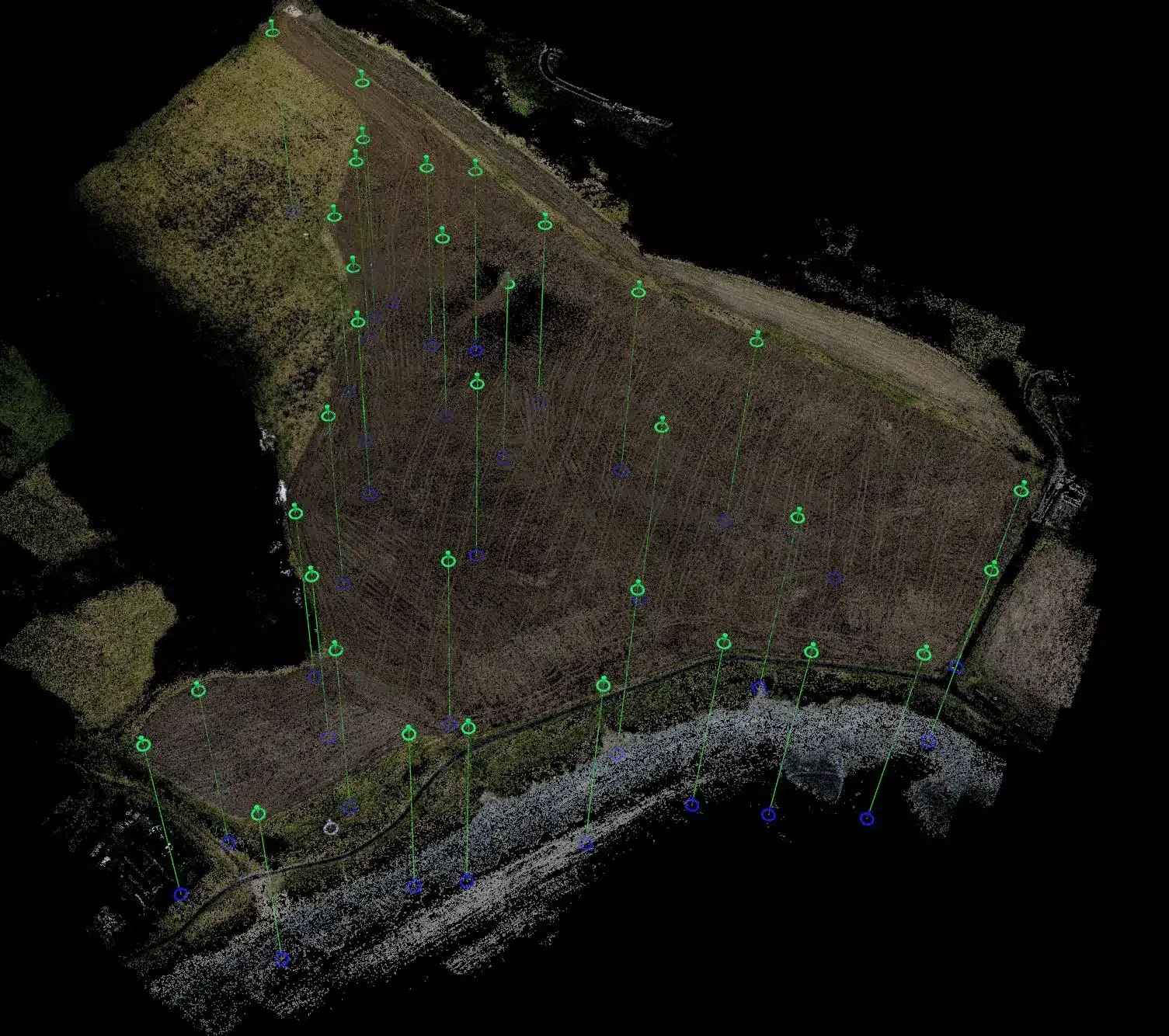
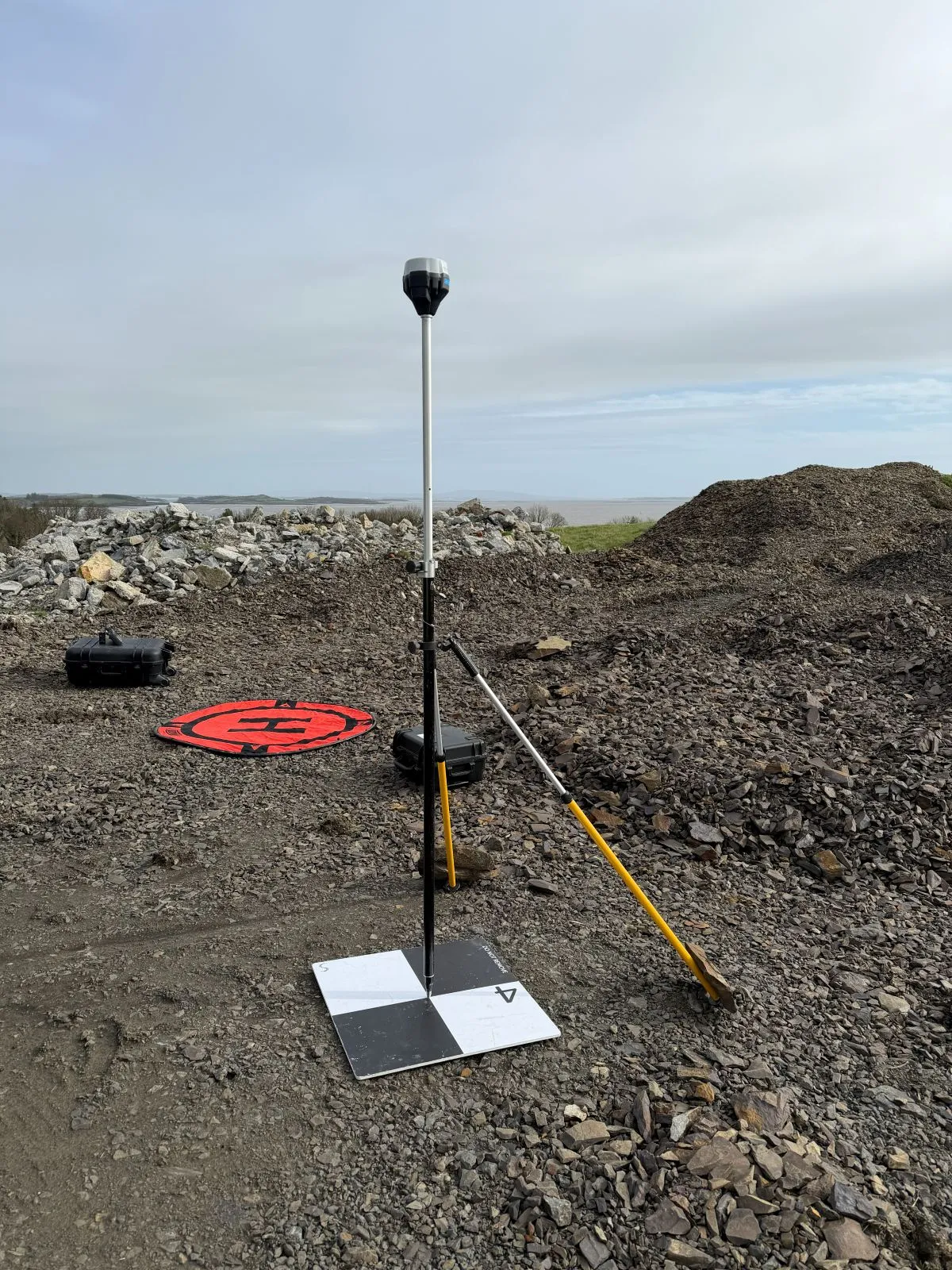
3. Ground control
State whether the survey operator establishes GCPs or whether you’ll provide them. Specify:
- Minimum number of GCPs and their distribution
- Number of independent check points for accuracy verification
- Coordinate system (typically ITM / IRENET95 for Irish projects)
- Height datum (Malin Head OD or Poolbeg OD)
- Connection to existing control on site (benchmark details)
4. Deliverable formats
Be explicit. “Survey data” is not a deliverable. Specify exactly what you need:
- Point cloud: .LAS or .LAZ, with classification requirements (ground, vegetation, buildings, noise)
- Digital Terrain Model: .DWG, .XML (LandXML), or .TIFF raster – specify grid resolution if raster
- Digital Surface Model: Same options, if required
- Orthomosaic: GeoTIFF, with resolution requirement
- Contour drawing: .DWG with specified intervals (e.g. 0.25 m minor, 1.0 m major)
- Cross-sections: .DWG at specified chainages and intervals
If your team uses AutoCAD Civil 3D or Trimble Business Center, say so. It lets the operator optimise the deliverables for direct import.
5. Survey report
Require a report covering:
- Equipment used (drone, camera, GNSS gear)
- Flight parameters (altitude, overlap, number of images)
- GCP coordinates and observation details
- Processing methodology and software
- Accuracy assessment with RMSE at check points
- Any limitations or areas where the spec wasn’t fully achieved
6. Operator qualifications
For Irish projects, the minimum requirements:
- IAA registration: Valid UAS Operator Registration with the Irish Aviation Authority
- EASA certification: Appropriate competency certificate (A2 CofC minimum, or STS authorisation for Specific Category)
- Insurance: Aviation liability insurance (1 million euro is typical; some public sector clients ask for more)
- Experience: Demonstrated experience with similar work – ask for case studies or references
More on regulatory requirements in our regulations guide.
7. Programme and access
The practical stuff:
- Required completion date
- Site access arrangements and restrictions
- Notice requirements (e.g. 48 hours for site access)
- Weather contingency provisions
- Health and safety requirements (method statement, risk assessment, site induction)
Common mistakes we see in specifications
Over-specifying accuracy
Asking for plus or minus 1 cm everywhere sounds rigorous but is unnecessary for most civil engineering work. It also bumps the cost up significantly – more GCPs, lower flight altitude, longer processing time. For a standard topographical survey, plus or minus 3 to 5 cm vertical is appropriate and achievable.
Under-specifying deliverables
Just asking for “survey data” leaves everything to interpretation. Be clear about whether you need a classified point cloud, a DTM surface, contours, cross-sections, or all of the above. Each one requires different processing and costs differently.
Ignoring vegetation
If your site is overgrown, specify whether you need a bare-earth DTM (which requires point cloud classification to strip vegetation) or a surface model including vegetation. For heavily vegetated sites, consider whether LiDAR should be specified instead of photogrammetry.
Forgetting the coordinate system
Always specify the CRS. Receiving data in WGS84 when your design is in ITM means someone has to do a conversion, and that’s where errors creep in.
Need help with your specification?
We’re happy to review draft specifications and advise on achievable accuracy, appropriate deliverables, and realistic programme. Get in touch, or browse our full range of drone services and survey equipment.
Download the drone survey specification template
Use our free, editable drone survey specification template to drop clean accuracy tolerances, deliverables and regulatory requirements straight into your tender documents. It was written for Irish engineering consultancies and covers ITM, OSGM15, EASA Specific Category, CORSnet RTK and PPK workflows.
How to use it: open the template page, then use your browser’s Print menu and choose Save as PDF to keep a copy, or copy the sections you need into your own tender Word document.
Free reference · ungated
Drone Survey Deliverables: Guide for Engineers
12-page reference covering every file format, coordinate systems, file size expectations, and Civil 3D + Revit import walkthroughs. Print it, share it, keep it on your desktop.