Table of Contents
Two different tools for 3D mapping
LiDAR and photogrammetry both produce point clouds, terrain models, and measurable 3D data from a drone flight. But they work through completely different physics, and each has clear strengths depending on what you’re surveying and what you need back.
We operate both LiDAR and photogrammetric platforms at Drone Services Ireland, so we recommend whichever actually fits the project rather than just using what we have on the shelf.
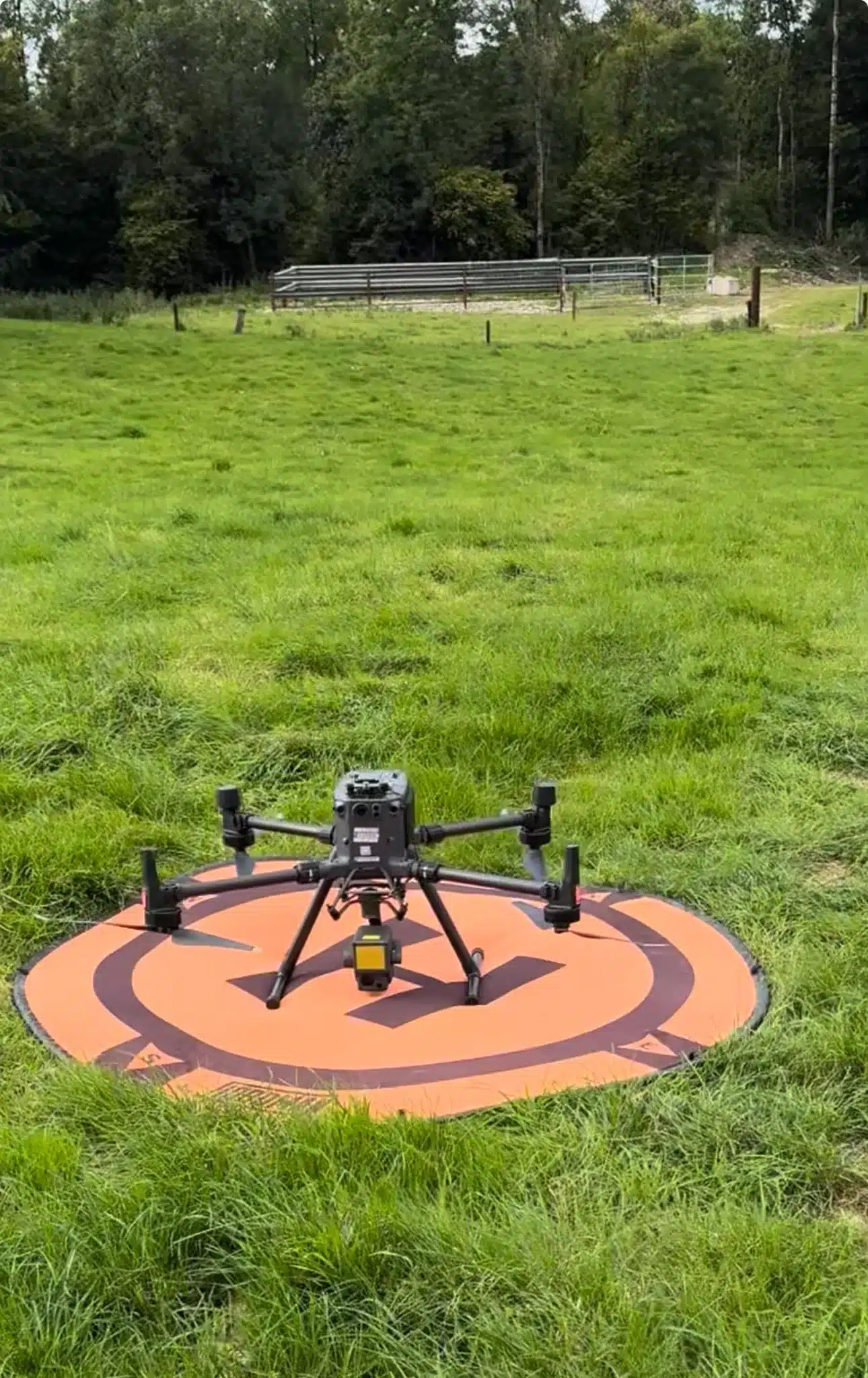
The basics
Photogrammetry
The drone takes hundreds or thousands of overlapping photos. Software finds matching features across multiple images and uses triangulation to work out the 3D position of every identifiable point. You end up with a dense, coloured point cloud and a photorealistic 3D model.
LiDAR
A laser scanner on the drone fires hundreds of thousands of pulses per second. Each pulse bounces off a surface and returns to the sensor, which calculates distance from the time-of-flight. Combined with the drone’s RTK/PPK position and IMU data, each return becomes a 3D point. LiDAR point clouds don’t have colour natively, but you can colourise them from camera imagery captured at the same time.
When photogrammetry is the better choice
- You need visual outputs: Orthomosaics, textured 3D models, and visual site records are native photogrammetry products. LiDAR can’t produce these without a separate camera.
- The site is open: On bare earth, hard surfaces, and construction sites, photogrammetry matches LiDAR accuracy at lower cost.
- Budget matters: Photogrammetric survey typically costs 30 to 50% less than LiDAR for the same area, because the equipment is cheaper.
- Colour and texture are important: For condition assessment, building inspection, and visual documentation, you need the photos.
For a typical topographical survey of a development site, road corridor, or construction project on open ground, photogrammetry gives most engineers everything they need.
When LiDAR is the clear winner
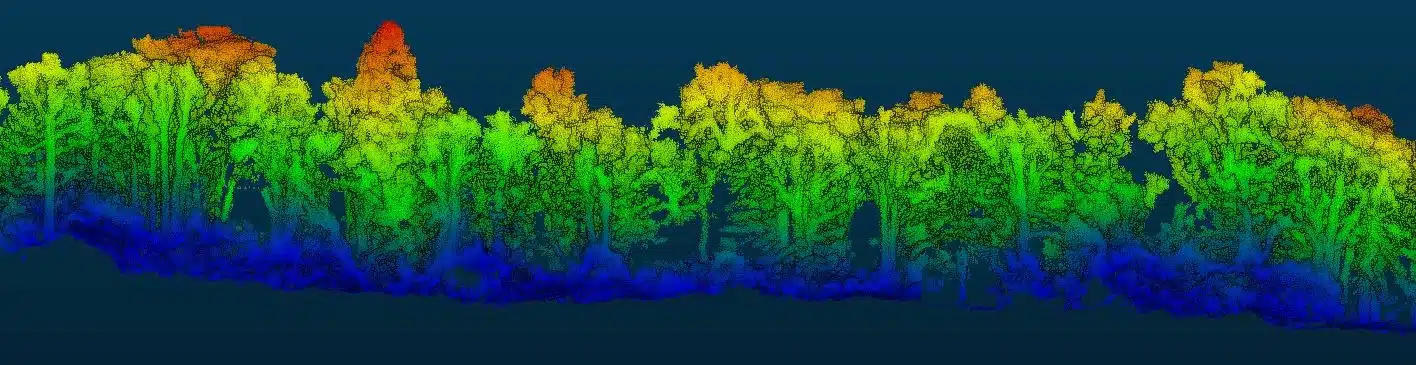
- There’s vegetation in the way: LiDAR pulses pass through gaps in tree canopy and undergrowth to hit the ground. Photogrammetry only sees the top of the vegetation. If you need a bare-earth DTM under trees, LiDAR is your only real option.
- The site is forested or overgrown: Forestry, overgrown brownfield sites, and archaeological sites under vegetation all need LiDAR.
- You need tighter vertical accuracy: LiDAR typically hits plus or minus 2 to 3 cm vertical on bare earth versus 3 to 5 cm for photogrammetry. For fine grading checks or structural deformation monitoring, that matters.
- Power lines and thin features: LiDAR picks up overhead power lines reliably. Photogrammetry struggles with thin linear features.
- Flood modelling: Hydraulic models need the ground surface, not the vegetation canopy. LiDAR is the standard data source for flood modelling in Ireland and the UK.
Accuracy side by side
| Parameter | Photogrammetry | LiDAR |
|---|---|---|
| Horizontal accuracy | plus or minus 2-3 cm RMSE | plus or minus 2-3 cm RMSE |
| Vertical accuracy (bare earth) | plus or minus 3-5 cm RMSE | plus or minus 2-3 cm RMSE |
| Vertical accuracy (vegetated) | Not reliable | plus or minus 3-5 cm RMSE |
| Point density | 100-500 pts/m2 | 50-300 pts/m2 |
| Vegetation penetration | None | Multiple returns per pulse |
More detail in our accuracy guide.
Using both together
For some projects, combining the two gives you the best of both worlds. We regularly fly LiDAR and camera payloads on the same mission to produce:
- LiDAR bare-earth DTM (for engineering design and flood modelling)
- Photogrammetric orthomosaic (for visual base mapping and planning drawings)
- Combined colourised point cloud (LiDAR geometry with photographic colour)
This combined approach works well on large renewable energy projects, construction sites with mixed terrain, and environmental assessments needing both topographic and visual data.
Rough cost comparison
- Photogrammetry: From around 500 to 800 euro for small sites, scaling with area
- LiDAR: Typically 40 to 60% more than photogrammetry for the same area
- Combined: About 20 to 30% on top of LiDAR alone
The gap narrows on larger sites where mobilisation cost (same either way) becomes a smaller share of the total.
Not sure which you need?
Send us your site details and deliverable requirements. We’ll recommend the most practical and cost-effective approach. See our LiDAR service or photogrammetric survey service for more.
Choosing between LiDAR and photogrammetry: a decision framework
In practice, the decision is rarely about which sensor is technically better – both are capable instruments in the right hands. It usually comes down to five questions that we ask at the start of every new engagement.
1. Is there vegetation obscuring the ground?
If any meaningful portion of the site is under tree canopy, dense hedgerow, scrub, bracken, or long grass, LiDAR wins immediately. Photogrammetry can only see what the camera sees, and what the camera sees is the top of the canopy, not the ground underneath. For a forested river corridor, a hedge-bounded agricultural field, or a brownfield site that has been left to regenerate for several years, LiDAR is the only sensor that will return a usable bare-earth DTM.
2. What vertical accuracy does the downstream design work require?
For general topographic mapping at ±3 to 5 cm, photogrammetry is usually sufficient and considerably cheaper. For drainage design, where inverts and gullies must tie into existing levels at ±1 to 2 cm, photogrammetry becomes marginal and we either add dense ground control or switch to LiDAR. For safety-critical infrastructure tying into Ordnance Datum Malin with national survey-grade accuracy, LiDAR with RTK-corrected flight lines is the safer choice.
3. What is the end deliverable?
Clients who want an orthomosaic, a 3D textured mesh, or marketing visualisations are served better by photogrammetry because it captures colour and texture. Clients who want a classified point cloud, a hydrologically enforced DTM, or a vegetation height model are served better by LiDAR. If the brief says “we need both,” we fly a combined mission and co-register the two datasets in post.
4. How much ground control can you allow?
Photogrammetry accuracy is highly sensitive to ground control distribution. On a 20-hectare site without RTK corrections, we typically need 12 to 20 well-distributed check points to achieve ±3 cm absolute accuracy. LiDAR, when flown from an RTK-PPK corrected airframe, can deliver the same absolute accuracy with only 3 or 4 check points, which matters enormously on sites where you cannot walk safely between points (live construction, waterways, steep terrain).
5. What is the budget?
Photogrammetry remains materially cheaper on a per-hectare basis because the hardware is cheaper, the processing is faster, and the data volumes are smaller. For most projects under 50 hectares where vegetation is not a blocker, photogrammetry is roughly 40 to 60 percent of the cost of LiDAR. On projects over 100 hectares with dense vegetation, the economics flip because LiDAR covers ground so much faster.
Ireland-specific considerations
Two characteristics of Irish sites affect this choice more than they would in continental Europe.
First, vegetation. Ireland’s climate produces dense, fast-growing hedgerows, rushy pasture, and gorse-covered upland that make bare-earth mapping by photogrammetry genuinely difficult outside the tightest winter windows. We find that even in February and March, Irish rushes and low gorse retain enough structure to bias photogrammetric DTMs by 10 to 20 cm in the worst cases. LiDAR looks through this almost completely.
Second, cloud cover. Photogrammetry depends on even natural lighting. Ireland’s famously variable sky – sun then shadow then sun again over the course of a single 20-minute flight – can introduce visible mosaicking seams in orthomosaics and subtle errors in the photogrammetric solution. LiDAR is indifferent to lighting and can be flown under heavier overcast, which often means we can get LiDAR data in a single day whereas a photogrammetry crew might wait two or three days for suitable light.
Frequently Asked Questions
Can you fly LiDAR and photogrammetry on the same flight?
Yes. Our DJI Matrice 300 RTK carries both a photogrammetry camera (typically the Zenmuse P1) and a LiDAR sensor (Zenmuse L2) on the same airframe, and we often fly both simultaneously. The resulting dataset gives you a classified point cloud from LiDAR plus a full-colour orthomosaic and textured mesh from photogrammetry, all referenced to the same ground control. For most mixed-use sites this is the best value option.
Is LiDAR always more accurate than photogrammetry?
Not in absolute terms. On a well-flown, well-controlled photogrammetry survey of an open, hard-surfaced site, we routinely achieve ±2 cm vertical. LiDAR on the same site is ±2 to 3 cm. The real LiDAR accuracy advantage shows up under vegetation, at steep slopes, and across sites with poor or sparse ground control.
Which sensor does a typical Irish planning application need?
For a planning topographic survey under the standard planning data formats, photogrammetry at ±3 cm is usually more than sufficient and is what we deliver by default. LiDAR becomes relevant for sites with significant vegetation, for sites adjoining protected woodland, or for large-scale infrastructure projects where the design accuracy demands it.
How do you decide for a client who isn’t sure?
We ask for a site boundary, a short description of the site, and a sentence about what the survey will be used for. From that we can usually recommend the right sensor in a five-minute conversation, and we never up-sell LiDAR when photogrammetry will do the job. If the site is borderline we offer a combined flight so the client has the best of both for modest extra cost.
Can your LiDAR data be imported directly into Civil 3D?
Yes. See our detailed guide on getting drone point cloud data into Civil 3D for the full workflow. Short answer: we deliver classified LAS or LAZ files in ITM (EPSG:2157) with ODM heights, which Civil 3D imports without any conversion steps.