Aerial forest surveys for timber volume estimation, canopy cover mapping, disease detection, and post-storm damage assessment. Covering commercial plantations, native woodlands, and riparian corridors across Ireland.
Survey pricing from €700 per day
Last updated: April 2026
Forestry survey outputs for coupe planning, stock assessment, grant applications, and infrastructure clearance verification.
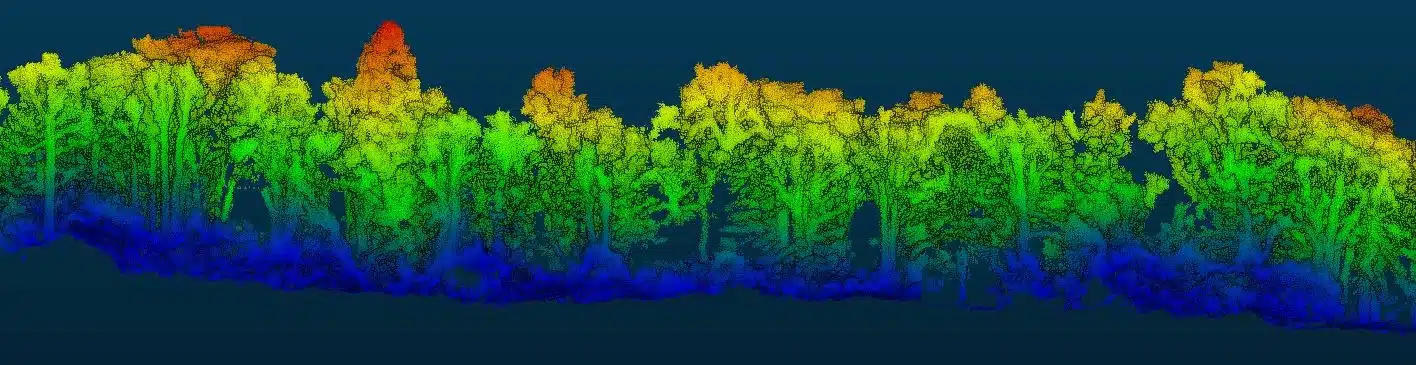
Classified LiDAR point cloud separating ground, low vegetation, and canopy returns. Enables under-canopy terrain modelling and canopy height model (CHM) generation.
Raster model showing tree height variations across the stand. Used for timber volume estimation, maturity assessment, and felling cycle planning.
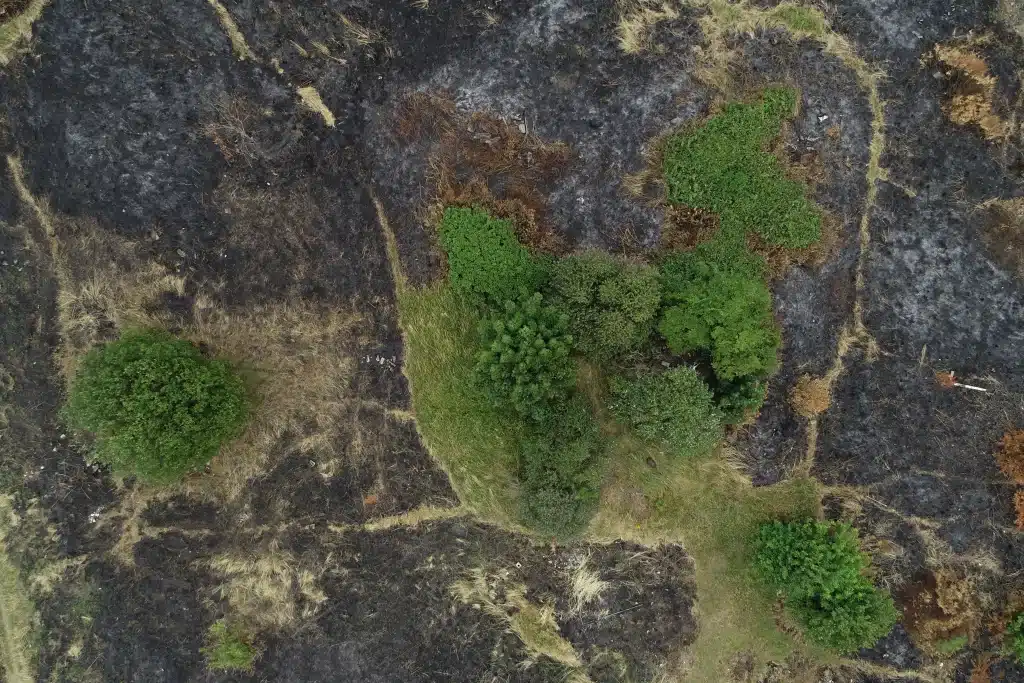
High-resolution georeferenced aerial map of the forest or plantation. Used for species classification, disease identification, and coupe boundary mapping.
Bare-earth digital terrain model derived from LiDAR ground returns. Supports road planning, drainage design, and ground condition assessment below canopy.
Post-windthrow assessment mapping blowdown areas, windsnap, and windthrow distribution. Used for salvage felling prioritisation and insurance claims.
Vegetation height measurement and clearance analysis along power lines, roads, and watercourses within or adjacent to forested areas.
We survey Sitka spruce plantations, broadleaf native woodlands, riparian corridors, and amenity forests. LiDAR penetrates the canopy to give you ground-level data that photography alone cannot capture.
Combining LiDAR and photogrammetry to deliver ground-truth forestry data that aerial photography alone cannot produce.
We review existing mapping, Coillte or Teagasc data, and site access arrangements before arrival. Flight corridors are planned to cover the full stand with appropriate LiDAR pulse density for canopy penetration. We check airspace constraints and notify relevant authorities as required under EASA Specific Category authorisation.
The DJI Zenmuse L2 LiDAR sensor is flown at low altitude to achieve the pulse density needed to penetrate closed canopy and return ground points. Multiple flight lines with cross-track overlap ensure consistent point cloud density across the full survey area, even in dense Sitka spruce or broadleaf canopy.
A separate photogrammetric pass captures high-resolution imagery for orthomosaic production, canopy colour interpretation, disease spotting, and wind damage mapping. This is delivered alongside the LiDAR data to give both structural and visual information from a single mobilisation.
LiDAR data is classified into ground, low vegetation, medium vegetation, and high vegetation returns. From this we derive the DTM, DSM, canopy height model, and any specialist layers requested. Outputs are delivered in LAS, LAZ, GeoTIFF, or DWG format within 48 hours, with a covering report documenting flight parameters and point cloud statistics.
LiDAR point clouds, classified vegetation returns, and aerial orthomosaics – all delivered in GIS-ready formats for your forestry team or consultant.
LiDAR-derived tree metrics, canopy models, and forestry data from Irish sites.


EASA-certified, comprehensively insured, and equipped with specialist LiDAR hardware for accurate forestry survey in challenging canopy conditions.
Everything you need to know about our drone forestry survey service.
Yes – high-pulse-density LiDAR can penetrate closed Sitka spruce canopy sufficiently to generate ground returns and a bare-earth DTM. The Zenmuse L2 system we use delivers up to 240,000 pulses per second. Ground return density varies with canopy density but is typically sufficient for terrain modelling and drainage analysis in commercial Irish plantations.
Yes. Georeferenced orthomosaics and canopy height models are accepted as supporting evidence for felling licence applications and afforestation schemes under DAFM requirements. We can tailor the deliverable format to your forestry consultant’s specifications.
We conduct a rapid post-storm aerial survey using high-resolution photogrammetry to map blowdown extent, windsnap locations, and damage severity across the stand. This produces a georeferenced damage map for salvage felling planning and insurance documentation within 48 hours of the survey.
For photogrammetric surveys we can cover 200–400 hectares per day depending on altitude and overlap requirements. For LiDAR surveys with high pulse density, typical coverage is 100–200 hectares per day. Large estates are surveyed over multiple days with consistent methodology throughout.
Yes – and this is very common for mixed landholdings in Ireland. A single mobilisation can cover both the forested and agricultural portions of an estate, delivering separate outputs for each area. See our agricultural survey page for more detail on what’s included for farm land.
EASA-certified pilots, canopy-penetrating LiDAR, and 2-day report delivery. Tell us your forest area and survey objectives and we’ll provide a fixed-price quote within 24 hours.
Tell us about your project and we’ll respond within 24 hours with a detailed quote.
Get a fixed-price quote within 24 hours. No obligation, no hidden costs.